Iolanthe – February 2012

7/10

By Gilbert and Sullivan

Directed by Peter Mulloy

Carla Rosa Company

Venue: Chichester Festival Theatre

Date: Monday 13th February 2012

This was definitely a game of two halves; the first half was a bit dull, and even a G&S fan like me was nodding off from time, while the second half opened well with the song from Private Willis and the contributions of the Earls of Mountararat and Tolloller, and it felt a lot livelier after that. I enjoyed the performance overall, though I found the Queen of the Fairies and the Lord Chamberlain were weaker than the rest of the cast; we couldn’t make out their lyrics so well, and they didn’t sustain the energy during their sections. The nightmare song isn’t my favourite patter song anyway, and this wasn’t the best version I’ve heard by a long way.

The set was fairly simple. Two flats of trees stood on either side of the stage to create the entrances, and a backdrop behind had an arch of flowers and greenery over a cobweb, through which the small orchestra could be seen. The costumes were again based on Victorian designs, so the fairies were pretty and the peers were in formal robes, as was the Lord Chancellor. The Queen of the Fairies had a black outfit with extra sleeves, as for a spider, Strephon was in a fairly bland shepherd’s outfit and Phyllis had a nice pink shepherdess dress.

That was the first half. For the second half the backdrop had changed to the Houses of Parliament, and a sentry box stood on the left hand side of the stage. The orchestra was still visible through the screen, but without the large hole they’d had in the first half, the conductor had a long journey to get to the front to take his bows at the end. The costumes were largely the same; the fairies wore sashes with ‘Strephon’ on them, while Strephon and Phyllis were much better dressed. Sergeant Willis was splendid, as usual, in an impressive Guards uniform – I fully understand his attraction for the Queen of the Fairies. Incidentally, she was dressed as Queen Victoria for this half; a nice touch.

Despite the weaker aspects of the production, it was well worth the visit for the second half alone, and it’s always good to see a company prepared to do a Savoy opera in the traditional manner.

© 2012 Sheila Evans at ilovetheatre.me

She Stoops To Conquer – February 2012

10/10

By Oliver Goldsmith

Directed by Jamie Lloyd

Venue: Olivier Theatre

Date: Wednesday 8th February 2012

This was a fabulous production which brought out all the humour in this classic comedy brilliantly. The cast did an excellent job, and the set and costumes set it all off perfectly.

The set first. Across the middle of the stage stretched a wall, suitable for the inside of an old manor house which looks like an inn. The fireplace in the centre was about twelve feet tall, and you could have roasted a couple of pigs in it no bother. The room had pictures on the wall, tables with fruit and drink, a sofa, an upholstered bench and a comfortable leather armchair. There was a large rug in the middle of the floor, another chair to the front and right, and a rustic chandelier hung from the non-existent ceiling. A door at either end of the wall allowed the characters on and off. Behind this wall we could see tree trunks but no greenery, and when we arrived there was plenty of birdsong to tell us we were in the country. At the start of each half we also heard some mooing and clucking, just to be sure we got the point.

For the scene in the inn, the revolve showed us the other side of the wall, which was a pretty basic country inn – wood panelling, window, couple of entrances – and there were tables and chairs for the customers. Strangely, there were also two tree trunks, one on either side of the stage, which appeared to be growing through the inn. Puzzling; I reckon it may be one of young Tony Lumpkin’s practical jokes.

The scene later in the garden was a lovely transformation. The revolve took the furniture to the back of the stage while the wall sank down to vanish completely. Assorted tree trunks were lowered into place, and with a squirt of mist and some atmospheric lighting we were in the perfect setting for either a dangerous isolated spot where robbers might pounce at any minute, or the (large) back garden of Mr Hardcastle’s residence.

The scene changes were covered by music from the cast, right from the start. They didn’t sing songs as such, just la-la-la and ba-ba-ba and suchlike, all very lively and enjoyable. I wasn’t sure about it at first, but when it came to the bigger scene changes, especially setting up the garden, I realised it was essential to do something to cover the hiatus. And if you’re going to do it then, you’d better get the audience used to it early on. So all in all I’m fine with that choice.

The costumes were splendid and totally in period from what I could tell – the National is usually reliable in these matters – and there were plenty of servants in this household, not to mention plenty of customers at the inn. The performances of the supporting actors were excellent with lots of good reactions helping the humour, especially in the scene where Mr Hardcastle tried to teach his servants how to behave in front of company. I loved the way they all tried not to laugh when one of them mentioned Mr Hardcastle’s funniest tale (old Grouse in the gun-room) but failed, and ended up roaring with laughter – his servants clearly loved his stories.

The plot has a lot of information to get across, and the clarity of the lines was tremendous. I know the story of old, but I found myself hearing more of the dialogue than before, and the way Sophie Thompson as Mrs Hardcastle emphasised the relevant bits for us was very helpful, and very funny. I suspect no one missed the crucial information that the manor house looked like an inn, wink, wink.

The play opened with singing from the servants, who appeared in a group at each doorway. Mr and Mrs Hardcastle came on for the first scene and got us off to a good start, with some funny descriptions of their neighbours as well as the info about the house (see above). When Tony Lumpkin came on, he was eating a chicken drumstick and used it to prepare himself for his night out, rubbing it on various intimate areas to transfer the scent. What put a lot of the audience off was that he then carried on eating it! His exit was very funny; Mrs Hardcastle was so desperate for him to stay with them that evening that she clung on to him and was dragged off stage, sliding across the floor behind him and out of the door which the servants helpfully held open.

Then we had a scene between Mr Hardcastle and his daughter, Kate, telling us about their arrangement whereby she’ll be wearing ordinary clothes instead of her finery later on that evening. I was struck by a stray thought at the start of this scene; when I heard Mr Hardcastle refer to his daughter as Kate, I immediately thought of The Taming of the Shrew. We’d seen the play recently at Stratford, and it occurred to me that this play was a kind of mirror image of that one. Instead of Kate being a shrew and Mr Marlowe a brawling sort of chap, this Kate is self-assured and very reasonable, while Marlowe is the strange character, bold with the lower class women he meets, but hardly able to say a word to ladies of his own class. The analogy took my fancy, and I found myself looking for further evidence during the performance; it didn’t spoil my enjoyment in any way, and although I have no knowledge of Oliver Goldsmith’s intentions in writing this piece, considering the similarities between the two plays has been an interesting process.

After Mr Hardcastle has told his daughter about the imminent arrival of Mr Marlowe, the son of his old friend, to be her suitor, and she and her step-mother’s niece, Miss Constance Neville, have informed us that Mr Marlowe is a close friend of Mr Hastings, Miss Neville’s intended, the scene changed to the inn, where Tony Lumpkin was enjoying himself with lots of beer. And then lots more beer. And then more beer. He sank a yard of the stuff and threw it up into a bucket. The company was lively, and then the two men we’d been hearing about, Mr Marlowe and Mr Hastings, arrived, looking for directions to Mr Hardcastle’s house. Their clothes and manners made them stand out immediately from the local rustics, and Mr Hardcastle’s comments about foppish London behaviour and excessive frippery were perfectly expressed by these two characters. Their costumes were splendid, and their discomfort at finding themselves amongst such rough company was very funny.

With Tony Lumpkin being unhappy about Mr Hardcastle’s attitude towards him, he decided to play a trick on these two. He told them they were too far out of their way to get Mr Hardcastle’s house that night, and then sent them off to the very place, telling them it was an inn they could stay at. He also provided them with a couple of mugs of ale, scooped from the bucket he’d just thrown up in.  They were given these mugs early on in the scene but didn’t drink any until the very end, when they took a swig each and paused before declaring the contents to be quite good. By that time the audience had got over its squeamishness, and had a good laugh at the well delayed joke.

The next scene was the very funny lesson Mr Hardcastle gave his servants, at the end of which he heard the coach arrive and went off to welcome his guests. Mr Hastings and Mr Marlowe entered, and in Mr Hardcastle’s absence we have plenty of time to learn about these two men. Mr Hastings was interested in seeing Miss Neville and running off with her if possible, while Mr Marlowe’s difficulties with the fair sex were expounded at length. When Mr Hardcastle returned, we started to reap the fruits of the earlier scene’s preparations, as Mr Hardcastle attempted to talk with his ‘guests’, while they talked to each other and ignored ‘the landlord’ as much as possible.

To show how relaxed the two men were at the ‘inn’, Hastings took some fruit from the bowl on the sideboard early on and threw the orange to Marlowe, keeping the apple for himself. Marlowe peeled this orange during their conversation, dropping the bits of peel on the floor, which certainly showed that he had no consideration for the place. Unfortunately, nothing more was done with this peel until the servants cleaned it up a couple of scenes later, so we had to put up with actors nearly treading on it and skirts sweeping bits of it around the stage with no pay off. It didn’t spoil my enjoyment, but it didn’t add anything either, and was a minor distraction.

Marlowe headed off to check his bedroom followed by Hardcastle, leaving Hastings alone on stage, but not for long. Miss Neville entered and Hastings was soon disabused of the notion that he was at an inn. When Marlowe returned, the couple arrange for him to meet Miss Hardcastle who at this point was still dressed as fine lady. Marlowe’s problems were not exaggerated; his difficulty in talking with Miss Hardcastle was extreme, and very funny for us. Hastings and Miss Neville stayed for a bit to egg him on, and then left Marlowe alone with Kate; Marlowe’s reaction to their leaving was another comic masterpiece.

The conversation between Marlowe and Kate was very good fun, with Marlowe never looking at her. She completed his sentences after a reasonable pause, and he left the room as soon as he decently could. Hastings and Miss Neville returned almost immediately, with Tony Lumpkin and Mrs Hardcastle. To keep her jewels in the family, Mrs Hardcastle has been working hard to get her son to marry Miss Neville, while she has been pretending to cooperate in order to get her hands on the jewels for herself. So in this scene, she cuddled up to a hostile Tony, while Hastings charmed Mrs Hardcastle. This was another example of Sophie Thompson’s excellent comedy performance. She managed to put on an almost unintelligible accent; we could tell she was trying to talk posh, and failing completely. Every so often she would lapse into her normal country accent, which was actually easier to follow, and Hastings complimented her on her taste and style as fulsomely as he could. When he was suggesting a new age which was the latest fashion in town, there was a lovely pause while he decided how far to go; his choice of “fifty” was very astute.

With Mrs Hardcastle and Constance out of the way, Hastings persuaded Tony Lumpkin to join in the elopement plan. I think the interval was taken after this scene, and then we restarted with another singing fest from the servants, which ended up with Mr Hardcastle standing in his own drawing room holding a pair of boots which Marlowe has given him to clean. When Kate arrived, now dressed much more simply, they discussed the man and have completely different points of view, naturally. Although they were both keen to reject him as a future husband for Kate, she was at least willing to give him another chance and her father agreed, while at the same time doubting that he’ll change his mind.

Tony had stolen Constance’s jewels from his mother, and gave them to Hastings. Unfortunately, unaware of this development, Constance was still trying to persuade her aunt to let her have the jewels, and when they come into the room, Tony suggested to his mother that she tell Constance the jewels have gone, been lost or whatever, to stop her asking for them. Mrs Hardcastle jumped at the chance to keep hold of the gems, and went along with this story. She did offer to let Constance have her garnets, though, which meant the theft of the other jewels was discovered earlier than anyone wanted. (Anyone that mattered, that is.) While Mrs Hardcastle wailed and shouted about the jewels actually being gone, Tony supported her in the ‘story’, winding her up even more.

As Kate prepared to meet Mr Marlowe on different terms, she had a short discussion with a couple of the servants (only one in the text). Kate was sure she could carry off the deception; the maids weren’t so convinced by her acting skills, but didn’t like to disagree and reassured her she’d be fine. Mind you, it took her some time to get Mr Marlowe to look at her at all. He was very preoccupied by his situation and determined to return to London the next day, and she was posing ever more provocatively to get him to notice her. Once he did, though, she had to move pretty fast to keep his hands off her, but didn’t quite manage it. Just as Marlowe was about to take advantage, Mr Hardcastle came into the room and was naturally astounded by what he saw. Marlowe fled immediately, and Kate had to haggle with her father to get another hour to prove that Mr Marlowe was not as he seemed.

With Marlowe’s father about to arrive any minute – Marlowe himself was still under the impression that he was at an inn – the jewels found their way back to Mrs Hardcastle as Hastings had left them with his friend for safekeeping, and he naturally thought to leave them with the’ landlady’ of the inn. Hardcastle took him to task for ordering his servants to drink as much as they could, and there was a lovely confrontation between them over this. Hardcastle ended up thrusting a lot of the furnishings into Marlowe’s arms, even breaking a painting over his head, and then stormed off in a temper. At long last Marlowe began to realise his mistake, and when he spoke to Kate next she confirmed the truth, that he was indeed in the house of his father’s friend. She didn’t tell him all, though; she stayed in the character of a poor relation of the family, and in short order got the declaration of love she was looking for.

On the jewels front, Tony had assured his mother it was simply a mistake of the servants, and he and Constance pretend to be fond of one another again to keep her happy. This time, they were almost at it on the bench in front of the fire when she came in, and when they broke off it was to act nice and play nasty. He twisted her hand, she slapped his cheek, that sort of thing. Unfortunately, a letter arrived for Tony from Hastings, but as Tony couldn’t read very well he asked his mother to read it out. Constance realised who it was from and took it herself, giving a false reading of the contents. But she made the mistake of inventing a plausible message that actually interested Tony, about fighting cocks and such. When she refused to read all the details, Mrs Hardcastle took on the job herself, and discovered the whole elopement plot. Her temper was very entertaining, especially when she made a very deep curtsey and needed help to get up – one of the funniest moments of the play.

Her decision to take Constance immediately to her aunt Pedigree allowed Tony to play another trick, and he lead the coach up, down and around until both ladies were completely shaken up, jarred to bits and lost. In the garden scene Tony told his mother, whose dress was now dirty from the horse pond, to hide if anyone came along. Mr Hardastle, taking a turn in his garden before bed, found Tony there, and because she was worried about his safety Mrs Hardcastle takes the brave step of coming out of hiding to tell the robbers to leave her son alone. Discovering his trick, she chased him into the house, followed by Hardcastle, and shortly afterwards Constance and Hastings. She was no longer prepared to elope that night, partly because of the journey she’d just had, but mainly because she’d realised that poverty wasn’t the greatest way to start a marriage and she wanted to ask Mr Hardcastle to take pity on them.

Meanwhile Marlowe’s father, Sir Charles Marlowe, had arrived, and yet again there were two competing opinions of young Marlowe’s behaviour, with Marlowe himself claiming he only met Kate once and hardly said anything to her, and Kate asserting that they had met several times, and that Mr Marlowe had, in fact, declared his love for her unequivocally. To find out the truth, Kate arranged for both fathers to overhear her final interview with Marlowe, in which she talked more like herself and he ended up kneeling as if to propose. At this point, Sir Charles leapt out of hiding (they hadn’t been quiet the rest of the time either) and all was revealed. With the remaining characters coming on stage as well, the final discovery regarding Tony Lumpkin solved all problems, and they finished with a rousing dance before taking their bows. Sophie Thompson did another deep curtsey and needed to be helped up – an enjoyable reprise.

Even with the scene changes the cast kept the energy up throughout the performance, and I would really like to see this one again.

© 2012 Sheila Evans at ilovetheatre.me

Our Country’s Good – February 2012

By Timberlake Wertenbaker

Directed by Alistair Whatley

Company: The Original Theatre Company

Venue: Rose Theatre, Kingston

Date: Thursday 2nd February 2012

We saw this play many years ago at the Royal Court (1988) where they played it paired with The Recruiting Officer, the play being rehearsed by the convicts. The casts were the same, so we had all the fun of seeing the actors rehearse as convicts and then play the same parts for real. As it happens, we’re going to see The Recruiting Officer in a few weeks, as Josie Rourke has chosen that play to start her Donmar reign; although the actors won’t be the same, it will be interesting to see the combination again.

The Recruiting Officer is a very funny play; Our Country’s Good makes full use of that comedy to lighten the darkness it’s exploring – our treatment of convicted criminals a couple of centuries ago, which just happens to be very similar to current events in many ways. Even if we hadn’t seen the play before, we had plenty of advance warning that it was a serious piece as we groped our way to our seats through thick fog. (Oh alright, it was only a light mist, but I have to keep my spirits up somehow.)

The set was evocative; there were two wooden frames which dominated the stage, and one of them had some pulley tackle attached which could have been on a ship or part of a construction site, both appropriate for the play. There were wooden boxes scattered around the place as well, and these performed a number of roles – mainly furniture, but they even stretched to a rowing boat at one point. A table was brought on from time to time as needed and there were blankets for the stage curtains; that was about it. The convicts were in tatty clothes of the period, while the officers wore splendid red coats and wigs. There was also a Reverend dressed in sombre black. As almost everyone doubled up at least once, the women all played officers as well – one played the parson – and they all did a very good job.

During rehearsal

Our Country’s Good

The opening scene is set on the ship taking the convicts out to Australia. As one chap was being flogged by a couple of the officers on the central frame, the other convicts huddled on the front of the stage, singing a song. The image of brutality was very clear. The next scene introduced us to the Captain and some of the officers. Their conversation covered the nature of the penal colony they were now running, their differing attitudes on punishment vs. rehabilitation, and the unusual flora and fauna to be found in this strange land. Despite professing some enlightened views about providing a civilising influence on the convicts, I noticed it was the Captain himself who was the first to shoot something.

We then met Second Lieutenant Ralph Clark, a young officer missing his wife back home terribly and keen to find some way of earning his superior’s approval and preferment. One of the men suggested to him that he stage a play using the convicts as his cast, and he decided to act on this. The rest of the play showed us the casting process, the convicts’ different attitudes and abilities, the response from the officers, especially those who objected to the play being put on, and the developing relationship between Ralph and Mary Brenham, his lead actress and one of the few convicts who could read. The final scene showed the start of their performance, with the stage audience on the other side of the curtains as we watched the back stage preparations. From the reactions we could hear, this was going to be a total success, and rightly so.

There was so much meat to this performance that it’s hard to know where to begin. The story was told very clearly, and at times it was difficult to watch. The abuse of these people, treating them as sub-human when they were mostly ill-educated and poor, was beyond moving. These were harsh times, and people were being transported for stealing a loaf of bread. The number of lashes needed to be effective was being discussed by the officers at one point, and two hundred seemed to be a reasonable amount to them – it’s clear they never expected to be on the receiving end. I soon found myself longing, as the prisoners did, for the relief of a rehearsal scene; even so, the author cleverly increased the tension by having the most unpleasant officers invade the final rehearsal we see and, overriding Ralph’s protests, abuse the convict actors horribly. It only stops because one of them, the most enthusiastic actor of the troupe, starts performing and the others join in, a brave choice in the circumstances but the only possible one if the play was to go on.

From time to time throughout the play, one of the natives came on stage and commented on what he saw. At first he thought these strange white people were part of a dream, but it didn’t take him long to realise they’re no dream; nightmare more like. Just before the final scene, as they were setting up the stage, the native appeared again but this time he was covered in sores from the diseases the white folk have brought with them. This oblique referencing of the natives’ experience was very powerful, as it emphasised both the impact which the new arrivals had and their disinterest in the native population – two hours of soapboxing wouldn’t have been so effective.

I want to remember so much about this play that I know I won’t be able to get it all down in time. There were so many layers that I’m still discovering things as I write. The discussion among the officers showed us their brutality, and with the doubling, it emphasised for me that the officers and men were just as brutal and uncivilised as the prisoners, but with the power they had they could express it more easily. There were educated prisoners as well such as Mary and John Wisehammer, who was also interested in Mary but had to watch as she and Ralph gradually became an item.

Our Country’s Good

Harry Brewer represented the guilty conscience, as his obsession with the ghost of a man he’d hanged on ship eventually drove him to madness and death. His relationship with Duckling Smith, in which he wanted some kindness and she withheld it until it was too late, showed the difficulty for women in those conditions. They were expected to provide ‘comfort’ for the men, but how could they then have any affection or tenderness in a relationship?

Ralph’s gradual change from dedicated husband to Mary’s lover was nicely done, and there were many lovely moments in the performance. I did find it hard to hear the lines occasionally – Liz Morden’s story was particularly quiet – but it didn’t stop me understanding what was going on. The music was good – we like traditional folk songs – and the cast did a fantastic job. It’s still early in the tour, so it may even improve, though we were very happy with our experience.

It’s a dark piece covering a difficult subject, and it’s a shame there weren’t more people in the audience to appreciate this excellent production. I can understand the difficulty, but this is definitely a modern classic – should be done in schools if it isn’t already – and I wish them every success with the tour.

The Original Theatre Company website – www.originaltheatre.com

© 2012 Sheila Evans at ilovetheatre.me

Noises Off – February 2012

10/10

By Michael Frayn

Directed by Lindsay Posner

Venue: Old Vic Theatre

Date: Wednesday 1st February 2012

I’m having a bit of difficulty rating this performance. We saw the first production of this play back in 1982 at the Savoy theatre, and it was the funniest thing I’ve ever seen on stage. I was laughing all the way home and into next week – I hurt from laughing. It would be unfair to expect this production to reach those heights especially as it didn’t have the advantage of surprise, but if I give it 9/10 it would be unfair. So I guess I’ll just have to rate the first production as 11/10, and leave it at that.

This cast were just wonderful in recreating these roles, and the script was just as funny as before. I particularly liked Robert Glenister as the director, Lloyd Dallas, who gets some of the funniest lines, but everyone was very good and there were no weak links. The set has to be the same, of course, this being farce. There’s no point going into the details of the story; I will just mention that reading the play text added to my enjoyment, as there are some very funny descriptions of the characters.

© 2012 Sheila Evans at ilovetheatre.me

Yes, Prime Minister – January 2012

7/10

By Antony Jay and Jonathan Lynn

Directed by Jonathan Lynn and Tim Hoare

Venue: Chichester Festival Theatre

Date: Tuesday 31st January 2012

Nice to see this one again. Although it’s a touring production they’re getting a couple of weeks in Chichester, where the play premiered last year, before heading off round the country. We saw it twice last year, and really enjoyed it – how would this version fare?

The set was almost identical to last year’s; the only change I noticed was the removal of the trailing greenery around the edge of the stage – a practical necessity for a touring production. The post-show chat confirmed that the script had been revised, and it certainly seemed tighter than last year although I couldn’t name any specific changes. It did seem to flow better, though whether that was the changes or our familiarity I can’t say.

The performances were very good for so early in the run. Graham Seed was wonderfully scatty as the Prime Minister, and although he seemed to stumble over his lines occasionally, he could get away with it given this characterisation. Michael Simkins, whom we remember fondly from A Small Family Business many years ago at the National, was very good as Sir Humphrey, and both of his set speeches were warmly applauded. His gravitas combined with his comic timing were a perfect foil for the PM.

Clive Woodward gave us another good performance as Bernard Woolley, and was suitably naïve as well as erudite; Sir Humphrey has a lot of exposition in the early stages, and Bernard is his excuse for all of that. Polly Maberly was good as the SPAD, Claire, and Sam Dastor reprised his role as the Kumranistan ambassador very entertainingly. Tim Wallers, the ersatz Paxman, was strongly reminiscent of the man himself, and Tony Boncza was fine as the Director General of the BBC (but was this part trimmed since last year?).

The post-show was unusually low-key tonight and we had to be quick as the stage crew needed to strike the set for a concert tomorrow. The three leads and Tim Hoare, the associate director, came and chatted with us for a while. They felt the history of the TV version was largely irrelevant as they had to find their own ways to play the parts, but the TV characters hovered in the background providing some guidelines; as Michael Simkins put it, he wouldn’t get away with playing Sir Humphrey as Arthur Mullard. They found the Chichester stage demanding, as usual, and not entirely suited to farce, although you do get a good connection with the audience compared to a pros arch. The problems with hearing the dialogue were mentioned, and the actors agreed this was an issue in this sort of space; even though Chichester uses a subtle form of sound enhancement, it’s hard to get a balance that will work for everyone.

They were asked if it was distracting having a sign language interpreter working beside them for the signed performances. Not after the first minute or so, they said, although there was the danger of becoming too interested in what was being signed and forgetting what you were meant to do. They start blocking for the pros arch stages tomorrow, and from the sound of it they’re all looking forward to the tour. Despite our small numbers, we were very appreciative, and went away happy with our evening. This is an enjoyable revival, and I hope they have a great time on tour.

© 2012 Sheila Evans at ilovetheatre.me

Measure For Measure – January 2012

9/10

By William Shakespeare

Directed by Roxana Silbert

Venue: Swan Theatre

Date: Friday 27th January 2012

Second time around, and we were seeing this performance from a completely different angle. This allowed us to catch up on some of the reactions we hadn’t seen before, but of course we still only getting a proportion of the performance. Even so, we could see areas which had come on for the practice, and the central characters and their relationships were still very clear.

The changes which I noticed: Pompey went into a lot more detail about the inhabitants of the prison, picking on lots of folk in the audience and involving all of us at the end, which was very funny. He made some comments about “it’s in the folio”, and “I can only work with what you give me”, lots of stuff like that. The Duke’s human lampshades were more demure on their second appearance when Angelo was there, folding their arms over their chests, and he snapped his fingers to get them off stage in a hurry when Isabella approached, obviously embarrassed. The third time around, they held their hands in a prayer posture in response to Angelo’s reference to praying, and they left of their own accord when Isabella was announced.

I found the arguments between Isabella and Angelo even clearer than last time, especially when he was trying to get her to understand his ‘proposition’; Isabella seemed less intense, but just as passionate. It was much clearer this time that the Provost knew what was going on once he’d read the Duke’s letter off stage. He was clearly in cahoots with the Duke during the final scene, beckoning Elbow over to his corner of the stage to stop him dragging the Duke/friar off to prison.

Things I forgot to mention before or which weren’t clear: in the early scene at the monastery, the Duke handed his hat, scarf and coat to the friar as if he were one of the Duke’s servants; the friar looked a bit bewildered, but still took them. Lucio was indeed at the brothel first time round. The interval came after the Duke’s second encounter with Lucio at the jail, after Pompey had been arrested and Lucio refused to bail him.

And of course the performance had moved on from the last time we saw it. I was aware this time how Escalus’s common sense judgement of Pompey, Froth and Elbow was being contrasted with Angelo’s absolute approach. In the final scene, Isabella was quite stunned to discover who the Duke was and took a while to adjust, although she was still taking in the other events that were going on and still chose very quickly to support Mariana’s plea for mercy. She took longer to accept the Duke’s offer of marriage at the end tonight, I thought, and she didn’t look as happy when she turned round at the end, before they started the dance, so she’s presumably doing this differently to when we saw it earlier. Otherwise, the performance was just as brilliant as before, and despite complaints from some that the darker aspects weren’t explored enough, I felt this was a very satisfying exploration of the play.

© 2012 Sheila Evans at ilovetheatre.me

The Taming Of The Shrew – January 2012

7/10

By William Shakespeare

Directed by Lucy Bailey

Venue: RST

Date: Thursday 26th January 2012

For an early performance, this wasn’t bad. We were right round the side in Row D, so although we inevitably missed some things, we did get a reasonable idea of the whole production, and as we’re seeing it again soon we can hopefully catch up on what we missed. And given that it’s early in the run and they’ve had to adjust to an accident which has meant recasting one of the actresses, they may well come on quite a bit for an extra couple of weeks.

We went to the director’s talk on Tuesday, so we were aware that the overall production concept was the marital bed. From a talk earlier today by Michael Dobson and Nicola Watson we learned that a previous experience of watching Henry V had been incorporated into this production by means of a brown cloth area. So it was that we were confronted by a massive hump of mattress and brown cover, raising the level of the RST stage enough so that we couldn’t see the faces of the people across from us. What this was like for the people in Row A I’ve no idea; I do know that one woman asked to move further back because she couldn’t see, and she had started in row B! (They found her another seat, bless ‘em.)

The back of the stage was covered by a curtain in some nondescript brownish colour. From this, a lumpy ramp (pillows) led down to the stage floor. The cast had some difficulty travelling down this ramp at times; although it wasn’t nearly as steep as the Heart of Robin Hood ramp, it was still difficult enough to suggest why a broken ankle had happened so early in the run. When the curtains were drawn back, we could see wooden panels behind them, which turned out to be multi-faceted doors – they could open wide top to bottom or smaller panels within them could be opened as needed. There was also a space behind these in which several of the cast waited to appear for various scenes. I noticed the servant types early on, but I’ve no idea if we could see them because of our acute angle or if they were visible from the front. Time will tell.

The time period for this production was post WWII in Italy, a setting which allowed for the sort of attitudes towards women which would fit with the play, and yet be contemporary enough for an audience to relate to. We had also learned from the director’s talk that the induction would feature prominently in this production, and it did. There was music and a rumpus behind the curtain, and then Christopher Sly was thrown out of the pub, rolling down the slope to land on the stage. I didn’t follow much of the dialogue for this bit, and I was a bit worried that I might not hear enough of the lines to enjoy myself, but it turned out to be only a short spell at the start, thank goodness. Sly ended up near the front of the stage, asleep or comatose, and then the bar staff and customers turned into dogs and started having a go at Sly’s body. Fortunately the huntsmen turned up in time and called them off, and the Lord also arrived, fresh from some hunting. I recall some discussion of the relative merits of a couple of hounds, and then the Lord spotted the sleeping Sly. As he came up with his plan to give Sly a fantasy makeover, I found myself thinking that this play has a strong theme of people learning their place, both in terms of gender and class. I also reckoned that Will might have been saying to those that would listen that the only things differentiating a lord from the common people were his clothes and the way people treated him.

There were plenty of servants in this production, but even so they could hardly move Sly, who was stoutly built. They did manage to get his outer clothes off, and despite his existing smell, and the additional burden of a loud fart, they had him snug in bed in no time in a corner of the stage. We had a few laughs during this part, especially when one servant waved his smoking censer in the vicinity of the bed after the fart.

The plans for the masquerade were pretty long-winded, but we got the gist. Bartholomew, the servant who was to play Sly’s ‘Lady’ had been sent off with the players, and was back again sorting out the curtains when he was taken away to become a woman. Meantime everyone else was fawning over Sly, and doing their best to convince him he was indeed a lord. When he asked if he had ever spoken in the fifteen years he had been out of his wits, only one man answered, and everyone looked at him; he was really on the spot. He got out of it well, though, and after this Sly seemed to be convinced that they were telling the truth. Then his ‘Lady’ arrived, and she looked very fetching indeed. She wasn’t too happy when the rest left him alone with Sly on his command, and despite several attempts to get out of the room, she eventually had to reason her way out of it.

There was plenty of crudity in this production, and here it took the form of Sly masturbating when he found he couldn’t have sex with his ‘wife’; I don’t mind it as such, but I’m not sure if it’s necessary to make the point. Anyway, Sly and his wife settled down in one of the front corners to watch the players, pulling the bedspread over them. I did wonder how good the view would be for anyone over that way; it might be us next time.

With the play proper starting, the doors at the back opened up and for the first time we saw sunshine. Lucentio was a bookish sort, definitely wet behind the ears, while Tranio was OK but not as well defined as some I’ve seen. When they stood to one side it was because of the music; a brass band heralded the arrival of Baptista Minola and his daughters, while I had already noticed Gremio lurking around the doors at the back.

The music and procession went on for some time, and when we finally saw Kate I realised that she had been taken round the streets in a scold’s fiddle – a fiddle-shaped form of the stocks which went round a person’s neck and held the wrists in two other holes to one side; a nasty implement for publicly humiliating someone who didn’t conform to society’s norms. This was quite a shocking image to deal with early on, and I felt the comic tone of the rest of the scene jarred slightly with this entrance. Once out of the ‘fiddle’ though, Kate soon took her revenge, and there were few characters left on stage who didn’t feel the force of her anger. The reason for the ‘fiddle’ was also evident; one poor chap had been walking behind her with his face bandaged up, clearly one of her previous victims. And also a current one, as she got in a good swipe at him again.

Bianca was slightly taller than Kate, and looked all demure and innocent, but we women know how these things work and Kate’s comment about sticking a finger in your eye was clearly based on knowledge – Bianca milked the sympathy vote for all it could give. I don’t know if they dropped Lucentio and Tranio’s asides, or if I just didn’t hear them as they were on the other side of a very busy stage. We did get to hear their lines after everyone else had left, and Lucentio was wonderfully silly, skipping around like a new-born lamb with delight at the thought of his love. Tranio was more practical, as ever, and fortunately they were a similar size, so swapping clothes wasn’t a problem. Sadly, they left it at the jackets and hats tonight – no trousers were removed.

After a comment or two from Sly the play continued with Petruchio’s arrival. At the talk this morning, Michael Dobson had passed on a comment from one of his daughters that if David Caves took his shirt off, he’d do fine as Petruchio. He did take his shirt off later as it happened, but I think it only fair to point out that even before that action sealed his performance, he was already doing pretty well fully dressed. The doors at the back had been closed, and during the fight with Grumio, Petruchio battered at it with Grumio’s head (Simon Gregor used his forearm to thump the door – one of the advantages of the side view). The Ulster accents of both men worked very well; they not only indicated they were relative outsiders to this community, but a sense of wildness and unpredictability came with it which suited the characters down to the ground. Petruchio certainly seemed wild, and definitely only interested in money at this stage, but would that change?

A nice touch with Hortensio was to have him a bit phobic about bodily fluids. When Petruchio spat on his hand before they shook on their deal, Hortensio took it willingly enough but wiped his hand immediately afterwards, and also put his handkerchief on the ground before he sat beside Petruchio on the ramp. He also put in a lovely pause after “Her only fault” when describing Kate; we filled in the gap and obligingly laughed. The gathering of the suitors was good fun too, and soon they were off a-wooing.

For the next scene, Kate came through the doors first, smoking. No sign of Bianca. She did turn up, though, bound hand and foot, and with something in her mouth. She had to hop through the door, and roll down the ramp before spitting out the gag and getting into the fight with her sister. They went at it pretty hard, and Baptista had to break things up before Kate smothered Bianca with a pillow. Of course Bianca did her victim number again – bitch – but she showed her true nature with lots of rude gestures at Kate behind their father’s back.

With the girls off stage the suitors turned up, and this was another entertaining run through the various characters, many of whom were in disguise. I always love the way Baptista responds to Petruchio’s first question – “Pray, have you not a daughter call’d Katherina, fair and virtuous?” with “I have a daughter, sir, call’d Katherina”. This was as good as usual, and as Steve pointed out, it’s just the sort of thing comedy writers are doing nowadays.

The tutors were presented, and Baptista gave the books to the musician and the lyre to the academic. They exchanged the gifts when they left the stage to go to Baptista’s daughters, and soon we heard the sound of a lute, played not very well, coming from behind the doors. We also heard the sound of the lute being broken over Hortensio’s head, and he re-emerged shortly afterwards to show us the damage. This whetted Petruchio’s appetite, and he was really keen to meet this woman who might actually be worth his while. I wasn’t sure about Baptista’s reactions to some of this part as he had his back to us for most of it, so I’m hoping to get a better view of that next time.

Kate came through the doors and kept herself aloof beside them, smoking again and with a hip flask. I got the impression that Petruchio was taken with her on first sight, whether by her looks or her attitude I couldn’t tell. They were soon sparring verbally, although Kate took a long pause before one of her early responses, and there were plenty of sexual references in the physical actions accompanying their joust. Petruchio mirrored Kate’s actions whenever she threw a tantrum, like banging on the doors, and this made her stop what she was doing; it was clearly the first time she’d met someone who wasn’t frightened or put off by her behaviour. Although he threatened to hit her if she struck him again, he didn’t beat her up, just had a fun time wrestling with her. She seemed to realise pretty quickly that she couldn’t get the better of him physically – he was a good deal taller than her – so she stuck to words, and even there he kept going past her ability to respond. She did seem to find his body attractive as well, so I was aware that they were potentially well matched, which made the dialogue easier to accept.

There was another unpleasant moment during this confrontation, when Kate, on the left walkway, lifted up her skirt and apparently peed on the floor. Of course it was faked, and there was a bit of a delay as the contraption didn’t work at first; it’s another thing I don’t mind but which didn’t actually help the production. Those nearby who were splashed weren’t so happy, though.

The financial fisticuffs between Gremio and Tranio-as-Lucentio was amusing, though I found myself remembering the wonderful Generation Game conveyor belt scene from our first Taming many years ago. (Just taken a quick break to review the cast at http://calm.shakespeare.org.uk/dserve/dserve.exe?dsqIni=Dserve.ini&dsqApp=Archive&dsqDb=Performance&dsqSearch=PerfCode==’TAM198304’&dsqCmd=Show.tcl – great fun!) The competition between the tutors was also entertaining, and although she wasn’t entirely convinced, Bianca was clearly favouring Cambio over Licio. There were two chairs on stage at this point, and each tutor kept pulling one of them away so the other chap fell down, which was more amusing than it sounds. Cambio in particular got himself into all sorts of contorted positions while he was ‘construing’ with Bianca, while Licio sang each line of his ‘gamut’ after Bianca read it out – very funny.

The wedding itself was pretty lively. We were given the full text, as far as I could tell, so Biondello had his chance to romp through the almost unintelligible speech about Petruchio and his nag – he did this very well, using postures to illustrate the descriptions. Petruchio and Grumio looked like they’d come straight from a particularly bawdy stag do – Petruchio had ‘Petruchio and Kate’ written on his chest in big black letters, while Grumio had ‘Grumio’ on his. They were scantily clad in what might loosely be called trousers, with greenery attached at strategic points and a large salami down Grumio’s trousers; this became his ‘weapon’ later. Kate was wearing a simple white tailored dress, while Bianca was in a pink ensemble. It took some effort for Kate to actually utter the word ’entreat’, but she managed it, and still she ended up being wrapped in Petruchio’s coat (or cloak) and carried off. There was a good laugh when she said ‘Father, be quiet’, given that he was behind her at that point.

They took the interval here, which meant that Sly had to get off stage as well. They’d kept him on throughout this first half, and between the early scenes they’d done a bit of under the covers rummaging. At first it was Bartholomew escaping his lord’s clutches, then Marion Hackett appeared for some unknown reason and stole Sly’s underpants. By the time of the interval, he was the only one of the induction scene characters left, and when he realised everyone else had left the stage, he held his vest over his willy and eventually made his way off. I found this stuff mildly amusing, but as they didn’t do much with it in the second half it was rather wasted for me, especially as it disrupted the rhythm of the play. They moved the bedspread around so much during those bits that some cast or crew had to come on and straighten everything out again before the action could continue.

Sly also came on at the start of the second half, on his own, holding a small saucepan over his nether regions. He went off stage at the back beside the pillows, as I recall, but he was hanging around during the next scene for a while, watching the action among the players. There was hardly any Curtis at all with this production – lost in rehearsal, poor chap – and they prepared for the scene by having lots of actors come on and pose themselves on the stage, asleep. The chairs which had been left there were put on their sides with somebody draped over the one nearest us. There were actors lying on the pillows, on the stage and hanging out of the back area, all fast asleep. Grumio woke them up and Petruchio came in soon after, with Kate crawling in after him. Her dress was a bit mucky, and I think she was shoeless, but otherwise she seemed fine. They skipped through this scene pretty quickly and after a short report from Curtis about the non-event in the bedchamber, Petruchio returned to give us a situation report. He waited quite a long time to see if anyone in the audience could suggest another way to achieve the desired result – no response.

The next scene is where Tranio craftily gets Hortensio to swear off Bianca, and although I couldn’t see all the action behind the doors, I got a clear idea of what was going on. Basically, Lucentio and Bianca were pre-empting the marriage vows and going at it, hammer and tongs. They started by kissing, but were soon into rampant sexual intercourse in all sorts of positions, culminating in pleasurable exhaustion when they finally joined Tranio. The activity was revealed by opening various panels in the doors, showing different parts of the lovers as they got it on. Early on, both Tranio and Hortensio were right by the doors, but fortunately the lovers were oblivious; later on it was just Tranio winding Hortensio up by opening yet another panel.

At the end of this scene, Tranio persuaded the travelling pedant to pose as his father, and then we were back in Petruchio’s house, with Kate trying to get hold of some food from Grumio. When Petruchio and Hortensio came on with the dish of meat, Hortensio ended up straddling Kate, who was face down on the stage, and as there was too much to eat he stuffed some items in his pockets to clear the plate.

The argument over the dress was good fun. The dress and hat themselves were very attractive, and the dressmaker arrived with a live model to show off his work. She was rather upset at having her sleeve ripped off, and Kate took the sleeve back off Petruchio and put it back on the model, only for it to be ripped off again, along with the other one and the cape. I think this was the scene where Kate paused the argument, got one of the chairs, put it in front of Petruchio, and stood on it so she could argue with him face to face – excellent fun.

The scene where Baptista met the fake Vincentio and then Biondello explained to Lucentio the basics of elopement, was pretty standard and then we saw Petruchio, Kate and Grumio returning to Padua for a family reunion. Kate finally decided to stop arguing, couldn’t tell why, and then the real Vincentio turned up. Dressed in a very natty suit, and wearing sunglasses, he was also accompanied by a bodyguard who wasn’t keen on letting these strangers anywhere near his boss, especially when they talked so weirdly. Vincentio wasn’t bothered though, and waved him away. After Kate and Petruchio had their fun, and Petruchio spoke to the new arrival to find out who he was, Vincentio joined in the game by addressing Kate as ‘Fair sir’ and Petruchio with ‘and you my merry mistress’. So at least he has a sense of humour; he’ll need it later after Tranio abuses him.

The party was going full swing when they arrived at Padua, and the melee in front of the house was mildly entertaining. Petruchio and Kate stood over at the far side of the stage, so I couldn’t see what they were up to, but I got the impression that they were chatting to each other instead of watching the action.

For the final scene, the rest of the cast entered through the doors, and Kate and Petruchio were a bit behind them. Kate was clearly embarrassed that they were still wearing their soiled clothes, and the other two wives were clearly sneering at her. She went back to the doors and stood along from Petruchio there, having nicked his hat and put it on her head. There was dancing, and Bianca was enjoying herself with Gremio as they did the tango.

The bickering was entertaining enough, with Kate really having a go at the widow over her ‘mean’ comment. Bianca was very lively, and then the women left the stage. The men were more laddish once they’d gone, and the money for the bet was soon on the floor in the middle of the stage. A chair was placed beside the money, and each husband waited on it, expectantly. Biondello gave the bad news to two of them, then Grumio went off for the final message, with Petruchio hoping for a good result. Even he was surprised by Kate’s arrival, and I always reckon this is where he goes a bit over the top because he’s worried she’s no longer got any spirit to her.

When he challenged her to tell the other two wives about their duty, she had to think about it for a while, and everyone else assumed she wasn’t going to do it. She sat on one of the chairs and lit up a cigarette, but just as the rest had given up on her, she started on the speech. I couldn’t decide on her motivation; it wasn’t clear to me why she’d decided to speak up, although the lines themselves were very clear. Her final offer to put her hand beneath Petruchio’s foot was OK, and he seemed to have realised that she was still the Kate he fell in love with. He took her in his arms, and then they were kissing, and rushing to the back of the stage to get their kit off and snuggle under the bedclothes.

The rest of the play was a bit of a blur. I don’t remember how the rest of the cast left the stage, but soon it was bare and in relative darkness. Sly staggered back on and collapsed on the far side of the stage, and from the noise behind the doors he was outside the inn we’d started from. Two characters came on and went over to him; Steve reckoned they were the Lord and Bartholomew, while I wasn’t sure it was the Lord himself. Either way, he left some money on Sly’s chest, while Bartholomew ran back to leave his scarf with Sly. The performance ended with Marion Hackett standing on top of the ramp and looking at Sly, while he held up some of the money and then collapsed back again on the stage.

I wasn’t taken with this ending; it wasn’t clear to me what was going on, and I only realised it was money on Sly’s chest when he held some of it up at the end. Since Lucy Bailey had described the play as the journey to get the two leads into bed, why carry on after that’s been done? And with the Sly subplot petering out during the second half, why go back to it? Maybe we’ll understand it better next time we see it as our angle will be better, although the way this bed set blocks the view, I’m not so sure.

This was a lively retelling of the story with lots of physical humour, some of which worked for me, some of which didn’t. The relationship between Kate and Petruchio was believable, and the rest of the performance was at least watchable with some nice touches. Steve wondered if Kate was actually challenging Petruchio at the end by offering her hand, testing him to see how he would take it. That’s possible, and we’ll both be watching closely next time to see if it becomes clearer.

© 2012 Sheila Evans at ilovetheatre.me
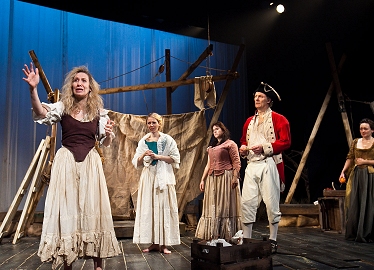
Written On The Heart – January 2012 (2)

9/10

By David Edgar

Directed by Greg Doran

Venue: Swan Theatre

Date: Wednesday 25th January 2012

This was a definite improvement on my experience of 20 days ago; not quite enough to warrant a 10/10 rating, but oh so close. There were three factors involved in this change: the first and most influential was our prior knowledge of the play, which meant we could follow the arguments better and appreciate the political exchanges as well as the personal stories. As we suspected, this play does benefit from some advance knowledge of the people and the situation. The second factor was the talk we’d had at the Winter School this afternoon, not only us but the entire group, of course. As a result we were a more responsive audience than before, and that naturally enhanced the experience for us. And finally there were almost certainly some improvements in the performance, but as we were in different seats, and given the effect of the other two factors, I have absolutely no idea what they were.

I did notice some things that I either missed last time around or got wrong. The Yorkshire rant about the constant changes to religious practices was done by the church warden, not the Lady of the manor. Before we visited Tyndale’s cell, there was a short scene at the back showing the priest being blessed by, I assume, the Pope; there was lots of singing and fancy dress. The second half started with the candles on the triangular chandeliers being lit by the choir, who then stood and sang for a bit before the play continued: again, the singing was a bit too dissonant for my taste, but I may have been warming to it. In the Yorkshire scene, I forgot to mention last time that the church warden came back into the church while the clerk and the chaplain were having their discussion, and lurked behind the screens to overhear them. We suspected later on that he may have been the one who betrayed the clerk to the authorities in revenge for his treatment of the windows, amongst other things.

I found the story much more moving this time, with plenty of sniffling opportunities along the way. I understood better the Bishop of Ely’s guilt at having been so harsh to the prisoners he visited, as represented by the Puritan clerk. That scene, of the prison visit, was played out in front of the Bishop, and I got the impression that Tyndale knew about it and forgave the man. The parallel with Tyndale’s own experience has only just become apparent to me; I claim the mercy of the court on account of my increasing years. Or senility. Or both.

The massive amount of exposition didn’t seem so clunky this time around, which helped, and the humour worked just as well if not better. I liked the way they went through some of the Biblical words and expressions that we use today, often disparaging them; ‘beautiful’ and ‘allegory’ are the only two I can remember off hand. It was not only amusing, but also a good way to link the story to the present. The maid’s rant at the end had less of an impact on me this time – may have been the angle we were seeing it from – and I could see in the Bishop of Ely’s discussion with her that he may well have been thinking of the Civil War to come, although I also take it as a reference to all future religious disputes based on rigidity and intolerance.

From today’s talk, I gathered that there were in fact only 47 translators involved in the work; I’m not sure where the 54 mentioned in the play came from, although Steve reckons that was the number they started with, but six years of translation took its toll. Very like.

© 2012 Sheila Evans at ilovetheatre.me
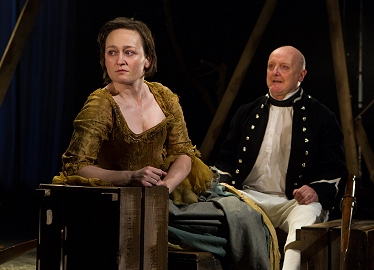
Neighbourhood Watch – January 2012

7/10

Written and directed by Alan Ayckbourn

Stephen Joseph Theatre Company

Venue: Yvonne Arnaud Theatre

Date: Monday 23rd January 2012

This was an enjoyable evening which ended rather unfortunately. A memorial statue which was meant to be revealed at the end refused to drop into place – looked like it was hanging the wrong way up – and so the cast had to take their bows without the punch line having been delivered, a real shame for them after their hard work. And it was hard work with this audience; we both felt, despite it being one of Ayckbourn’s darker offerings, that there was more humour in this play than the audience response indicated. It may be that the subject matter was a bit too close to home for comfort; we noticed that several jokes about Daily Mail readers received a lukewarm chuckle, but a similar disparaging remark about Guardian readers a few lines later got a huge laugh.

The play covered current concerns about security, and the trend towards high-security compounds for the ‘posh’ folk to protect them from the ‘yobs’ from the sink estates. We followed the experiences of a brother and sister, newly arrived at the Bluebell Hill development, from their housewarming party to the memorial service for the brother, Martin, after his sad demise while fighting to protect the standard of life for the local residents. The opening scene, and what would have been the last had it worked, were set at the memorial service; the rest of the scenes were in chronological order.

The set was straightforward. There were black walls at the back with gaps right and left, and two curved sofas on either side covered in a plain fabric with large flower outlines and with three matching cushions on each. In the centre was a fake circular fireplace with a flicker effect which they turned on whenever there were guests, and a large rim which doubled as a table. There were also two side tables on the audience side of the sofas. An extra chair was brought on for some of the meetings, and there was carpet on the floor up to the patio door on the right, where a section of the stage had been tiled to show the outside area. They acted the patio door, thank goodness.

The characters were a lovely mixed bunch. Martin and Hilda, brother and sister, were very prim and proper, with a strong moral and religious streak. Actually she was much more rigid than he was, and during the course of the play he even developed a relationship with another woman and planned to leave his sister. His death shortly afterwards meant she could ignore this inconvenient fact in her eulogy, while freeing her up to develop her own unconventional relationship.

Rod was one of their neighbours who was retired from some kind of security job, and was positively rabid about the threats they faced from the scum who lived in the estate nearby, across a field. He had even forced his way into someone’s house to retrieve a hedge trimmer which he knew this man had stolen, searching the place while the man was there. He eventually found his hedge trimmer and walked off with it, only to find himself in trouble with the police! His hedge trimmer was now in custody as it was evidence, and he was livid about the whole incident. He certainly showed us the potential for violence and law-breaking from the self-righteous, aggrieved middle classes, who feel everyone else is out to get them.

Dorothy was another retired neighbour who used to work on the local paper. We were led to believe she was a reporter, so there was a good laugh when she finally admitted that she worked on small ads. She was a good source for the local gossip which allowed us to find out a lot about the situation and the people, and she took on the media work for their neighbourhood watch scheme when it attracted lots of media attention.

Luther and Magda were the next door neighbours. He was a bully and a wife beater, she was a woman who had been abused from an early age and who ended up staying with Martin and Hilda for protection. Luther was the one person who spoke up against the rather extreme measures taken by the neighbourhood watch committee, and he was also the Guardian reader, but he seemed a bit underwritten compared to the others. Magda was a musician who also gave lessons, and her description of her early experiences was quite hard to listen to. Her final choices indicated that she’d found another strong character to take charge of her life.

Gareth and Amy were the final two characters. He was an older man who liked tinkering in his shed, but his main motivation for supporting the neighbourhood watch was that his wife, Amy, was a total slut, sleeping around with every man on the development regardless of their marital status. She’d married Gareth on the rebound, and he’d been regretting it ever since. It did give him an interest in various forms of public punishment, including the stocks, the pillory, scold’s bridle, etc., and the committee made good use of his woodworking talents and this interest. Amy wore very fitting dresses with very high hems with red hair and lots of makeup. She was very interested to find that Martin and Hilda were siblings rather than married, and we weren’t surprised to find Martin’s attitudes changing a bit over the course of the play.

The housewarming scene led to the inaugural meeting to set up the neighbourhood watch scheme. When the police were unable to attend to give advice, and someone threw Martin’s garden gnome through the window, destroying it completely, Martin decided they should go it alone and include some people who weren’t keen to be involved if the police were part of it. These turned out to be the local crime boss and his two thuggish sons; patrols were very effective and crime was slashed, but their methods were rather drastic, and when a house on the estate was burned down when they went to ‘have a word’ with its occupant, the police turned up at the Bluebell Hill security gatehouse demanding to get in to arrest the two sons.

After making sure that the stocks weren’t visible, Martin authorised the security chief (Rod) to radio the gatehouse to let them in. Unfortunately, they only caught one of the sons, which meant that an angry armed sociopath was hiding within the security fence, waiting to get his revenge for being shopped to the police. Fortunately he was too stupid to count properly, so it was the house next door to Martin and Hilda’s that went up in flames, and it was when the fire service and police were trying to deal with that problem that Martin, armed only with a statue of Jesus, went out into his garden and met his fate.

The final scene showed us the aftermath through the preparations for the memorial service, and then a curtain came down to shield the fireplace from our view while they lowered the statue chosen to commemorate Martin’s life. Being so close, we could see a bit of it, and at first it looked like a giant dildo which made us laugh to ourselves. But then we realised it was the hat of a large garden gnome, about three feet high I would guess, and gold coloured, which had slipped onto its side and just wouldn’t come down onto the fireplace. A stage hand came on at the back and realised he couldn’t do anything, so they just had to leave things there and take their bows. We felt for them; it was clearly meant to be a funny punchline as Hilda’s opening speech had claimed this was not only a fitting memorial, but also a symbol of much greater and higher things. A garden gnome would have been very funny, but alas not tonight.

The performances were all fine, and there was plenty to enjoy, but the audience, like the gnome, weren’t as cooperative as we would have liked.

© 2012 Sheila Evans at ilovetheatre.me

Swallows And Amazons – January 2012

7/10

By Helen Edmundson and Neil Hannon, based on the book by Arthur Ransome

Directed by Tom Morris

Company: Children’s Touring Partnership/Bristol Old Vic

Venue: Chichester Festival Theatre

Date: Friday 20th January 2012

I think I would have been better off not to have re-read the book shortly before going to see this wonderful adaptation. It took me a fair while to adjust my ideas, much as I loved some of the staging choices, and I would have probably found it an 8/10 experience if I’d warmed up sooner. As it is, I was thoroughly hooked by the end, joining in the shouts of ‘plank’ with enthusiasm. The cast all did a great job, and I hope they have a great time on tour.

The stage was littered with all sorts of objects before the start, some of which didn’t become clear until they were used. There were four tall irregular-shaped pillars along the back of the set, which each had a large band of white on them – I noticed during the interval that these were painted, and looked like brick. There was a picture frame hanging centre stage, and some musical instruments over in the far right corner, including a piano. I don’t remember anything else specifically, and they brought so much other stuff on during the play that I’d be misleading myself to attempt any more detail.

The play began with an old lady walking on to the stage, and sitting on a chair in the middle. She’d been carrying a pair of secateurs and a feather duster with bright red, green and yellow sections, and put them down to one side of the chair. As she looked through an old album of photographs, the characters of the Walker family started appearing on stage, with Mother and Father posing together in the central picture frame, Mother holding Fat Vicky, and other picture frames being held up for the rest of the family to pose behind. The old lady herself turned into Titty, and the feather duster and secateurs became the parrot. So now we had the four children, the baby and their parents. Father sailed away, and the action began with Roger arriving, breathless, with the telegram which would give them Father’s answer – to sail or not to sail.

Before I go any further, I must point out that the casting was weird and wonderful. Roger, the youngest child, nearly eight, was played by the tallest actor, and there aren’t many eight-year-olds with a beard! This worked really well, and gave us some humour from the start. The other ‘children’ were mostly to scale, although Susan was a bit on the small side. I always find the telegram a bit sniffly – “Better drowned than duffers. If not duffers won’t drown” – so this got me going early on, and then they were soon through the planning stage and off to the island. This was a musical, and the songs were pretty good, although I couldn’t always make out the words. The packing phase was done to music, and Swallow herself was a prow, a couple of wheeled dollies, a mast with a sail, some ropes and some ribbons – blue ribbons which other members of the cast held out and moved around to represent the water.

The story was told briskly, and while some bits were dropped – going to the farm to get the milk, for example – we didn’t miss much, and it made for a good piece of theatre. Other characters came on as needed, and there was plenty of music all the way through – this is a really talented bunch. Titty’s experience near Cormorant Island was staged as a dream sequence, with lots of pirate types carrying lots of boxes and singing a song, while the two ship’s companies and Captain Flint found the box the first time they searched the island. For the attack on Captain Flint’s ship, they passed out sponges to the audience, and we were told to throw them on the command ‘attack!’ which we did, and a fine old mess it made of the auditorium – great fun. When Captain Flint begged for mercy we were merciless, calling for the plank as loudly as we could (told you I was well into it by then). He dropped down through a trapdoor for this bit, and when he came back up and all was forgiven, they were about to head off for a feast on shore when he decided to give Titty a present for finding his book. The parrot was duly handed over, and with a final rousing song we were done.

The Amazons were also very good; two women with war paint and feathered headdresses. Peggy in particular had a great voice, and Nancy was all scowls, even when you’d expect her to be happy! Titty’s spell alone on the island came across better than the book for me – the way she read out her log entries was very funny. When anyone used the telescope, a round frame was held up and showed what they were seeing, whether it was Captain Flint sitting at his desk writing or Mother on her way to the island. Captain Flint’s ship was represented by a massive prow at the back of the stage, and it had a large mast too which may have been lowered down – I lost track a bit during the busy times. The reed beds were very well done, with the spare cast members holding long sticks and moving around the Swallow to show the way the reeds separated and came together again. The charcoal burners were included, but only to give the message about Captain Flint’s ship needing a lock – we didn’t get to see the snake – and this also allowed us to see John’s embarrassment at being called a liar when he tried to deliver the message to the Captain. It was good to see the way these children learned from their experiences, and from each other’s way of handling things. I also liked the way they meshed their fantasy versions of the lake and its islands, with Nancy recognising that Rio was a good name for the town and the Walkers accepting the Blackett’s name for the island.

Susan was much more priggish than I remember from the book, but it worked well enough for me, and the storm came early in this version, during the night raid on the Amazon’s boat shed. The sailing terminology was used sparingly – terms like ‘leading lights’ were demonstrated down at the harbour – so although it didn’t feel quite as inspiring in terms of the sailing, it still had that sense of adventure and freedom to use one’s imagination which is so strong in the book. The cormorants were quite scary. They were made out of bin bags and garden shears, and flew around in an intimidating manner.

Quite a few of us older children stayed behind for the post-show, and there was much praise from all sections for their performance. There were many stories of children young and old being introduced to the books and loving them; one chap has only got one more book before his wife divorces him, apparently – I hope for his sake that she’s a slow reader. It all went quite well until one man asked a rather hostile sounding question about what they were doing to take this sort of show to disadvantaged kids who might never see a play or read many books. The cast handled it very well, explaining the purpose of the Children’s Touring Partnership, and we finished on a lighter note, thankfully.

© 2012 Sheila Evans at ilovetheatre.me