King John – May 2012

5/10

By William Shakespeare

Directed by Maria Aberg

Venue: Swan Theatre, Stratford

Date: Thursday 17th May 2012

Controversial! This re-interpretation of one of Shakespeare’s least-loved plays had some interesting ideas and stagings, but ultimately proved to be a triumph of style over substance. The stage was covered in a chain-link carpet in drab brown, with steps at the back and various rectangular blocks around the place for tables, seats, etc. there were potted plants, an art deco sunburst chandelier, and a netted swathe of large balloons above the steps, completely blocking out a neon ‘for God and England’ which appeared once the balloons were released at the start of the second half. This was a sleazy, corrupt, eighties-style country, with everyone out for financial gain and not much else, and lots of strong women pushing the men around. An interesting starting point, but would it bring out aspects of the play we hadn’t experienced before?

Before the play proper, Pippa Nixon, in multi-coloured tights and a short black dress, warmed us up with a shaky rendering of ‘Land of Hope and Glory’ on her ukulele. We joined in as best we could, at her insistence, then they started their version of the play itself with the entrance of the king and his court. This opening section was good fun, with Alex Waldmann’s King John a stronger presence than I’ve seen before. With the whole court assembled, he stood on the steps and toyed with them by starting to put the coronet on his own head, then stopping, then actually going through with it. The court was caught mid-bow or courtesy, but then there were cheers and applause. When a man in a pastel pink suit arrived, he was told to wait, and was kept waiting for some time until the king deigned to speak with him. This turned out to be Chatillon – the king read out his name tag in slow syllables before letting it ping back – and the bickering between France and John over the true king of England had begun.

After Chatillon’s departure, while John was giving orders for the church establishments to pay for the expected war, the dispute between two of Robert Falconbridge’s ‘sons’ came before John, only this time the elder ‘son’ was actually a daughter, played by Pippa Nixon. Both Queen Elinor and John registered their recognition of the Bastard’s similarity to Richard Lionheart, although we had nothing to go on, of course. The forthright battling spirit of the Bastard matched well with Elinor’s attitude and added to the play’s emphasis on strong women, but I was concerned at the Bastard’s lack of physical prowess – would she really be able to cut her way through a mass of soldiers? – and the added element of sexual attraction between her and John didn’t help the play at all as far as I was concerned. It might have worked better for me if they’d simply had Pippa playing the Bastard as a man, but perhaps not. Either way, they feminised the language, and although this interpretation conflicts with historical reality, not to mention the text, at least Pippa had one of the clearer deliveries of the evening and her high energy levels helped to keep me awake for most of the performance.

Lady Falconbridge, the Bastard’s mother, arrived by motorbike; for a brief moment I thought it might actually be coming onto the stage, it was so close, but in the end it was just the lady herself in her leathers, and good fun it was too. Then the action moved to the French court, where we met Austria, Arthur and Constance, as well as the French king and the Dauphin. This was where the dialogue started to lose clarity, and although I got the gist I was beginning to miss more than I heard. Added to this problem was the dreadful blocking. From the post-show we learned that the director didn’t bother blocking the scenes. From experience I can safely say that if they don’t block, they will block, and badly too. The effect of this was to cut our view and muffle the sound so that we might as well have been in another theatre for all that we could tell of the performance at times. Not the RSC’s finest hour, and something that could and should be addressed.

I was aware that Constance advised the French king to wait for the ambassador to return before attacking the English-held city in front of them, just in case, only for the ambassador to turn up a few moments later to warn of the impending arrival of the English army. And indeed they did turn up almost immediately, and settled down to a long war of words. At one point, King John made as if to put the coronet on Arthur’s head, but again snatched it away at the last moment and placed it back on his own. Constance, played by Susie Trayling, was another strong performance and also very clear, and I enjoyed the bickering between her and Elinor very much. Elinor produced a will which Constance grabbed, tore and scrunched up before throwing the bits away – I only mention this because there was a lot of that in this production, paper being ripped and/or scrunched up and tossed to one side, leading to an accumulation of debris.

The citizens of Angiers (for so it was, according to the text) appeared around the stage on the first balcony level while John and Phillip made their speeches asking for their support. Two microphones on stands were brought forward, and John did his speech first, followed by Phillip. It was a bit like a reality kingship game show, with the final choice going to the public vote, but there was a twist in this case. Not happy with the citizens’ indecision, and prompted by the Bastard’s fighting talk, Phillip and John agreed to join forces temporarily to destroy Angiers and carry on their own battle afterwards. Only the quick wits of the Angiers delegation prevented this, with their suggestion that Louis the Dauphin should marry Blanche, John’s niece.

The deliberations following this suggestion were nicely done, as far as I could see. Elinor was happy that the union would strengthen John’s claim to the throne, and encouraged him by a look to add Anjou to Blanche’s dowry. She wasn’t so happy about the thirty thousand marks John threw in as well, though. The actual contributions by Louis and Blanche themselves were largely hidden from my view and I couldn’t tell from the delivery what was going on, but it certainly seemed to be the clumsiest wooing ever by a long way. Since Constance wasn’t around to shove her oar in, and only the Bastard was unhappy that the fighting was over before it had begun, they went straight into the wedding ceremony.

Blanche put on her fancy togs at the top of the stairs – 50s pink skirt, socks, high heels – but I couldn’t see what Louis was doing. The microphones were cleared away, and the party began. With the two courts posed together on the steps, the Bastard took a photo, and then the courts froze while the Bastard talked us through the commodity speech – a long time for some of the cast to hold their poses.

After the speech, the action started up again with music and dancing, including a karaoke number from John. He brought a microphone back on and used that – cries of ‘speech’ from the others – but instead he went into an old number, I forget which, and with the rest of the cast joining in it all became a bit rowdy. John even took the microphone off the stand and was holding it out for the audience to sing along. Blanche took the microphone herself and had a go, and then the bride and groom said their vows followed by another slow dance between them which turned into a Dirty Dancing number. With much hilarity, the couple left the stage followed by the rest of the partygoers, leaving an empty stage for Constance to have a rant on. Arthur and Salisbury were there too, of course, but it’s Constance’s big number, and she did it very well. The contrast with the upbeat, high energy party scene was very effective, even more so when the revellers came back on, still in party mode but with extra hats, tinsel and the like. They stopped when they saw Constance, and it was an awkward moment.

The bickering continued, especially between Constance and the king of France, and only stopped when the Pope’s legate, Pandulph, arrived on the upper balcony. Another female version, this Pandulph was played by Paola Dionisotti in a white shirt and smart black trouser suit (well, she is Italian). John’s defiance of the Pope’s instructions (to release the Pope’s chosen Archbishop of Canterbury) led to Pandulph excommunicating him, and the pressure was on Phillip once again to go to war with England. Despite a crafty attempt to manoeuvre the legate into providing a third option, Phillip was faced with the stark choice of being excommunicated himself or fighting John. I’m not sure if the contrasting arguments of Constance and Blanche were cut; if not, they didn’t make much of an impact on me, though I was vaguely aware that Blanche had a difficult choice to make. I assume she went with Louis; again, it wasn’t clear to me.

The next scene had the Bastard coming on stage with a big bag from which she took the head of Austria. She placed the head near the front of the stage, and then the king turned up with young Arthur. Normally Hubert pops up as well at this point, but to save confusing the audience (the other choices were straightforward, were they?) the Bastard took on this role as well. (We women are just so good at multi-tasking.) King John asked the Bastard to take care of Arthur, and a short while later he made it clear exactly what ‘take care of’ meant. Like Richard III, he wants the only other contender for the throne removed before there’s any more trouble. The Bastard was very willing, and agreed immediately out of loyalty to the king rather than any great desire to kill children.

It was during the next scene, which according to my text has a debate among Phillip, Louis, Constance and Pandulph, that I started to lose consciousness. Despite Constance having anger in her grief, she does go on a bit and the later reaches of this scene, after Constance had left, are mostly blank. Apparently Pandulph worked on Louis to make him desire the English throne for himself, through his marriage to Blanche, and we would see the consequences of that later on. For now, it was peaceful slumber, and although I was aware of the change of scene to the Bastard (as Hubert) and Arthur, I have no clear recollection of that either. The fast pace of the start had given way to a gentle lull, and either I was more tired than I realised (possible) or the performance hadn’t engaged me as much as I would wish (also possible). Either way, I soon had a chance to stand up, move around and wake myself up for the second half, as the Bastard’s inability to kill the little boy was followed by the interval.

The second half opened with another song from the Bastard – don’t know this one either – and then the balloons were freed and the paper confetti released to smother the stage in a wild celebratory gesture. Only there was just John and two lords on the stage, and the whole effect was of a damp squib. The balloons went everywhere, and had to be kicked out of the way from time to time, but for once I didn’t mind – the effect was worth it.

The political bickering continued, then the Bastard reported that Arthur was dead. This news was not well received by the lords, and John became very unhappy with the Bastard for following his orders. I didn’t get all of this bit, and the next scene was no better. Arthur was on the ramparts of the castle, edging steadily along a dangerous wall on top of the steps. As he jumped off the stairs, falling behind them, a dummy was dropped in front of the steps to represent the dead body. This was what the lords found, and the Bastard, having told the king that Arthur was still alive, had to contend with the awkward reality of the boy’s body. This section also wasn’t fully clear to me, and the text is no help either, as Hubert and the Bastard are both present in this scene and have a long dialogue together. I assume this was truncated to a soliloquy, but don’t quote me.

With the French already on English soil, John had to swallow his pride and bow to Rome’s authority. For his third coronation, John was practically naked, and prostrated himself before Pandulph, who then gave him his crown again, just as the English lords were about to join with the Dauphin and support his challenge for the kingship. Pandulph then arrived to send Louis packing, but found it harder than expected to control the Dauphin’s actions. The King was taken ill, and the English lords, warned of the Dauphin’s intended treachery towards them, changed allegiance again. Too late; John died, his son became king, end of play.

There were some good performances in amongst all this, but with the unclear dialogue and resulting loss of the storyline, I couldn’t really get into this version of the play. We’re seeing it again later in the run; perhaps we’ll enjoy it more, perhaps not.

© 2012 Sheila Evans at ilovetheatre.me
Anne Boleyn – April 2012

7/10

By Howard Brenton

Directed by Rachel Tackley

Company: English Touring Theatre (based on the Shakespeare’s Globe production directed by John Dove)

Venue: Theatre Royal, Brighton

Date: Thursday 5th April 2012

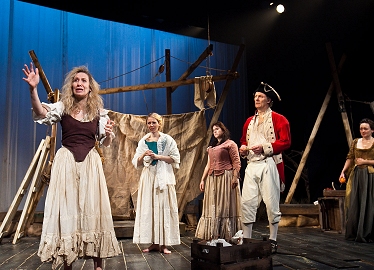
There was a lot of overlap between this play and Written On The Heart, which we saw this winter in Stratford. Both concerned the writing of the King James Version of the Bible, but came at it from different angles. Written On The Heart looked in some detail at the wider historical context of the changes in religion at that time, plus the theological and political wrangling that went on, while Anne Boleyn focused on the lady herself, and the way in which her likely Protestantism and possible involvement with William Tyndale may have contributed to Henry’s change of heart and the secession from Rome.  This was blended with a framing context of James’s succession to the English throne, and his use of the KJV as a way of bringing together the warring factions within the new Christianity. All of this with a lot of humour, plenty of lively action and tremendous performances.

The play started with some of the cast coming out and chatting with the audience, a much harder thing to do in a proscenium arch setting. In fact the whole performance suffered from being taken out of the Globe and thrust into a non-thrust environment. Apart from the stuffiness of the atmosphere in the Theatre Royal, the energy levels just weren’t up to the liveliness of the Globe, as far as the audience were concerned that is. The actors gave us plenty of oomph, and I suspect a 3D acting space would have made the performance even more enjoyable. Still, I’m glad they’re touring some of their work, as I think it deserves a wider audience.

Anne’s ghost then chatted to us for a bit, and her direct gaze and frank speech made her an attractive heroine for a modern audience. She introduced us to James, Sixth and First, before she left, and immediately we learned of his obsession with Elizabeth’s frocks. James Garnon played him as a very naughty schoolboy who just happens to be king, although his upbringing had made him shrewd as well as rude. He also had a stammer and a tendency to fart, and all in all it was an excellent performance.

The play then alternated between Anne’s story and James’s, with the bulk of the story being about Anne. We saw the beginning of King Henry’s seduction of Anne (or was it the other way round?), through the political attempts to have Henry’s marriage to Katherine annulled, to the final plot against Anne by Cromwell which led to her trial and execution. She also met William Tyndale a couple of times along the way, a speculative insertion by the author but not without foundation. James’s story started with his arrival in London, and combined his sexual romps with George Villiers with his determination to get agreement between the warring religious factions in England – the recently established Church of England, the puritans and the Catholics. Not an easy feat, given the intense hostility that existed between the groups, and so the idea of a new translation of the bible came along, a way of bringing the divided flock together. The play ended with a very drunk James seeing Anne’s ghost; he passed out from the drink leaving her to say her final lines to us, the demons of the future. It was a surprisingly upbeat ending to a very interesting and entertaining play.

All the performances were excellent; I’ve already mentioned James Garnon, and I will also mention Jo Herbert, who played Anne, and gave her all the liveliness, intelligence and passion the part required. But the ensemble worked brilliantly together, and only the deadening effect of the proscenium arch held my enjoyment back to the 7/10 level. I’d certainly see this again, especially if performed in a more suitable space.

© 2012 Sheila Evans at ilovetheatre.me
Richard III – March 2012

6/10

By William Shakespeare

Directed by Roxana Silbert

Venue: Swan Theatre

Date: Friday 23rd March 2012

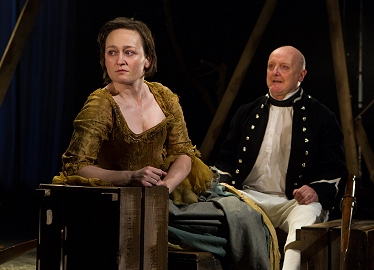
This was only the second preview performance (press night 17th April), and although it was a little patchy there were signs of great potential for the future. It was also lovely to see a production that’s not distorted by some heavy concept which the director has imposed on it; this was a relatively straightforward telling of the story with some nice touches in the staging and some lovely comic performances.

The set first. At the back of the thrust there was a silvery grey panelled wall which could provide doors, windows, etc. as needed, as well as opening wide to reveal the space behind all the way to the bricks at the back. Above the stage hung a selection from the RSC’s vast store of light bulbs (Midsummer Night’s Dream) – good to see them recycling so effectively. They brightened, they dimmed, and for each execution one or two bulbs descended lower to represent the lives snuffed out. During the dream sequence, the bulbs came down again as each ghost had its say in Richard’s nightmare, and they stayed lowered during the rest of the play; only one or two had to be raised a bit again to avoid the flashing swords. That was it, although chairs, tables, thrones and the rest were brought on as needed. The costumes were a mixture; mainly modern, they were combined with armour and swords, and it worked for us.

The opening was done by having the king (Edward, that is) proceed onto the stage with his queen through the partially opened doors at the back. He was accompanied by his children, his brothers and his in-laws, and they were clearly celebrating the final victory of the Yorkist line. Even Richard looked happy. When the others left, he stayed behind to inform us of the situation – everything’s going well, but he’s not happy about it so he’s going to take the crown. Jonjo O’Neill wouldn’t have sprung to my mind as likely casting for this part, and from these opening speeches I would say he has some way to go to cover the full range this part demands. He’s more at home with the comedy, and once we were past the early scenes he managed that aspect very well, but these opportunities to show us the inner workings of his villainous mind were lacking in depth and clarity, which he’ll hopefully develop with more experience of the role. He’s also better looking than I would expect for a Richard, which threw me a little bit. Not that the other actors have been totally repulsive physically, but they have usually manifested a greater degree of deformity of body, mind or both. We’ll have to see how it goes.

Clarence and Hastings were soon dealt with, and for once I was aware that Mistress Shore had been involved with Edward and was now ‘attached’ to Hastings. After Richard left, Anne arrived with the corpse of her dead husband, Henry VI, carried on a bier and covered with an ornate red cloth. Pippa Dixon was a very good Anne, and played her part strongly. Richard’s wooing of her could do with being a bit crisper, but that will come in time. Her arguments against Richard were strong, and for once I wasn’t clear about her conversion; that may also have been my angle, which was blocked a lot tonight; don’t ask me about King Edward’s performance – he might as well have been a potato for all I could see of him! Anne did at least leave with some tartness in her final line, and then Richard halted the bearers to speak his first question – “Was ever woman in this humour woo’d?” – to them.

The queen entered for the next scene looking worried, and Rivers and Grey’s attempts to comfort her were in vain. I thought at first that Siobhan Redmond was using her own Scottish accent for this part, but later I realised she was using a posh English accent instead. However, it didn’t come easily from the sound of it, and I could still hear the Scottish intonation at times, and even a few vowel sounds when her character was letting rip. Not a problem, but again that will probably improve in time. By contrast, Stanley was played with as thick an accent as you could wish for, and later on I found his dialogue completely unintelligible because of it. I don’t mind accents as such, but when they get in the way of hearing the lines I reckon they need to cut back on them for clarity’s sake.

This is the scene where the brawling court unites against the previous queen, Margaret. She appeared in a tall window at the back, invisible to the court at first and also to me, sadly, as Paola Dionisotti gave one of the strongest performances of the entire play. She was still lively, not burdened with age but brisk and light on her feet. She was angry and bitter and wanted revenge, but her mind was sharp and she delivered her lines so beautifully that their meaning became crystal clear. Once she inserted herself into the scene properly, she walked around, unfazed by the scorn coming her way from the newly allied court, and dishing out plenty of her own in return. She was momentarily taken aback by Richard ending her curse early, but she soon recovered. When she was warning Buckingham about Richard, she stood next to him in the centre of the stage and spoke quietly. Richard was at the back of the stage, and when he asked Buckingham what Margaret had said, she was already on her way to the exit when Buckingham gave his reply.

After the brawling court had left the stage, Richard had a bit of a chat with us and then his two murderers turned up. This was where the humour really got going, as these two lads were very funny. Richard handed over the warrant which Catesby had only just handed to him before leaving the stage with the rest of the court. That done, we moved to the Tower, where Clarence told Brakenbury his dream. He sat on his bed – Brakenbury stood all the while – and although it’s not my favourite sequence I found this enjoyable enough. The whole scene lifted with the arrival of the murderers, though. Their discussion was brisk and very funny, and despite Clarence making a strong attempt to dissuade them, the first murderer stabbed him from behind while he was focused on persuading the second murderer, who was wavering. The body and the bed were soon disposed of, and we moved back to the court for the mock reconciliation scene.

This was the scene where I could see very little of the king. He was on a high throne – a chair that needed three steps to get up to it – with the queen on a normal throne to his right and the rest of the nobles spread around the stage. I can’t really comment on the staging of this bit as I saw so little of it, but the dialogue remained the same.

The Duchess of York had her little conversation with Clarence’s son and daughter, and then the queen came on to announce the death of the king; more complaining by the women, but they did it well enough that I wasn’t bored. The arrival of Richard, Buckingham and the rest put a stop to the complaints for now, and Richard’s performance was starting to get into its stride with the humour coming more to the fore. Buckingham made his allegiance clear, and then we skipped the citizens’ discussion of the political situation and moved straight into a shortened version of Act 2 scene 4, where the duchess, the queen and her younger son heard the news that Rivers and Grey have been sent to Pomfret on the orders of Gloucester and Buckingham.

Nothing much to report there, but when the new King arrived in London and Richard was explaining the absence of two of his uncles, Edward skipped the line “God keep me from false friends! But they were none”. I don’t know if that was intentional or a mistake; it certainly seemed odd but that may just be my familiarity with the lines. Richard also repeated “sanctuary children” with a smile and a shake of his head; what an absurd idea!

They trimmed the confrontation between Richard and the young Duke of York, but kept the request for the knife and the ensuing leap onto Richard’s back. Both Richard and the young Duke ended up on the floor, and Richard appeared to be trying to strangle the little chap until Buckingham put an end to their wrestling match. Catesby left to sound out Hastings, and Richard promised Buckingham a reward for his services once he was king, and then the scene changed to Hastings’ house. This was shown by having a window opened on the right of the wall with a door in the centre. We could see Mistress Shore through the window, indecently dressed (it is 4 a.m.) and she came along a bit later to help Hastings get dressed, as I recall. The first messenger warned Hastings to flee – he ignored him – and then Catesby turned up and put it to Hastings that the country would be better off with Richard on the throne. Hastings was having none of it, and rather stupidly suggested that his head would have to be cut off before he’d allow such a thing. How these people arrange their own downfall! Even Stanley couldn’t talk any sense into the man.

Rivers and Grey were executed next. Two bulbs were lowered, and then the men came on flanked by two guards each, Ratcliffe being one of them. A rope was put round each man’s neck, and they just had time to point out how Margaret’s curse had come upon them before the ropes were pulled tight and they were strangled to death.

Back in London, the council was meeting. The table was in the middle of the stage, two benches either side, and a chair at the far end. Hastings was in the chair, and the Bishop of Ely to his left, with Stanley on his right. Buckingham was free range for this scene. I’m not sure what gave me the impression, but I felt that this was one of several meetings that had been held for some time, possibly several weeks, and that they were finally prepared to set the date. I’ve never had that impression before, but as time is even more relative in Shakespeare than Einstein deduced, it was an interesting idea. The change in Hastings’ fortunes was swift, and the man recognised his doom. A light bulb was lowered for him as he commented on his fate, slightly shortened by a few well-placed cuts (to the comments).

The comedy level now reached new heights with the persuasion of the mayor. Richard and Buckingham re-arranged the furniture, throwing over the table and chairs, and with their armour on, prepared to act as if they were under siege. There were windows in the back wall at this point, and from behind the wall came the sounds of swords clashing, but we were aware that it was just Ratcliffe, on his own, banging several swords against each other. Occasionally Richard leant out and had a go himself, as Ratcliffe provided the sound effects of a multitude of soldiers. This was very funny.

As they were preparing the scene, Richard asked Buckingham if he could play his part in the pretence. Buckingham was very scornful in his reply, using a posh Scottish accent instead of his usual one, mimicking the voice and behaviour of “the deep tragedian” nicely. With the arrival of the mayor, they got down to business. Ratcliffe soon entered with Hastings’ head, holding it by the ear, and the emotional suffering displayed by Richard and Buckingham was great fun. The mayor was easily led into agreeing to tell the citizens the ‘correct’ version of events, and Buckingham was sent after him to add some extra details to promote Richard’s cause.

When Ratcliffe left the stage earlier, he placed Hastings’ head on the floor by the back wall. The next character to come on, the scrivener, was able to refer to this when he informed us of the strange goings-on at court; how he was asked to write the indictment on Lord Hastings long before he’d been charged, and now here he was, dead. It didn’t come across so well to me this time, though I liked the staging. I think the scrivener may have taken the head off with him.

When Buckingham returned, he told Richard of the populace’s silence at the story he was spinning them. The details about the recorder were omitted, as were the few who cheered, so Richard had to leave very quickly to set up the prayer book and two churchmen photo op. The mayor arrived with some of the citizens, and they stood all around the auditorium and on the balconies. Catesby was sent out, very reluctantly, to speak to them first. His stumbling over the story to be told suggested this was a hastily cobbled together plan rather than a carefully prepared one, which is usually the way. With Catesby coming out a second time, and Buckingham spinning the ‘news’ for all it was worth, this was a very funny scene, especially as we could see ‘monks’ running around behind the windows, and once Richard actually prompted Catesby loudly from behind the wall. When Richard did appear with the churchmen, he and they stood in the three windows at the back, apparently oblivious to the assembled throng. I don’t remember if they made anything of the reference to a prayer book. The arguments between Buckingham and Richard were edited, and soon Richard was proclaimed king. With the crowd gone, the monks were paid off by Catesby, and the rest of Richard’s team left him alone on stage. The first half ended with him standing in that middle window, grinning, as the lights went down.

The second half opened with the gathering of the women, intending to visit young King Edward in the Tower. Earlier I had the thought that there must have been an amazing number of high-quality boy players in the Chamberlain’s Men around the time Will wrote this play, as there are so many strong parts for women in it. And they all get very long speeches to do as well. Anyway, the actresses playing these women were all good, so although these parts are often trimmed, they carried them off pretty well. Mind you, the moaning and groaning does go on a bit, so judicious editing is a must, and I would have preferred a little less of Anne’s speech before she went off to be crowned; it’s mostly a repeat of what she said earlier, so a bit of pruning wouldn’t go amiss.

Richard had been crowned, and entered with his court from the back of the stage. The high throne had been brought on, but with its back to the audience which was quite funny – when he sat on it he was forever looking round at us, which made us part of the whispering. He motioned for the rest of the court to shove off and carry on the party on the far side of the wall, and then he got down to suborning Buckingham for the deaths of his nephews. Unfortunately Buckingham also had his back to me, so I don’t know how he played this bit, other than requesting some time to think about it. Richard called Ratcliffe over and asked him to suggest a possible murderer, he suggested Tyrell, fetched him over, and the deal was soon struck. Richard and Hamlet have very little in common as far as getting things done is concerned – this was very brisk and decisive.

When Buckingham came back, he was too late to get involved, and Richard dismissed his pestering requests for the promised reward by emphatically stating “I am not in the giving vein today”. The other conversations Richard had with other characters were slotted in somewhere along the line, and then we moved on to Tyrell’s description of the murder of the two young princes in the Tower. After he reported this to Richard, and Richard explained his various stratagems to us, the news of the defections of Ely and Buckingham arrived, and the final battle wasn’t far off.

First, though, there was a short remembrance ceremony for the two princes, as wreaths and bouquets were brought on stage and left by the back wall.  Queen Elizabeth and the Duchess of York, overlooked by Margaret, added to them, and had another go at expressing their grief and suffering. Margaret could top them all, and it was another opportunity to hear Paola Dionisotti’s marvellous delivery of these lines. When Richard turned up, he shocked the women by adding his own contribution to the flowers – two teddy bears, one with a blue ribbon round its neck, the other with a red ribbon. I didn’t see this bit fully from my position, and Steve didn’t see it at all; hopefully we’ll get a fuller picture next time around.

During Richard’s negotiation with Elizabeth over her daughter, I noticed that Siobhan Redmond was clenching her fists behind her back, both when she had her back to us and later, when she was facing the other way. I took this to mean that Elizabeth was not convinced by Richard’s arguments, and was simply going along with the political reality. They did this scene pretty fully, and then the battle plans started. From here it’s fairly straightforward to the end of the play, with the executed and murdered lining up on the side of Richmond, and hardly anyone supporting Richard. Messengers rushed on and off to bring us updates on the military situation, Stanley made his position clear to Richmond when they met briefly, Buckingham was executed – another light bulb, another reference to Margaret’s abilities – and then Richmond and Richard squared up, metaphorically speaking, for the decisive battle. No replays, it’s winner take all on the day.

The two sides came on at the back and occupied the stage briefly while they told us the necessary information, and then Richard came on to do his pen and ink bit. They set up a desk and chair to the right of the stage, and he fell asleep over it. At this point, the ghosts began to come forward, starting with the young king, Edward, who ran on and snatched the crown off Richard’s head, making him wake up. As each ghost came on to add their curse, a light bulb descended as they had for the deaths. Hastings ended up with the crown, and after Richard had been thoroughly demoralised, he was lying at the front of the stage looking towards the back where Richmond stood, arms outstretched, receiving the blessings of the ghosts. This was a nice double effect; Richard didn’t just get the curses, he also saw the ghosts bless Richmond, while Richmond himself was having this wonderful dream about how all the people whom Richard had killed were coming to him and giving him their support. I liked this staging very much.

The next day, we heard each manager’s team talk before the battle. Richmond was noble and uplifting as you would expect, while Richard was sneering and contemptuous. The fighting was kept to a minimum, with four on Richard’s side walking to the front of the stage and turning to face four on Richmond’s side who lined up at the back – the panels had been folded back to reveal the full depth of the stage by this time. The two lots charged at each other and fought for a bit, then they cleared away leaving Richard lying in the middle of the stage with blood on his mouth, calling for a horse. Richmond came on and they fought, with Richmond naturally winning. The young Elizabeth of York was present for Richmond’s final speeches, and ran to embrace him, showing that this will be a love match rather than an arranged political marriage. With all the living and most of the dead now happy, it was a good point to end the play, so they did.

With Jonjo O’Neill reining back his accent a bit, there weren’t too many problems with his lines tonight, though his performance was definitely on the lighter side of the Richard III spectrum. The story was told relatively clearly, and with practice this should be a good production, with some excellent performances already. I’ve mentioned Paola Dionisotti earlier; Alex Waldmann was both funny and menacing as Catesby, as was Neal Barry as Ratcliffe and Joshua Jenkins as the second murderer. Worth catching again.

© 2012 Sheila Evans at ilovetheatre.me

Being Shakespeare – March 2012

7/10

By Jonathan Bate (with a bit of help from William Shakespeare)

Directed by Tom Cairns

Venue: Trafalgar Studios 1

Date: Saturday 17th March 2012

The set consisted of a square platform with one step along the front and side, placed at an angle to the front of the stage. Four plain wooden chairs were stacked against the dark right-hand wall. The light-coloured wall on the left had two windows high up, and there was another light-coloured part wall behind the platform. Two trees emerged from the darkness at the back of the stage towards the end of the first half, and were replaced by two more trees during the interval; these encroached further forward. The platform held various props – sword, paper crown, globe, cap, books, small mobile with figures dangling from it, etc. – as well as having two trapdoors, one of which provided flames for the early Mark Antony speech from Julius Caesar – “Friends, Romans” – and another occasion later on. There was a sweep of dark marbly bits to the left of the platform – a slight nuisance, as they kept tracking across whenever Simon Callow walked on them – but otherwise the stage seemed bare from our angle.

The play was very interesting and entertaining. Using Shakespeare’s Seven Ages Of Man speech – spoken by Jacques in As You Like It – Jonathan Bate has devised this ramble through Shakespeare’s work and what we know about the historical context in which it was written, both political and personal. Simon Callow delivered it all very well, although at times the lecturing style of the author shone through; not a bad thing, but less dramatic than some other parts of the afternoon. I recognised many of the readings, of course, but there was a lot of newer information as well, and the overall framework made it more easily digestible. Things went a little wobbly around the ‘soldier’ part, with the lack of evidence about Will’s life making it harder to stick to the speech, but with an actor of Simon Callow’s talent we were in safe hands. His delivery was very good, and my only quibble was that he had so little time to set up the speeches that I wasn’t able to make as strong an emotional connection as I would have liked. Still, the purpose of the piece was to take us on the lifetime journey, and that it did very well.

© 2012 Sheila Evans at ilovetheatre.me

The Heresy Of Love – March 2012

8/10

By Helen Edmundson

Directed by Nancy Meckler

Company: RSC

Venue: Swan Theatre

Date: Thursday 8th March 2012

This is a great new play; I really don’t think I’ll be able to fully express how moving and entertaining it was, but I’ll do my best. As an experience it felt very complete, and the actors in the post-show commented on how little the dialogue was changed during the rehearsal process. There were great performances all round and plenty of humour, although as the play drew to its conclusion that naturally lessened as death and destruction rained down on Mexico. It was full of ideas and arguments, but underpinning it all was that understanding of the direct approach of the heart, which knows no boundaries and heeds no rules made by man. And it was men making the rules in this society, and then using those rules to supress one half of the population – shame on them. They had their reasons, and I loved the way every character not only had a chance to express their point of view, but were given a valid perspective which I could respect, even if I completely disagreed with it; the piece was the stronger for it.

The play was based on the life of Sor Juana Ines de la Cruz, a Mexican nun who defied the rules to read widely and to write – plays, poetry and other material on a wide range of subjects. Her success was due to the influence of the Mexican court, especially the friendship and support of the Vice Regent’s wife, while her downfall was due to the unease felt by many men within the Catholic hierarchy at such a graphic and popular demonstration of mental ability by a woman. It was clear from the play that women’s roles in Spanish society at that time were very limited – wife and mother, nun, or fallen woman were all that seemed to be on offer – and so Sor Juana’s choice to take the veil had a degree of ambiguity to it; did she cloister herself from her love of Jesus or from her love of learning? And are the two things actually incompatible, or was that just the official (male) view at the time?

The play opened with a scene demonstrating the change of policy that came with the new archbishop, Aguiar Y Seijas (Stephen Boxer). The laxity of the Mexican Catholic community had troubled the central command of the Spanish church, so the new archbishop had been chosen to restore order, which included a crackdown on the freedoms enjoyed by, amongst others, the nuns of various orders. Two other clergymen had been summoned to meet him privately; one, Bishop Santa Cruz (Raymond Coulthard) was known for his work with women, especially nuns given to ecstatic visions, while the other, Father Antonio (Geoffrey Beevers) was Sor Juana’s confessor and in that role had persuaded her to take the veil. He was a vacillator: when chastened by the new archbishop about Sor Juana’s literary activity, not normally allowed to a nun in any order, he confessed that he had probably been weak in his work with her, but he had hoped to convince her of the error of her ways. Sor Juana’s view was that he had supported her in her activities, and she was quite shocked to discover his change of heart. Bishop Santa Cruz saw Sor Juana as a splendid example of what women could achieve, but given the way he was passed over for promotion and the incompatibility of his views with the new regime, he became interested in Sor Juana mainly as a political pawn, someone he could use to torment the archbishop while in public seeming to be on his side. His political manoeuvring supplied a lot of the comedy moments in the play, and was an interesting counterpoint to the machinations of the Duke in Measure for Measure, the other role played by Raymond Coulthard in this mini-season.

The scenes in the convent were usually in either the locutory or Sor Juana’s cell, if cell it could be called – bit bigger than the usual allocation. The locutory was set up by a circular wall of railings which was moved round onto the stage. It had a small door to the right, and stools were often set up outside it, as with the first visit of the Vice Regent and his wife. Sor Juana’s cell had a small table and chair against the back wall – this was covered by a large picture of the head of Christ on the cross – and not much else, although the characters talked of and pretended to look at lots of books which she’d collected. For the final scenes, the convent started to crumble, and so a large piece of the wall fell forward and stayed that way till the end of the play. For the scenes in the archbishop’s palace, there was a chandelier, a throne and not much else as I recall. The set supported the production beautifully, with costumes to match.

In the convent there was a lot of affection for Sor Juana which seemed to be based mainly on her popularity at court, with many gifts being brought for her (and what happened to the vow of poverty?) and many visits from the vice-regal couple. There was also jealousy, of course, manifesting in the bitterness of Sister Sebastiana (Teresa Banham) who was the convent’s gatekeeper. Her desire for revenge was so strong that she connived in the seduction and ravishing of Sor Juana’s niece, young Angelica, who was not yet old enough to take holy orders. The seducer was Don Hernando (Simon Thorp), one of the Vice Regent’s supporters, who had no compunction in ruining Angelica’s life and prospects of marriage. Sister Sebastiana also used Bishop Santa Cruz’s known interest in visions to lure him away from his support for Sor Juana; I reckoned at the time she was making it all up, although as she was clearly highly strung it’s possible that she believed in these experiences.

Sor Juana remained oblivious to all of these machinations which were whirled around her until a trick by Bishop Santa Cruz exposed her private thoughts on a sermon by the archbishop. With the threat of interrogation by the Inquisition looming over her, she had a final confrontation with the archbishop himself, during which both put forward their arguments passionately and clearly. It was only the mention of her niece’s fate that put Sor Juana off her stride; up to this point she was unaware of what had happened, and her realisation that she failed to keep her niece safe from the dangers of the world, as she was supposed to do, finally weakened her confidence enough to cause her to renounce her work and confess her ‘sins’. The play ended with the Vice-Regent and his family retuning to Spain, along with Don Hernando, as plague and torrential rain swept through Mexico City. Sor Juana, having confessed her sins and renounced her writing, spent her final days tending the sick in the convent, and also died of the plague. The last scene showed Bishop Santa Cruz turning up at the locutory only to hear the news of her death, and his final musings about putting up a statue to this unusual nun were a fitting end to the story of a woman whose talent and determination got her into so much trouble.

The play has so many levels to it that I find it hard to explain its effect on me. Helen Edmundson intended to use many of the themes of the Spanish Golden Age dramas to tell this story, and she’s done an excellent job. There were contrivances, disguises (Angelica pretending to be her much taller aunt was a funny one), servants who help and hinder, and even touches of Measure For Measure in the way the Bishop suddenly found himself sexually attracted to Sor Juana, his intellectual equal; the less well educated women he’d been helping out for many years had never interested him, despite gossip to the contrary. In fact, I reckoned it was this sudden change of awareness and accompanying sense of guilt that made the Bishop so ready to believe Sister Sebastiana’s cunning lie about Sor Juana. She reluctantly ‘confessed’ that she’d heard Sor Juana telling the other nuns about how he touched her during a previous visit, and that was why she was uncertain about spending time with him to describe her visions. This apparent slander on his good name, semi-deserved as it was, offended the Bishop greatly, and Sor Juana would no longer receive his protection. This sort of complexity was rampant throughout the play, and made for a very rich experience.

As Sor Juana, Catherine McCormack gave a splendid central performance. She had no problem conveying the woman’s intelligence, determination and lack of political awareness. I did find myself thinking at times that she was in the wrong to insist on doing something that was against the rules she’d taken a vow to obey, but at the same time she was championing the rights to free thought and free expression which are so important to all of us. It was a sad ending, though not a downbeat one, and I hope to see this play again sometime. It’s been an amazing mini-season in the Swan this winter, with intelligent plays that demand a lot of the audience – long may this continue.

© 2012 Sheila Evans at ilovetheatre.me

Travelling Light – February 2012

7/10

By Nicholas Wright

Directed by Nicholas Hytner

Venue: Lyttelton Theatre

Date: Tuesday 21st February 2012

This was the story of a young Jewish man in an Eastern European shtetl, Motl Mendl, being inspired by a motion picture camera to make movies, and his subsequent career in Hollywood – sort of Fiddler On The Roof meets Tales From Hollywood. It’s set around the end of the nineteenth century and in 1936, with the 1936 character being the narrator for the earlier parts, having changed his name to Maurice Montgomery.

The set was craftily designed to double as the inside of a house in the shtetl and a film set of the inside of a house in a shtetl. Curving round the back was a white curtain which acted as a screen for the movie clips, some of which were also shown on the wall of the room facing us. Below the screen were the rooftops of the other houses in the town, screened by the room itself. A long back wall had a door on the left to the aunt’s small room, a main door in the middle and an alcove on the right which seemed to be the developing room; it could be screened off with a curtain. On the far right wall, above the single bed, were photographs taken by Motl’s father, the village photographer. To the left were the table and chairs, sideboard, etc. In the middle stood a Lumière Brothers Cinematograph, facing the wall; it had two gas tanks at the back for the limelight, and a large wooden stand.

Motl’s father had died some time before, and Motl had only just returned to the shtetl, having missed the funeral. He was hopefully employed as a journalist – hopefully because they hadn’t actually published any of his stories yet – and he wanted to sort out his father’s things and get back to the city as soon as possible. With his aunt telling him the express train didn’t always stop at their station (a fib, as we discovered later) and a local family very keen to have a photograph of their son before he went away to the army, Motl ends up taking not just some photographs of the young man and his parents, but also a short moving picture.

The father was so taken with this that he came every day for a week to watch this movie, projected onto the wall of the room. I don’t remember when they started using the back screen as well to show these movies on a larger scale; it could have been from the start, and they also used the bigger screen when there was no action on stage or the projector wasn’t in use. Anyway, Motl has decided he wants to make movies now, but has no money. Jacob, the father, has been so moved by being able to see his son on film that he recognises a money-making opportunity; if he enjoyed seeing this movie, perhaps everyone will enjoy seeing themselves or loved ones on screen. After a lengthy explanation of his background and his rise to prosperity and respect within the shtetl, Jacob agreed to pay for enough film to capture life in their town. His accountant, Itzak, who was also his son-in-law, had arrived by this time, and the author takes a poke at the involvement of money-men in film-making a couple of times, especially when Itzak’s penny-pinching leads to an embarrassing shortfall in the fiddler department (more on that story later).

Jacob also sent along one of his servants, Anna, to help Motl with his film-making. She’s a very attractive young woman and clever too. It took Motl some time to fall for her – he thought it was just about getting her to star in one of his movies – but they were soon spending time together on the mattress. She also had the idea to edit the bits of film from around the shtetl to tell a story, and even though the locals could all tell that it wasn’t the rabbi buying a coat in the tailor’s shop, they still enjoyed the movie, although the initial focus group, set up by Jacob to make sure the movie is as good as it can be, was full of picky complaints – nothing changes.

From this beginning, they moved on to the make another movie which told the sad story of a woman, spurned by her father and sent out into the world with nothing, etc., etc. Jacob’s daughter thought that she would play the lead role, but both Jacob and Motl wanted Anna to do it. The daughter wasn’t too happy with this, and played one of the sulkiest maids you’ve ever seen, but the combination of producer and director proved too much for her. Mind you, the director had a lot of trouble with the producer’s interference during filming – like I said, nothing changes.

With the filming done, Motl left the shtetl and took the train to the city. Anna had told him she was pregnant, but pretended it might not be his, and his desire to make more and better movies made it a relatively easy decision to leave. During the 1936 sections we learned that he was making a movie based on these early experiences, and after he’d explained a lot of this story to a young actor who would be playing him in the movie, we got to hear the rest of the story from the young man himself; it followed the plot of the staged movie remarkably closely.

They finished the piece with Maurice stepping back into the past and the early characters coming into the room for Shabbos. As the aunt placed her hand over her eyes, the lights went down to end the play – a slightly downbeat ending, but OK.

I did wonder if they could have introduced the framing device earlier, perhaps even from the beginning; we didn’t meet the young man and learn of the intended movie until the start of the second half. But this is only a minor point; the real fun was in the rich detail of the shtetl experience and the beginnings of movie-making, with the reminder of the strong Jewish influence on the early days of Hollywood. Although this play covered some familiar territory, I did still learn some things, and the characters and the humour made for an entertaining afternoon. The performances were all excellent, and the ability of the National to get a good size cast on the stage really helps with the group scenes.

And as for the shortfall in the fiddler department? For the scene where Anna‘s character finds out about her long-lost daughter, Motl had wanted a fiddler to play background music to help her produce the emotional responses he needed for the scene – this was silent movies, remember. To cut costs, Itzak hired a youngster as the regular fiddler was going to charge too much. Everyone was disconcerted when a young boy turned up to do the job. Seeing their attitude, he made some scratchy sounds when they first asked him to play, but he was just winding them up. When it came to the real thing, he put bow to strings and played beautifully; it was a very moving piece. A voiceover by the narrator told us who he probably was – Jascha Heifetz!

© 2012 Sheila Evans at ilovetheatre.me

Our Country’s Good – February 2012

By Timberlake Wertenbaker

Directed by Alistair Whatley

Company: The Original Theatre Company

Venue: Rose Theatre, Kingston

Date: Thursday 2nd February 2012

We saw this play many years ago at the Royal Court (1988) where they played it paired with The Recruiting Officer, the play being rehearsed by the convicts. The casts were the same, so we had all the fun of seeing the actors rehearse as convicts and then play the same parts for real. As it happens, we’re going to see The Recruiting Officer in a few weeks, as Josie Rourke has chosen that play to start her Donmar reign; although the actors won’t be the same, it will be interesting to see the combination again.

The Recruiting Officer is a very funny play; Our Country’s Good makes full use of that comedy to lighten the darkness it’s exploring – our treatment of convicted criminals a couple of centuries ago, which just happens to be very similar to current events in many ways. Even if we hadn’t seen the play before, we had plenty of advance warning that it was a serious piece as we groped our way to our seats through thick fog. (Oh alright, it was only a light mist, but I have to keep my spirits up somehow.)

The set was evocative; there were two wooden frames which dominated the stage, and one of them had some pulley tackle attached which could have been on a ship or part of a construction site, both appropriate for the play. There were wooden boxes scattered around the place as well, and these performed a number of roles – mainly furniture, but they even stretched to a rowing boat at one point. A table was brought on from time to time as needed and there were blankets for the stage curtains; that was about it. The convicts were in tatty clothes of the period, while the officers wore splendid red coats and wigs. There was also a Reverend dressed in sombre black. As almost everyone doubled up at least once, the women all played officers as well – one played the parson – and they all did a very good job.

During rehearsal

Our Country’s Good

The opening scene is set on the ship taking the convicts out to Australia. As one chap was being flogged by a couple of the officers on the central frame, the other convicts huddled on the front of the stage, singing a song. The image of brutality was very clear. The next scene introduced us to the Captain and some of the officers. Their conversation covered the nature of the penal colony they were now running, their differing attitudes on punishment vs. rehabilitation, and the unusual flora and fauna to be found in this strange land. Despite professing some enlightened views about providing a civilising influence on the convicts, I noticed it was the Captain himself who was the first to shoot something.

We then met Second Lieutenant Ralph Clark, a young officer missing his wife back home terribly and keen to find some way of earning his superior’s approval and preferment. One of the men suggested to him that he stage a play using the convicts as his cast, and he decided to act on this. The rest of the play showed us the casting process, the convicts’ different attitudes and abilities, the response from the officers, especially those who objected to the play being put on, and the developing relationship between Ralph and Mary Brenham, his lead actress and one of the few convicts who could read. The final scene showed the start of their performance, with the stage audience on the other side of the curtains as we watched the back stage preparations. From the reactions we could hear, this was going to be a total success, and rightly so.

There was so much meat to this performance that it’s hard to know where to begin. The story was told very clearly, and at times it was difficult to watch. The abuse of these people, treating them as sub-human when they were mostly ill-educated and poor, was beyond moving. These were harsh times, and people were being transported for stealing a loaf of bread. The number of lashes needed to be effective was being discussed by the officers at one point, and two hundred seemed to be a reasonable amount to them – it’s clear they never expected to be on the receiving end. I soon found myself longing, as the prisoners did, for the relief of a rehearsal scene; even so, the author cleverly increased the tension by having the most unpleasant officers invade the final rehearsal we see and, overriding Ralph’s protests, abuse the convict actors horribly. It only stops because one of them, the most enthusiastic actor of the troupe, starts performing and the others join in, a brave choice in the circumstances but the only possible one if the play was to go on.

From time to time throughout the play, one of the natives came on stage and commented on what he saw. At first he thought these strange white people were part of a dream, but it didn’t take him long to realise they’re no dream; nightmare more like. Just before the final scene, as they were setting up the stage, the native appeared again but this time he was covered in sores from the diseases the white folk have brought with them. This oblique referencing of the natives’ experience was very powerful, as it emphasised both the impact which the new arrivals had and their disinterest in the native population – two hours of soapboxing wouldn’t have been so effective.

I want to remember so much about this play that I know I won’t be able to get it all down in time. There were so many layers that I’m still discovering things as I write. The discussion among the officers showed us their brutality, and with the doubling, it emphasised for me that the officers and men were just as brutal and uncivilised as the prisoners, but with the power they had they could express it more easily. There were educated prisoners as well such as Mary and John Wisehammer, who was also interested in Mary but had to watch as she and Ralph gradually became an item.

Our Country’s Good

Harry Brewer represented the guilty conscience, as his obsession with the ghost of a man he’d hanged on ship eventually drove him to madness and death. His relationship with Duckling Smith, in which he wanted some kindness and she withheld it until it was too late, showed the difficulty for women in those conditions. They were expected to provide ‘comfort’ for the men, but how could they then have any affection or tenderness in a relationship?

Ralph’s gradual change from dedicated husband to Mary’s lover was nicely done, and there were many lovely moments in the performance. I did find it hard to hear the lines occasionally – Liz Morden’s story was particularly quiet – but it didn’t stop me understanding what was going on. The music was good – we like traditional folk songs – and the cast did a fantastic job. It’s still early in the tour, so it may even improve, though we were very happy with our experience.

It’s a dark piece covering a difficult subject, and it’s a shame there weren’t more people in the audience to appreciate this excellent production. I can understand the difficulty, but this is definitely a modern classic – should be done in schools if it isn’t already – and I wish them every success with the tour.

The Original Theatre Company website – www.originaltheatre.com

© 2012 Sheila Evans at ilovetheatre.me

Written On The Heart – January 2012 (2)

9/10

By David Edgar

Directed by Greg Doran

Venue: Swan Theatre

Date: Wednesday 25th January 2012

This was a definite improvement on my experience of 20 days ago; not quite enough to warrant a 10/10 rating, but oh so close. There were three factors involved in this change: the first and most influential was our prior knowledge of the play, which meant we could follow the arguments better and appreciate the political exchanges as well as the personal stories. As we suspected, this play does benefit from some advance knowledge of the people and the situation. The second factor was the talk we’d had at the Winter School this afternoon, not only us but the entire group, of course. As a result we were a more responsive audience than before, and that naturally enhanced the experience for us. And finally there were almost certainly some improvements in the performance, but as we were in different seats, and given the effect of the other two factors, I have absolutely no idea what they were.

I did notice some things that I either missed last time around or got wrong. The Yorkshire rant about the constant changes to religious practices was done by the church warden, not the Lady of the manor. Before we visited Tyndale’s cell, there was a short scene at the back showing the priest being blessed by, I assume, the Pope; there was lots of singing and fancy dress. The second half started with the candles on the triangular chandeliers being lit by the choir, who then stood and sang for a bit before the play continued: again, the singing was a bit too dissonant for my taste, but I may have been warming to it. In the Yorkshire scene, I forgot to mention last time that the church warden came back into the church while the clerk and the chaplain were having their discussion, and lurked behind the screens to overhear them. We suspected later on that he may have been the one who betrayed the clerk to the authorities in revenge for his treatment of the windows, amongst other things.

I found the story much more moving this time, with plenty of sniffling opportunities along the way. I understood better the Bishop of Ely’s guilt at having been so harsh to the prisoners he visited, as represented by the Puritan clerk. That scene, of the prison visit, was played out in front of the Bishop, and I got the impression that Tyndale knew about it and forgave the man. The parallel with Tyndale’s own experience has only just become apparent to me; I claim the mercy of the court on account of my increasing years. Or senility. Or both.

The massive amount of exposition didn’t seem so clunky this time around, which helped, and the humour worked just as well if not better. I liked the way they went through some of the Biblical words and expressions that we use today, often disparaging them; ‘beautiful’ and ‘allegory’ are the only two I can remember off hand. It was not only amusing, but also a good way to link the story to the present. The maid’s rant at the end had less of an impact on me this time – may have been the angle we were seeing it from – and I could see in the Bishop of Ely’s discussion with her that he may well have been thinking of the Civil War to come, although I also take it as a reference to all future religious disputes based on rigidity and intolerance.

From today’s talk, I gathered that there were in fact only 47 translators involved in the work; I’m not sure where the 54 mentioned in the play came from, although Steve reckons that was the number they started with, but six years of translation took its toll. Very like.

© 2012 Sheila Evans at ilovetheatre.me

The Lion In Winter – January 2012

7/10

By James Goldman

Directed by Trevor Nunn

Venue: Theatre Royal, Haymarket

Date: Thursday 19th January 2012

We were a bit closer for this one than we like – Row B – because we didn’t book early enough. Even so, we had a good view of the action and heard every word, which made for an enjoyable afternoon. Unfortunately we also heard the mobile phone right behind us, and it was at a bad time (there’s a good time?) when Eleanor had just cut her arm. It’s all a ploy to manipulate Richard into giving her what she wants, so nothing to worry about, but the effect was spoiled by the ringtone. Anyway it’s a good old workhorse, this play, and this was a better than average production with some very good performances and a lot of humour. It’s mostly in the first half, true, but there’s still fun to be had in the second half, including one of the best lines – ‘all families have their ups and downs’; in context, it was hilarious.

This play is the archetypal family-from-hell Christmas. Everyone is plotting against everyone else, with the possible exception of Alais, and if I didn’t know the history I would have expected dead bodies to litter the stage. The bickering does get a little tiresome towards the end, but this cast kept our attention all the way through. I really enjoyed Joseph Drake as Prince John; we enjoyed his Nijinsky last summer at Chichester, and this snivelling Prince made a nice contrast.

The set was quite elaborate, making use of two revolves to change the scenery. They had small apartments for intimate gatherings, a larger reception area with a huge Christmas tree – the anachronisms were deliberate – two bedrooms and a wine cellar, all created with the minimum of fuss. I particularly liked the scene in the French King’s bedroom, with two Princes hiding behind the tapestry, another in the four-poster screened by the curtains, and King Henry himself knocking on the door to have a word. The costumes were mock mediaeval, in keeping with the setting, and worked very well.

© 2012 Sheila Evans at ilovetheatre.me

Written On The Heart – January 2012 (1)

8/10

By David Edgar

Directed by Greg Doran

Venue: Swan Theatre

Date: Thursday 5th January 2012

The opening scene of this new play by David Edgar was well complicated, with all sorts of historical characters, done up in drag most of ‘em, chattering on about different bits of the Christian Bible and which English word they should use for which Hebrew, Latin or Greek one. This was a hastily summoned meeting of several of the important members of the translation committee (who were 54 men in total) with the Bishop of Ely (at his London residence apparently) to finalise the last few controversial verses of the new King James Bible. It was hard to follow and a little dry at times, but as we learned in the post-show session, David Edgar had likened this bit to The West Wing, where no quarter is given to the uninitiated audience, and characters talk freely and fast in full blown jargon until we catch up.  Fortunately there was also some humour to keep us going, mainly through the political aspects of the different choices, and with the Bishop refusing to put in an appearance for a while (busy praying) the stage gradually cleared so that we could savour some discussions between just two or three characters at a time. Much easier to follow, and now I felt I was getting a handle on the debates. A lot was at stake, literally in the case of the Protestant Martyrs burned by Queen Mary, and it was enlightening to see such passions involved in what to us is now a very abstruse and academic subject.

This first scene was set in London in 1610. The next scene took us to Flanders in 1536, while the third scene, set in Yorkshire in 1586, bridged the gap between then and 1610, to which we returned for the final scenes. For Flanders, a small square platform rose up from the bowels of the stage, containing a table and chair, a stool, an unlit stove, and William Tyndale. This was Tyndale’s prison cell, and as he was due to be executed very soon, a Catholic priest had been sent to persuade him to recant his ‘heretical’ views, particularly those relating to his translation of the Bible into English. He refused, and in his heartfelt urging of the importance of a Bible that a ploughboy could read for himself, he converted the young priest to his way of thinking. As a result, Tyndale’s translations of several more books of the Old Testament  were rescued by the priest, just in the nick of time. The guard, helpfully setting a fire in the hitherto unused stove, was planning to use Tyndale’s work as kindling; the priest deftly substituted his own now worthless papers about Tyndale’s ‘crimes’, and secured the precious translations for posterity.

They had one minor problem with this scene when the candle, blown out to distract the guard, unhelpfully went out a second time before its cue, but never mind. I did find the long opening section of this scene a bit too gloomy, in terms of the lighting rather than the mood, but I appreciate it’s a tough call when Tyndale’s main complaint is that he hasn’t been allowed any artificial light in his cell, thereby hindering his work. They had to give us a lot of information at the start of this scene, to establish who was who, when, what had happened, etc., and on the whole this worked OK, although I was surprised that Tyndale had to explain what the Pentateuch was to a priest. However I know a lot of that was to explain it to the audience, and I’m sure many of them were grateful for that. Oliver Ford Davies explained at the post-show that with David Edgar, you had to keep pushing him to explain things so the audience can follow what’s going on. He’s worked with David on a number of plays now, so he spoke from experience, and with feeling.

The next scene, in Yorkshire, is set during Elizabeth’s reign, and shows the visit of a group of clergy to a small church which does not appear to have done everything it could to remove all traces of Popery. There are still stained glass windows, pictures of saints have been reapplied to the whitewashed panels within the building (intruders, apparently) and there’s no record of the disposal of the gold chalice or some ornate vestments. The visiting group have the authority to punish the churchwarden for these offences, and one chap, a clerk, is just about to smash the windows when a local lord and his wife turn up and try to put a stop to it. It doesn’t help that this Lord isn’t as familiar with the Ten Commandments and Articles of Faith of the Church of England as he ought to be to take Communion, but at least he distracts the clerk from his mission of destruction. With some stiff warnings to the errant churchwarden, and his promise to get rid of the remaining Catholic accoutrements, the group is relatively satisfied with their work.

At the start of this scene, the young priest from Tyndale’s cell met the Archdeacon who leads the visiting group, and after a little while I realised this was the same man at two stages in his career. The archdeacon used Tyndale’s very words when expounding on the necessary changes to religious practices, and it was very interesting to see that, despite being ignored and rejected during his lifetime, Tyndale’s approach had finally become the accepted norm in England. During the course of this scene, we also get to see a discussion between the clerk, a rampant Puritan, and the Chaplain, who turns out to be a younger version of the Bishop of Ely – this is how the scenes bridge between the time zones. I didn’t follow all of their conversation, but I did gather that the Puritans were keen to disassociate themselves from the ‘impure’ in society (judge not, least ye be judged?) and the chaplain was strongly against that idea, seeing the divisions it would cause. In the second half, which is all set in London, we get flashbacks to this earlier time, with the clerk now in chains being visited by the chaplain, who has been given the same task as the young priest in the second scene – get the man to confess to save his soul. It’s not entirely clear, but it seems that the Bishop of Ely is full of guilt over his treatment of this man, whom he may have betrayed to the authorities, and whose fate he almost seems to relish. To return to the end of this third scene, the chaplain buys the chalice off the churchwarden, claiming that he can get a better price for it in York than the churchwarden could get locally, and then as the Bishop comes on stage for the end of the first half (we have covered a lot of ground, haven’t we?) passes the chalice to him.

The second half begins with the Bishop at prayer, yet again, kneeling at the altar at the back of the stage. Samuel Ward, one of the translators with a serious concern about allowing any hint of Catholic terminology into the King James Version, brings on a pile of books, a pile which he’d taken from the Bishop’s servant to take to the Bishop at the end of the first scene, another nice link. They have another chat about the choices facing them; the Bishop just wants to wash his hands of the whole thing and leave the decisions to others, while Ward is vociferous in his convictions about how a number of the verses should be translated.

Then things get a little more complicated. After Ward leaves, the Bishop still wants help with the situation, and suddenly hears a voice speaking to him. A moment or two later, Tyndale (the ghost of) walks on stage, and there follows a most entertaining conversation between the two men, with the Bishop bringing Tyndale up to date on the rash of English Bibles since his time (and even an officially approved one during Tyndale’s last year on earth!) and Tyndale having a good old rant about how much of the Catholic tradition is still flourishing in the ostensibly Protestant Church of England. It really brought home both how much of Tyndale’s battle had been won and how much had been lost.

During their conversation, we see the flashback to the younger version of the Bishop, visiting the clerk in prison, and when that finishes Tyndale has gone and the translators have turned up. Tyndale’s dictation to the Bishop, resolving the contested verses, is seized upon by the rest of the committee members as giving them the finality they need. Unfortunately the paper gets blotted with ink (the Bishop being clumsy) and they can’t read it all.

Prince Henry turns up, the Prince of Wales, with his younger brother Charles, the future king. With Henry taking charge of the discussion, the decisions are made surprisingly quickly for once, and the resulting hodgepodge, which includes the classic ‘swords into ploughshares’, is quickly taken to the printers. With the departure of the Royal entourage and most of the committee members, the Bishop has a change of heart, and accepts his servant’s offer to write a letter at his dictation to the Archbishop of Canterbury to suggest the revisions may themselves need to be revised. His servant, a woman who was brought up on the English Bible and the stories of the martyrs – her grandmother was one of those burned as a heretic in Mary’s reign – does the writing OK, but she gets very upset at the idea of changing the word of God. Her fanatical zeal for leaving things as they are (in which case the Bible she adores would still be in Latin, if not Hebrew) is terrifying, and gives a clear link to some of the religious issues facing us today, where a little learning coupled with passionate beliefs can have horrific results. However, she does agree to take the letter, and after she leaves, the Bishop starts looking up the sources for some lines from Genesis. Tyndale makes a handy reappearance to help him, and the play finishes with these men facing each other over the texts on the table.

Although I found it hard going at the start, once we got into Tyndale’s story it all flowed much better. The humour was lovely, and there was lots of it. I felt for the poor folk in Yorkshire; the Lord’s wife expressed the difficulty so many people had when they were told to worship one way, then it was changed, then changed back again, and yet again. They just wanted to be left in peace to do things the way they’d always done them. The linking of the scenes with the younger and older versions of characters was nicely done, and again the author hasn’t taken sides in this debate, just shown us the sort of things that went on to increase our understanding; we can all make up our own minds about the issues, of course.

English: William Tyndale, Protestant reformer ...

Image via Wikipedia

The crucial aspect of the whole piece is the way that Tyndale (right) emphasises the heart rather than the head; this stops it being just an intellectual debate which could have become very boring. I found I could relate to the characters and their situations, and it left me feeling I understood more of that period and the huge importance placed on theological ideas. Earthly kingdoms were at risk, never mind heavenly ones. I hadn’t realised how much I expected to hear the King James Version, and how odd some of the others sounded, although I found I preferred some of the alternatives on offer and I have a sense of liberation now that I don’t have to take any translation as gospel!

The set was pretty impressive, making the Swan feel very much like a church for most of the performance. There were carved arches with central double doors screening off the rear of the stage; these were dressed differently for the different locations. Four large circular candelabras were lit at one point, and apart from the platform for scene two there were tables and chairs brought on and off as needed. The costumes were period – this led to one approving comment from a member of the audience later – and there was music between scenes. The singers were good, but there was a little too much dissonance in the music for me.

The performances were all excellent, especially those of the two central characters, Tyndale (Stephen Boxer) and the Bishop of Ely (Oliver Ford Davies). Almost the entire cast came out for the post-show, and there were some very good questions again tonight. The cast had eleven weeks for rehearsals, but this was split between two plays, so they had to move pretty sharpish from one rehearsal room to the other at times. They covered the difficulty of the massive amounts of exposition in the play, not to mention the relatively undramatic nature of the story, and they did a lot of research themselves into various related subjects. Jodie McNee, who played the Bishop’s servant Mary, researched the Protestant Martyrs, and discovered the story of a plough girl who was burned as a heretic. With Tyndale’s emphasis on ploughboys being able to read the word of God, this girl’s story was added to the script during Mary’s passionate speech at the end of the first scene.

There was a lot more that I don’t remember now, but it was a thoughtful discussion with plenty of humour, as was the play. Having slept on it, I reckon this is such a detailed piece of work that it really needs to be seen at least twice to fully appreciate it; good job we’ve already booked.

© 2012 Sheila Evans at ilovetheatre.me