On Golden Pond – March 2012

6/10

By Ernest Thompson

Directed by Michael Lunney

Company: Middle Ground

Venue: Connaught Theatre

Date: Wednesday 14th March 2012

          This is not our preferred type of entertainment; nothing wrong with the production or performances, but the story itself is on the bland side. An elderly couple spending the summer by a lake are visited by their daughter and her new partner. The parents end up taking care of the partner’s 14-year-old son while the younger couple have a holiday in Europe, and in the course of the summer some attitudes are changed and a major rift starts to be healed. It’s very predictable, and if it wasn’t for the good performances and a regular dose of humour, the evening would have been a complete snooze fest.

          The story actually stood the test of time pretty well. The slang of the late seventies had dated a bit, of course, but the sense of an out-of-the-way location and the effects of getting old were still understandable, while difficulties with relationships are never likely to lose their relevance, sadly. A good effort, and despite the modest size of the audience I felt we responded well both during the performance and at the end.

© 2012 Sheila Evans at ilovetheatre.me

The Heresy Of Love – March 2012

8/10

By Helen Edmundson

Directed by Nancy Meckler

Company: RSC

Venue: Swan Theatre

Date: Thursday 8th March 2012

This is a great new play; I really don’t think I’ll be able to fully express how moving and entertaining it was, but I’ll do my best. As an experience it felt very complete, and the actors in the post-show commented on how little the dialogue was changed during the rehearsal process. There were great performances all round and plenty of humour, although as the play drew to its conclusion that naturally lessened as death and destruction rained down on Mexico. It was full of ideas and arguments, but underpinning it all was that understanding of the direct approach of the heart, which knows no boundaries and heeds no rules made by man. And it was men making the rules in this society, and then using those rules to supress one half of the population – shame on them. They had their reasons, and I loved the way every character not only had a chance to express their point of view, but were given a valid perspective which I could respect, even if I completely disagreed with it; the piece was the stronger for it.

The play was based on the life of Sor Juana Ines de la Cruz, a Mexican nun who defied the rules to read widely and to write – plays, poetry and other material on a wide range of subjects. Her success was due to the influence of the Mexican court, especially the friendship and support of the Vice Regent’s wife, while her downfall was due to the unease felt by many men within the Catholic hierarchy at such a graphic and popular demonstration of mental ability by a woman. It was clear from the play that women’s roles in Spanish society at that time were very limited – wife and mother, nun, or fallen woman were all that seemed to be on offer – and so Sor Juana’s choice to take the veil had a degree of ambiguity to it; did she cloister herself from her love of Jesus or from her love of learning? And are the two things actually incompatible, or was that just the official (male) view at the time?

The play opened with a scene demonstrating the change of policy that came with the new archbishop, Aguiar Y Seijas (Stephen Boxer). The laxity of the Mexican Catholic community had troubled the central command of the Spanish church, so the new archbishop had been chosen to restore order, which included a crackdown on the freedoms enjoyed by, amongst others, the nuns of various orders. Two other clergymen had been summoned to meet him privately; one, Bishop Santa Cruz (Raymond Coulthard) was known for his work with women, especially nuns given to ecstatic visions, while the other, Father Antonio (Geoffrey Beevers) was Sor Juana’s confessor and in that role had persuaded her to take the veil. He was a vacillator: when chastened by the new archbishop about Sor Juana’s literary activity, not normally allowed to a nun in any order, he confessed that he had probably been weak in his work with her, but he had hoped to convince her of the error of her ways. Sor Juana’s view was that he had supported her in her activities, and she was quite shocked to discover his change of heart. Bishop Santa Cruz saw Sor Juana as a splendid example of what women could achieve, but given the way he was passed over for promotion and the incompatibility of his views with the new regime, he became interested in Sor Juana mainly as a political pawn, someone he could use to torment the archbishop while in public seeming to be on his side. His political manoeuvring supplied a lot of the comedy moments in the play, and was an interesting counterpoint to the machinations of the Duke in Measure for Measure, the other role played by Raymond Coulthard in this mini-season.

The scenes in the convent were usually in either the locutory or Sor Juana’s cell, if cell it could be called – bit bigger than the usual allocation. The locutory was set up by a circular wall of railings which was moved round onto the stage. It had a small door to the right, and stools were often set up outside it, as with the first visit of the Vice Regent and his wife. Sor Juana’s cell had a small table and chair against the back wall – this was covered by a large picture of the head of Christ on the cross – and not much else, although the characters talked of and pretended to look at lots of books which she’d collected. For the final scenes, the convent started to crumble, and so a large piece of the wall fell forward and stayed that way till the end of the play. For the scenes in the archbishop’s palace, there was a chandelier, a throne and not much else as I recall. The set supported the production beautifully, with costumes to match.

In the convent there was a lot of affection for Sor Juana which seemed to be based mainly on her popularity at court, with many gifts being brought for her (and what happened to the vow of poverty?) and many visits from the vice-regal couple. There was also jealousy, of course, manifesting in the bitterness of Sister Sebastiana (Teresa Banham) who was the convent’s gatekeeper. Her desire for revenge was so strong that she connived in the seduction and ravishing of Sor Juana’s niece, young Angelica, who was not yet old enough to take holy orders. The seducer was Don Hernando (Simon Thorp), one of the Vice Regent’s supporters, who had no compunction in ruining Angelica’s life and prospects of marriage. Sister Sebastiana also used Bishop Santa Cruz’s known interest in visions to lure him away from his support for Sor Juana; I reckoned at the time she was making it all up, although as she was clearly highly strung it’s possible that she believed in these experiences.

Sor Juana remained oblivious to all of these machinations which were whirled around her until a trick by Bishop Santa Cruz exposed her private thoughts on a sermon by the archbishop. With the threat of interrogation by the Inquisition looming over her, she had a final confrontation with the archbishop himself, during which both put forward their arguments passionately and clearly. It was only the mention of her niece’s fate that put Sor Juana off her stride; up to this point she was unaware of what had happened, and her realisation that she failed to keep her niece safe from the dangers of the world, as she was supposed to do, finally weakened her confidence enough to cause her to renounce her work and confess her ‘sins’. The play ended with the Vice-Regent and his family retuning to Spain, along with Don Hernando, as plague and torrential rain swept through Mexico City. Sor Juana, having confessed her sins and renounced her writing, spent her final days tending the sick in the convent, and also died of the plague. The last scene showed Bishop Santa Cruz turning up at the locutory only to hear the news of her death, and his final musings about putting up a statue to this unusual nun were a fitting end to the story of a woman whose talent and determination got her into so much trouble.

The play has so many levels to it that I find it hard to explain its effect on me. Helen Edmundson intended to use many of the themes of the Spanish Golden Age dramas to tell this story, and she’s done an excellent job. There were contrivances, disguises (Angelica pretending to be her much taller aunt was a funny one), servants who help and hinder, and even touches of Measure For Measure in the way the Bishop suddenly found himself sexually attracted to Sor Juana, his intellectual equal; the less well educated women he’d been helping out for many years had never interested him, despite gossip to the contrary. In fact, I reckoned it was this sudden change of awareness and accompanying sense of guilt that made the Bishop so ready to believe Sister Sebastiana’s cunning lie about Sor Juana. She reluctantly ‘confessed’ that she’d heard Sor Juana telling the other nuns about how he touched her during a previous visit, and that was why she was uncertain about spending time with him to describe her visions. This apparent slander on his good name, semi-deserved as it was, offended the Bishop greatly, and Sor Juana would no longer receive his protection. This sort of complexity was rampant throughout the play, and made for a very rich experience.

As Sor Juana, Catherine McCormack gave a splendid central performance. She had no problem conveying the woman’s intelligence, determination and lack of political awareness. I did find myself thinking at times that she was in the wrong to insist on doing something that was against the rules she’d taken a vow to obey, but at the same time she was championing the rights to free thought and free expression which are so important to all of us. It was a sad ending, though not a downbeat one, and I hope to see this play again sometime. It’s been an amazing mini-season in the Swan this winter, with intelligent plays that demand a lot of the audience – long may this continue.

© 2012 Sheila Evans at ilovetheatre.me

Romeo And Juliet – February 2012

9/10

By William Shakespeare

Directed by Robert Icke

Company: Headlong

Venue: Yvonne Arnaud Theatre

Date: Friday 24th February 2012

This was superb, one of the best productions of R&J I’ve seen. And as it’s still early in the tour, there’s the chance it will get even better.

From early on, I realised this was going to be a very different version of the play than I was used to, so I had to set aside all previous knowledge and just flow with the action on stage. And there was plenty of fast-paced action in this production, which made it easy both to follow the story and to forget what was ‘supposed’ to come next. To start with, the set was bare apart from a large white frame high up towards the back of the stage. Once the lights came up a bit I could see that this surrounded a platform, which I thought would be the balcony later on. Steps led up to this platform on either side, and there was a wide doorway underneath the platform with meshed areas either side. The floor was simple wooden boards, and the bed was slid on through the doorway as needed. This allowed for fast-paced changes of scene, and as they often ran two scenes at the same time, we got through a much edited version of the play in two and three-quarter hours. Nothing was skimped, however, although I did feel the ending was a little brief for the emotional rollercoaster ride to fully sink in. Even so, it was an amazing journey, and one I hope to repeat (if we can fit it in).

No prologue, just a droning sound before the start – I was very relieved when it stopped (reminded me of Therese Raquin at the National) – and then the lights came on very brightly and the time was projected onto the screen in front of the platform: Sunday, just before 5 a.m., and we saw the seconds count through. Two characters came on from the wings and crossed to the right of the stage; one of them was lighting a cigarette. Two other characters crossed the opposite way and left the stage, with the two groups barely acknowledging each other. Then we had the first of the rewind/repeat sections. The actors all moved back into their start positions, pretty much, the time went back to the start point, and the action began again. This time, the lighter wouldn’t work and when he tried to light his cigarette, the chap hurt his thumb which he then sucked. He’d already made a noise from the pain, and that caused the other two blokes to look round. When one of them saw the lighter chap suck his thumb, he asked the question, “Do you bite your thumb at us, sir?”, a reasonable request in the circumstances. Thumb-sucker was very conciliatory during this bit, but his companion was well up for it, and then Benvolio and Tybalt joined in – well, it’s not going to end happily, is it? Tybalt spat on his chips and offered one to Benvolio, who ate it, just to avoid a nasty scene. Then the bed came on in the middle, with Capulet and Lady Capulet on board. Capulet received a phone call, clearly to tell him of the fight, and he leapt out of bed a little too briskly for a man of his advanced years, calling for his sword. Mrs Capulet also got up – we may have got her line about “a crutch” – and then the prince was making a chunk of his speech condemning the violence, standing on the platform at a podium bristling with microphones.

At this point, the order of events was very different from the text, and the cross-cutting of scenes is a little tricky to recall; I’ll do my best to get it down. I think the next bit was a short chunk of the scene where Capulet invites Paris to his feast and gives Peter some letters to deliver. The time was being shown on the screen again, and after making a brief invitation to Paris, Capulet called for a servant. Peter and the nurse both came on stage and Capulet handed the letters to the nurse, or she took them, I’m not sure exactly how it went. They left the stage, and then we had the second rewind/repeat section; this time the letters went to Peter, with a puzzled look from the nurse (presumably she knows that Peter can’t read) and the action continued.

I wasn’t sure at first about these rewind sections, but I kept an open mind and now I can see that they bring out the chance nature of the tragedy. If the lighter had worked, if the nurse had taken the letters, if, if, if. The first rewind may not have made a huge difference, admittedly, but it did show us the level of hostility between the two camps and how some little perceived slight can set them off, which is a very important aspect of the play to establish early on.

I think the next bit was Romeo either coming on stage and lying on the bed or the bed coming back on with him on it, having been taken off sometime before. He may have lain there through the letter bit, but he was certainly there while his father talked about how withdrawn he was, and the picture on the stage was a clear demonstration of Montague’s words. Benvolio also reported the events of the fight up on the platform, as if he’d followed on from the prince’s speech. Whatever the order of events, Romeo got up just before Benvolio arrived and they went straight into discussing Romeo’s sadness. I had a few brief seconds of fame again tonight, as I was the unlucky comparison with Rosaline.

Peter came on next and told us of his plight. He did ask someone in the audience for help reading the letters, through mime, but no luck. Romeo offered to help, and looked through each envelope, telling Peter the names, while he tried to remember them by counting on his fingers. When Romeo got to the one for Rosaline, he reacted strongly, letting Benvolio know who his love was. As Peter left to make the deliveries, Benvolio snuck the Rosaline invite out of his back pocket and waved it under Romeo’s nose as they finished the scene.

Juliet was next on the bed; she was listening to her iPod, wearing large headphones. We could hear the music blaring out, and it was no wonder she didn’t hear the nurse call at first. When she realised her mother was coming to see her, she stopped the music and took the headphones off, and from Lady Capulet’s behaviour, it was clear that mother and daughter hadn’t spent a lot of time together over the years. The nurse was in the room at first, folding some laundry, but Lady Capulet sent her out. Then she sat on the bed to talk to Juliet, but the distance between them was too much for her and she didn’t know how to start, at least that’s how I saw the situation. I felt she called the nurse back in to help her find some way to broach the subject of marriage, and despite the nurse’s ramblings, she did at least bring up that very subject.

It was very noticeable how different Juliet was with the nurse compared to her mother. Her mother was distant and uncomfortable with her; the nurse was very relaxed and cuddlesome with Juliet, and the funny story, apart from being very well told, had Juliet joining in for her bit – this was clearly a well-worn tale which Juliet liked to hear. The nurse used a West Indian accent when quoting her husband’s words, which gave it a more authentic feel. During the final repetition, Juliet saw from her mother’s expression that they’d overdone it, and her request to the nurse to “stint” was a wise choice. What Juliet wasn’t keen to hear was talk of marriage, and although she said the right things to her mother, it was clear to us that she didn’t fancy becoming anyone’s wife just yet. Peter broke up the scene by telling them they were all wanted for the feast – the screen was showing Sunday at 7 p.m. or thereabouts (they actually used 24 hour notation).

Before this point, we had the rest of the scene where Capulet talked with Paris, but I’m not sure where exactly that was inserted. I do remember that when Lady Capulet was telling Juliet what a fine catch Paris was, the man himself walked through the back of the stage, coming on from the right and exiting by the centre doorway. His torso certainly looked splendid from where I was sitting, and if that was the only consideration I would have advised Juliet to snap him up immediately.

The torch/Queen Mab scene was played using actual torches – electric ones – and Benvolio and Romeo lit Mercutio’s face while he went through the details of Queen Mab’s attributes. I was aware during the party scene that Mercutio had actually been on the invitation list, and in this scene he had his visor up, while Benvolio and Romeo had theirs down. There was loud music playing in the background for most of this scene, although they did start off with some funky (and funny) dancing on the stage. The servants were running around with trays and wearing white DJs, and we also saw Lady Capulet and Tybalt up on the platform having a snog, so the relationship there was clear cut. Capulet’s cousin was brought on in a wheelchair, and although he was willing to get up, Capulet insisted that he sit. I noticed during their reminiscences that they talked of Lucentio’s marriage – as we’ve just seen Taming recently I wondered if that was an in-joke by Shakespeare, referring to his earlier play? And then we heard Petruchio mentioned later on..…the plot thickens.

After Tybalt had finished smooching with Lady Capulet, they both came downstairs, and Tybalt was very unhappy at Romeo’s presence. Capulet was firm with him, and even snippy by the end, but I didn’t see any awareness of Tybalt’s extra-curricular activities with his wife. Instead he seemed to want everyone to get on for the sake of having a good time, and his comment about Romeo’s good reputation suggested that he was less focused on revenge than is sometimes the case with this play. Capulet can often seem more concerned that nothing untoward is done in his house to spoil the fun, but later…… This was more a total ban on hurting someone who hasn’t done him any harm and who is generally reputed to be a decent young man, Montague or no.

Romeo’s chance encounter with Juliet didn’t happen at first. He was sitting on the front left corner of the stage, swigging from a bottle, while in the centre of the stage Capulet called for his daughter to be brought out and presented to Paris, who was done up in African tribal gear. Juliet was very reluctant, but Paris ignored this and embraced her. They then left the stage, and the rewind button went into action again. This time, one of the servants – Peter? – brought on a tray and crashed into Paris, spilling the contents, don’t know what they were. As they scattered, and Peter and the nurse picked some up, Juliet skipped out of the way towards the front of the stage and looking across it saw Romeo standing there, looking back at her; he’d been alerted by the noise of the spillage. Their eyes met, it was love at first sight, you know the deal. Their sonnet was spoken later at the front of the stage, and I reckoned they were both feeling their way through this first encounter. Their youth and inexperience came across clearly.

The party finished with Capulet very drunk and wanting everyone else to stay. I think someone whispered in his ear to point out that it was after two (the clock was showing us the time as well) and he looked at his watch before saying “Is it e’en so?” and saying goodnight to everyone. When Juliet asked the nurse to name the people as they were leaving, the latter pretended not to know who Romeo was at first, but when Juliet told her to run after him, she relented and told her – obviously too tired to walk far, never mind run.

The next scene was mainly Mercutio and Benvolio in front of the Capulet garden wall. Romeo leapt off the stage to begin with, which represented his escape into the garden, and the other two were left, much the worse for drink, sprawled on the stage and singing songs very loudly, as drunks tend to do at 3 a.m. when other people are trying to sleep. There were plenty of bawdy gestures as Mercutio attempted to conjure Romeo’s presence, but nothing too over the top (makes a pleasant change) and they soon left to go to bed. Romeo came back down the aisle he’d hidden on, and I got another surprise; the balcony scene wasn’t played out using the platform! The bed came back on with Juliet on it, and they played the scene that way. The stage isn’t very high in the Yvonne Arnaud, so Romeo could get onto it very easily, and this helped to move the scene along quickly. Juliet was lying on her front on the bed with her head on her hands, as remarked on by Romeo, and there was a lovely sensitivity to her performance. Romeo was still a bit gangly and uncoordinated which fitted his age, as they were playing them both very young this time.

The next scene had Friar Laurence giving a lecture on the medicinal properties of plants with the aid of slides which were projected onto the big screen. The friar snapped his fingers to have them changed, which mostly worked fine, but I think he had a bit of trouble with one of them (intentional, for laughs). He was carrying a folder with his notes, and his attitude of a teacher addressing a class was a nice bit of fun. They even rang a bell towards the end of his speech – fortunately no one left the classroom. He also held up a small phial of liquid when he mentioned “for this, being smelt..” – pay attention, cause it’s going to come back in later. When Romeo told the friar his news, he dropped his notes in surprise – got a good laugh – and he gave Romeo a strong telling off for his behaviour. I noticed that Romeo, like Juliet, joined in for some of the friar’s familiar lines, possibly “Riddling confession finds but riddling shrift”?

Now for the hangover scene. In similar vein to the famous RSC production many years ago which had the Ferrari on stage, there was a gelato seller with his trolley and a couple of chairs for Mercutio and Benvolio to rest on. I noticed that Mercutio wore blue suede shoes, and given the use of music in this production (I haven’t gone into detail yet) I half expected some Elvis before the night was out. But they didn’t make anything of it that I saw, so perhaps it was just a fashion statement this time. Romeo was livelier when he met them this time, and when the nurse turned up with Peter, she had clearly spent a good part of the morning taking advantage of the Verona sales – Peter was laden with carrier bags. Mercutio’s line about “a sail” became “a sale”, with the word written large across most of the bags.

This was the next rewind section. When the nurse and Romeo moved aside to converse, Peter turned his back, I think to light a fag, and Mercutio snuck over and rummaged in the bags, throwing the contents all over the place and brandishing a bra. This broke the conference up, and the nurse left without making the necessary arrangements with Romeo. So the action rewound, and this time although Mercutio threw some of the clothes about the place, he and Benvolio were chased off and the nurse was able to complete her business with Romeo. She took his offered money after an initial show of reluctance, and when she began with “Lord, Lord, when ‘twas a little prating thing” I thought we were going to get the whole weaning story again, but mercifully not.

Juliet came back on with the bed, and her impatience was absolutely typical of a teenager. The nurse did look tired when she turned up, but given the number of bags she’d accumulated, we could see why. The two of them sat on the end of the bed and had their little conversation. Juliet hit the nurse with a pillow at one point, which led to the comment about having an aching head, and she made Juliet rub her back (other side) before finally giving her the news she wanted. She also gave her a lovely cream or pale yellow dress with a veil to wear to her wedding, so she’d done more than shop for herself all morning.

The scene at Friar Laurence’s cell was brief, and I don’t remember if we got any of the lines at all. If we did, it was just the opening bit. The friar and Romeo stood on the platform and Juliet joined them there in her wedding dress before heading off for the marriage ceremony. This was a general point about this production; they preferred to show rather than tell, so a good deal of the dialogue was cut in favour of showing us the essential action, and on the whole I found it worked very well for me.

Back in the streets, and at the gelato stand Mercutio and Benvolio were still lounging around. Tybalt arrived with a couple of his men, and despite Mercutio’s aggression, Romeo spoke very amiably with him and Tybalt actually did look satisfied as he put away his knife and turned to go. Of course Mercutio couldn’t leave it at that, and squirted some raspberry sauce from the gelato stand on Tybalt’s head. He may also have added some sprinkles. While the others held him back, Romeo being right in front of him, Tybalt was able to stab Mercutio under Romeo’s arm before running off.

The usual lines from Mercutio about his wound were played very differently tonight. At first he fell down and seemed to be hurt, but then he got up and it was clear he had been joking with them. My mind was reeling a bit as I tried to figure out where we were going – was this going to be a rewind moment? Were they going to play it without Mercutio being killed? And then, amidst the joking, Mercutio took off his shirt and we could see the red stain under it, on his vest. Benvolio and Romeo saw it as well, of course, and their looks alerted Mercutio to his fate. This was an incredibly moving moment. We’d been shaken out of our complacency, and lulled into a humorous mood by Mercutio’s clowning, and now the fact of his death hit us like a bullet; I’m tearing up with the memory as I write – a superb bit of staging. Mercutio had a few final lines before Benvolio helped him off stage, and then Romeo was left alone to seek revenge on Tybalt. He had a knife which had been dropped during the earlier brawl, and used it on Tybalt who came back, unarmed. His body fell in the front left corner of the stage, and Romeo half knelt, half lay on it through the next section.

At this point the bed came on again with Juliet, and she launched into “Gallop apace, you fiery-footed steeds”. I found this incredibly emotional; with Tybalt’s body reminding us of Romeo’s impending banishment, her joyful anticipation of her wedding night was beautifully juxtaposed with the evidence of the violent social order which has doomed that very relationship from the start, and it emphasised the love/hate dichotomy of the play, which this production brought out to the full.

For the next part there were three scenes intercut, if memory serves. The prince announced Romeo’s banishment from the platform, Juliet on her bed received the bad news from the nurse, while Romeo was also on stage with the friar, seeking his help. They whirled around one another, with the two older characters trying to soothe the younger ones, until both Juliet and Romeo were standing side by side on the bed and the nurse and the friar were walking round it. It worked very well, and although we missed out on the nurse’s visit to the friar, the through story was very clear. The first half ended with Romeo and Juliet kissing, embracing, and starting to throw their clothes off as the bed was drawn back and the lights went out.

The second half began with the short scene between Capulet, Lady Capulet and Paris. The bed had already been brought on below, and stayed in darkness while these characters were on the platform above. Again, they used the rewind feature with this scene; after Capulet had explained the situation, Paris took the huff, went behind the doorway to pick up his bag and left, after Lady Capulet’s two lines and a look from him that made her move out of the way. He didn’t come across as a nice man, this Paris, rather domineering and unpleasant. Then they redid the scene, with Capulet deciding at the last minute to make Juliet’s choice for her, much too late as it happened. With the time being shown so clearly throughout this production, the humour of Capulet’s change of day from Wednesday (too soon) to Thursday (just right) was emphasised, and we laughed. Lady Capulet looked unhappy about the match, and from Capulet’s behaviour later we got a good idea why. But now the action shifted to the bed below, with Romeo and Juliet waking up and discussing the time. They were decent when they got out of bed, thank goodness – nudity may be realistic, but it can distract from the main point of the scene – and Romeo left up the aisle as he had before.

Juliet was a changed girl when she stood up to her mother this time. She’d been very cooperative earlier when her mother paid her an unaccustomed visit to tell her about Paris, but now she threw quite a strop over the suggestion of marriage. But first they discussed Tybalt, and I got the impression that her mother wanted her to stop grieving because it was hard for her too, and either Juliet’s obvious suffering made her restraint harder to maintain or if she could suck it up, so could Juliet – not sure which it was. They did seem to be closer for a while at this point, although it’s only because Juliet was choosing her words carefully and therefore appeared to be in sympathy with her mother. Anyway, once the marriage deal was mentioned, the claws were out, and it’s up to Capulet to sort out the mess.

This portrayal, by Keith Bartlett, was marvellous. He managed to show us a man whose anger and need to control made him a monster, while still being a recognisable human being. Of course, it was the reactions of the nurse and Lady Capulet, along with Juliet, which really gave us the sense of this man’s effect on his family; they were terrified to step out of line, and kept glancing at him in that submissive way that told us how bad things were. Capulet spoke his lines slowly and clearly, with pauses between each few words, as if he was being ever so reasonable when all around him were acting like lunatics; the anger came across more strongly because of it.

At the friar’s cell, Paris was oozing confidence, and perhaps showed a little impatience with the friar when he questioned the speed of the marriage? When Juliet turned up, we could see that Paris was in the same mould as her father; he regarded her as a possession, and she would have been as miserable as her mother if she’d married him. The friar gave Juliet the same phial he had shown us earlier during his lecture, and with the clock showing a time around 7p.m. on Tuesday, Juliet returned to her father to apologise for her behaviour.

The pace really speeded up after this, with her father deciding to have the wedding a day earlier and Juliet taking her poison after her mother and the nurse left her alone. There was a tender moment when her mother came in to see if she could help with the preparations; she touched Juliet’s face so gently, and was clearly feeling more sympathy for her daughter than ever before. She was sad to be sent away this time.

Once Juliet drank off the phial, she sat back down on the bed, upright against the back with her eyes open, and then the weird effects started. They used projected video to show the preparations going on, but with the voices slowed down and accompanied by jerky images, as if Juliet were on some strange drug trip, which in a sense she was. These images covered the whole back of the stage, and then the nurse was sent in to wake Juliet. Her image loomed large on the screen, and we heard her lines as if they were far away. After the discovery of Juliet’s ‘death’, there were only a few lines of dialogue in the background, and then the bed was moved back (not even a sniff of the musicians) so that Romeo could appear in Mantua. Benvolio brought him the bad news, and then Romeo quickly bought the poison from the apothecary. This man was remarkably well dressed; he wore a smart grey suit and stood at the front of the stage on the left while Romeo stood on the right, and they made the gestures of passing the money and poison to each other without actually doing it. As Romeo was about to leave, he came face to face with Mercutio, as it seemed, but he turned out to be Friar John, the messenger who failed; these scenes were overlapped. Friar Laurence was suitably angry for once about the letter not being delivered, which brought out the importance of Romeo being informed of the situation.

The final scenes were kept very simple. No Paris arriving at the monument with flowers, no hidden servants, no friar arriving late, nothing but the bed with Juliet lying on it, crosswise this time. Romeo spoke several lines over Juliet’s body before drinking his poison, and as he cradled her, she started to move her arm. As he lay back, she was brought round to mirror his position, and so she woke up with Romeo dead beside her. His knife was lying on the bed, and she used that to stab herself, falling back so they lay dead together. After this, we went straight to the prince’s admonishment – “Where be these enemies” – followed by Capulet and Montague almost vying to honour the other’s offspring, then hugging. The prince’s final lines brought the performance to a conclusion, a more abrupt end than I was expecting, I must admit, but still it was a tremendous experience and one of the best versions of the play I’ve seen.

The performances were all excellent. I’ve already mentioned Keith Bartlett who played Capulet. He was crystal clear all the way through and was willing to show us the unpleasant side of this male-dominated society. He also got quite a few laughs with the funny stuff. Caroline Faber was superb as Lady Capulet. It’s such an underwritten part, yet she brought out so much of that character’s suffering through her expressions and her hesitations that I was much more aware of her story tonight. Her arranged marriage was unhappy so she took comfort from another relationship, and I think her inability to do anything to change her circumstances spoke volumes about the nature of that society.

Simon Coates was excellent as the friar with his authoritative manner, and Stephen Fewell was good as Montague and the apothecary. I didn’t realise who he was during the first scene; assuming they weren’t just giving him another part, it was Montague himself who asked about the thumb biting. I wasn’t sure about the lack of colour coding for this production; on the one hand it can make it more confusing knowing who’s who, but on the other it emphasises that these people aren’t actually different from each other, and only the long-standing feud separates them. Once I got to know the characters it wasn’t a problem, and given that they were using modern dress it would probably have been harder to colour coordinate, so on the whole I’m fine with this choice.

Daniel Boyd as Romeo was a bit gawky all the way through, which did fit with his youth but wasn’t the most effective style for delivering the lines. He did well enough though, and I appreciated the youthful aspects of the performance; it felt very fresh. Catrin Stewart was a very good Juliet, demure to begin with but toughening up later on in response to the changes in her world. Her delivery of the lines was very good, and her journey very clear. It’s always a difficult choice to make with these parts, whether to go for experience or youth, and this time it worked well. Some aspects weren’t brought out so much, but the sense of these two young people being destroyed by a combination of chance and the prejudices of their elders was very strong.

The nurse (Brigid Zengeni) was another great performance. In the early scenes she came across as more Juliet’s mother than Lady Capulet, and while the cuts made it harder to see the changes in this relationship, she was still an important presence. Paris (Tunji Lucas) and Tybalt (Okezie Morro) were also good in these small but important parts, and Steve was disappointed not to see Paris being killed in this version. Tom Mothersdale was a more unpleasant Mercutio than most, but gave us the lines pretty well, Danny Kirrane did a fine job as Benvolio, and David Hooke was an entertaining Peter.

The music was interesting. The fateful day of Tybalt and Mercutio’s death, and Romeo and Juliet’s marriage, is a Monday according to the chronology of the play; from the fight scene onwards they played a gentler version of I Don’t Like Mondays (no credits in the program) which fitted very well. There was disco music for the party scene, mostly in the background, and other good choices during the play, though I don’t remember the details now.

There was so much in this production that I’m hoping we can fit it in again so I can catch even more of the detail. My lasting impression is that it was all Mercutio’s fault – if he hadn’t insisted on fighting Tybalt…..

© 2012 Sheila Evans at ilovetheatre.me
Muswell Hill – February 2012

6/10

By Torben Betts

Directed by Sam Walters

Venue: Orange Tree Theatre

Date: Tuesday 23rd February 2012

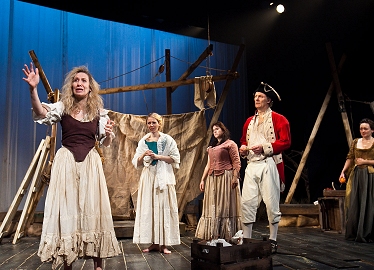
The set was very straightforward for this play – a kitchen. We sat in the front row, and the U-shaped work island was open on our side. Sink on the right, hob and oven on the left, plus all the paraphernalia for a dinner party. A netbook was open on the front right corner of the unit, and there were two stools on that side. A fridge stood in the corner to our right.

The play covered the new social processes of the Facebook generation, with frequent interruptions and conversational non sequiturs as emails, texts and people arrived at the flat for a dinner party. Mat (it’s short for Matthew, but not the typical abbreviation) and Jess are in the process of breaking up, but their inability to connect with each other is getting in the way. Also getting in the way are their several guests; Karen, a friend of Jess whose own husband Julian committed suicide several years ago, Simon, a friend of Mat’s from university days who has an attitude problem, Annie, Jess’s sister by adoption who has  great looks and a needy personality but no discernible talent, and Tony, Annie’s ‘fiancé’, a much older man who teaches at the drama school Annie’s hoping to get into.

The action all takes place over the one evening, with short scenes in the kitchen giving us the story. Mat has heard from a social networking friend that Jess has been having an affair, and challenges her about this just before the guests start arriving – bad timing or what? There was no inkling of this revelation beforehand so it could seem a little odd, but with the communication problems of this group of people, somehow it worked. I found myself thinking that they might have done better to text each other even though they were in the same room, as they paid more attention to electronic conversations than to what the other person was saying.

The first guest to arrive is Karen, who’s still getting over the loss of her husband Julian, an incredibly selfish, opinionated boor from the sound of him. She tells plenty of stories about what he used to do, and it’s clear that she’s still a bit lost without him. She’s also a non-drinking vegetarian who doesn’t eat fish, so the dinner menu of prawn avocado and monkfish stew is off to a bad start.

Simon, the second to arrive, is one of those left-wing, belligerent, contemptuous types who have difficulty making friends because they’re always bitching about something. His initial unpleasantness puts Karen off, and the way he takes the photo of Jess and Annie off the fridge door and puts it in his pocket is decidedly creepy. He fancies Annie based solely on her photo, but once he meets the real thing he changes tack and starts chatting up Karen instead. She warms to Simon as the evening progresses and she starts on the booze again; she needs someone with his strong opinions and apparent dedication to helping others, and even comments herself later on that he’s almost exactly like Julian.

Annie is indeed a looker, but as Mat has already informed us she’s got very low self-esteem. She was adopted by Jess’s parents, having come from a very difficult background, and now she’s quit her job and taken up with Tony, a man old enough to be her grandfather, because he may be able to help her get into drama school. It comes as quite a shock to Jess to find out that her sister is engaged – Annie forgot to mention that fact before – and that Tony is also coming to the dinner party. Good job there’s a spare prawn avocado and plenty of monkfish stew!

Tony calls himself a director, but how much actual directing he does is anybody’s guess. He just can’t help taking advantage of all the lovely young things who attend his classes wanting fame and fortune and expecting him to get it for them. Unfortunately his wife has found out about this affair with Annie through reading his text messages and has thrown him out. He’s another emotional wreck, trying desperately to get back with his wife, aghast at Annie’s excessive clinginess, competing unsuccessfully with Simon for Karen’s attention and even trying to seduce Jess. Any port in a storm.

The scene where Annie introduced Tony to Jess was wonderful. He stood there, still in his coat and carrying a bottle wrapped in black tissue paper, looking uncertain of his welcome, while Annie gushed about their wonderful relationship and her future career as an actress and singer, and Jess just stood there, holding the platter with bread on it, completely stunned by what she saw. It was very funny, and made us very aware of the massive number of assumptions Annie was making and which Tony hadn’t yet had the heart to challenge. Well, the sex was great, so why bother?

Annie’s demonstration of her acting and singing abilities (I use the word loosely) was another horrifyingly funny moment. She did at least know Cleopatra’s lines from Shakespeare’s play and she was bossy enough with her supporting cast to be believable as a demanding queen, but her style of delivery was atrocious, even from behind. Her singing style appeared to be modelled on the worst excesses of the reality casting shows (we don’t watch them, so I’m guessing a bit here) and her nasal tones grated really badly with me. I’m confident that Tala Gouveia, who played Annie, is very talented to be so good at playing someone who isn’t.

There were plenty of entertaining moments like that throughout the play, and the cast brought the characters to life so well that at times I felt like I was suffering through a real dinner party. Despite this, I didn’t leave early, as I would probably have done in real life, so I did get a chance to enjoy the disintegration of most of these characters’ lives, and see the little bud of hope that was the emerging connection between Simon and Karen. The only down side is that when such unpleasant or boring people are being shown so realistically, the play itself can suffer from the lack of interest on the stage; this production wasn’t too bad, but it did drag a little during the early stages. Still it did pick up as things went from bad to worse, so it was quite a good afternoon in the end.

© 2012 Sheila Evans at ilovetheatre.me
Travelling Light – February 2012

7/10

By Nicholas Wright

Directed by Nicholas Hytner

Venue: Lyttelton Theatre

Date: Tuesday 21st February 2012

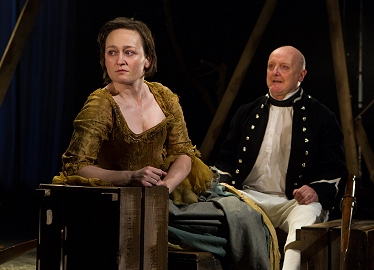
This was the story of a young Jewish man in an Eastern European shtetl, Motl Mendl, being inspired by a motion picture camera to make movies, and his subsequent career in Hollywood – sort of Fiddler On The Roof meets Tales From Hollywood. It’s set around the end of the nineteenth century and in 1936, with the 1936 character being the narrator for the earlier parts, having changed his name to Maurice Montgomery.

The set was craftily designed to double as the inside of a house in the shtetl and a film set of the inside of a house in a shtetl. Curving round the back was a white curtain which acted as a screen for the movie clips, some of which were also shown on the wall of the room facing us. Below the screen were the rooftops of the other houses in the town, screened by the room itself. A long back wall had a door on the left to the aunt’s small room, a main door in the middle and an alcove on the right which seemed to be the developing room; it could be screened off with a curtain. On the far right wall, above the single bed, were photographs taken by Motl’s father, the village photographer. To the left were the table and chairs, sideboard, etc. In the middle stood a Lumière Brothers Cinematograph, facing the wall; it had two gas tanks at the back for the limelight, and a large wooden stand.

Motl’s father had died some time before, and Motl had only just returned to the shtetl, having missed the funeral. He was hopefully employed as a journalist – hopefully because they hadn’t actually published any of his stories yet – and he wanted to sort out his father’s things and get back to the city as soon as possible. With his aunt telling him the express train didn’t always stop at their station (a fib, as we discovered later) and a local family very keen to have a photograph of their son before he went away to the army, Motl ends up taking not just some photographs of the young man and his parents, but also a short moving picture.

The father was so taken with this that he came every day for a week to watch this movie, projected onto the wall of the room. I don’t remember when they started using the back screen as well to show these movies on a larger scale; it could have been from the start, and they also used the bigger screen when there was no action on stage or the projector wasn’t in use. Anyway, Motl has decided he wants to make movies now, but has no money. Jacob, the father, has been so moved by being able to see his son on film that he recognises a money-making opportunity; if he enjoyed seeing this movie, perhaps everyone will enjoy seeing themselves or loved ones on screen. After a lengthy explanation of his background and his rise to prosperity and respect within the shtetl, Jacob agreed to pay for enough film to capture life in their town. His accountant, Itzak, who was also his son-in-law, had arrived by this time, and the author takes a poke at the involvement of money-men in film-making a couple of times, especially when Itzak’s penny-pinching leads to an embarrassing shortfall in the fiddler department (more on that story later).

Jacob also sent along one of his servants, Anna, to help Motl with his film-making. She’s a very attractive young woman and clever too. It took Motl some time to fall for her – he thought it was just about getting her to star in one of his movies – but they were soon spending time together on the mattress. She also had the idea to edit the bits of film from around the shtetl to tell a story, and even though the locals could all tell that it wasn’t the rabbi buying a coat in the tailor’s shop, they still enjoyed the movie, although the initial focus group, set up by Jacob to make sure the movie is as good as it can be, was full of picky complaints – nothing changes.

From this beginning, they moved on to the make another movie which told the sad story of a woman, spurned by her father and sent out into the world with nothing, etc., etc. Jacob’s daughter thought that she would play the lead role, but both Jacob and Motl wanted Anna to do it. The daughter wasn’t too happy with this, and played one of the sulkiest maids you’ve ever seen, but the combination of producer and director proved too much for her. Mind you, the director had a lot of trouble with the producer’s interference during filming – like I said, nothing changes.

With the filming done, Motl left the shtetl and took the train to the city. Anna had told him she was pregnant, but pretended it might not be his, and his desire to make more and better movies made it a relatively easy decision to leave. During the 1936 sections we learned that he was making a movie based on these early experiences, and after he’d explained a lot of this story to a young actor who would be playing him in the movie, we got to hear the rest of the story from the young man himself; it followed the plot of the staged movie remarkably closely.

They finished the piece with Maurice stepping back into the past and the early characters coming into the room for Shabbos. As the aunt placed her hand over her eyes, the lights went down to end the play – a slightly downbeat ending, but OK.

I did wonder if they could have introduced the framing device earlier, perhaps even from the beginning; we didn’t meet the young man and learn of the intended movie until the start of the second half. But this is only a minor point; the real fun was in the rich detail of the shtetl experience and the beginnings of movie-making, with the reminder of the strong Jewish influence on the early days of Hollywood. Although this play covered some familiar territory, I did still learn some things, and the characters and the humour made for an entertaining afternoon. The performances were all excellent, and the ability of the National to get a good size cast on the stage really helps with the group scenes.

And as for the shortfall in the fiddler department? For the scene where Anna‘s character finds out about her long-lost daughter, Motl had wanted a fiddler to play background music to help her produce the emotional responses he needed for the scene – this was silent movies, remember. To cut costs, Itzak hired a youngster as the regular fiddler was going to charge too much. Everyone was disconcerted when a young boy turned up to do the job. Seeing their attitude, he made some scratchy sounds when they first asked him to play, but he was just winding them up. When it came to the real thing, he put bow to strings and played beautifully; it was a very moving piece. A voiceover by the narrator told us who he probably was – Jascha Heifetz!

© 2012 Sheila Evans at ilovetheatre.me

King Lear – February 2012

9.5/10

By William Shakespeare

Directed by Andrew Hilton

Shakespeare At The Tobacco Factory

Venue: Tobacco Factory

Date: Friday 17th February 2012

I’m rating this at 9.5/10 tonight, it was so good. As we’re seeing this again, and there’s some room for it to come on, I want to leave the 10/10 rating, just in case.

The set at the start: a table covered with black cloth edged with gold tassels stood centre and left of the stage, with an hourglass seat or throne behind it to our left, and at that end of the table there was a gold coronet. At the other end of the table was a stool covered with cream brocade, also with complementary tassels. Behind this were two other stools in dark blue and red, on either side of the stage. The pillar nearest us had the hexagonal seat round it, and all the pillars were disguised as tree trunks (silver birch, from the look of it) with some stubby bits of branch projecting out higher up. Behind the throne was a black door with a corresponding gap in the seating.

To open the first scene a map was spread on the table, and someone was studying it – turned out to be Kent. Gloucester’s comment about the Dukes of Cornwall and Albany was very relevant in this context, and Kent rolled up the map before he responded, holding it in his hand. Edmund came on and stood on the other side of the table; while Gloucester introduced him to Kent his expression gave away his discomfort at the story of his birth, though he put a sycophantic smile on his face when necessary. When he was told who Kent was, his desire to serve him may have been genuine – it was hard to tell – but I certainly had the impression that Edmund was a young man determined to climb the greasy pole by any available means.

When the court arrived, Goneril and Regan came through first with their husbands, and took their places by the stools – red for Goneril, blue for Regan. After them came Lear and a servant who sat to one side and wrote everything down – he had a small writing desk with him. There was a pause while Lear waited for Cordelia, who finally came skipping on with a girlish giggle. Lear led her round to the central stool and sat her down, then stood behind her placing his hands on her shoulders and kissing her hair, very tenderly. Then he moved round to the throne and as he made to sit down he gestured to the other daughters to sit, a huge difference in attitude.

Goneril drew the short straw in having to go first in praising her father; her speech was rather stumbling as she groped her way to find suitable phrases and comparisons to please the king. I couldn’t see Regan’s reaction to this as she was sitting on our side of the stage with Cornwall standing behind her. When Lear showed Goneril the extent of her new realm, she looked very pleased.

Regan was more assured on her turn – she’d had some time to prepare – and I got the impression this was some kind of family game, with neither of the elder sisters taking it seriously. Goneril didn’t look at all put out when Regan topped her efforts, and the laughter at what Cordelia was saying sounded almost genuine. Cordelia gave us her asides from the stool and her lines were delivered very strongly, although she looked very young compared to her sisters. This was a forthright Cordelia who spoke her mind, and when she pleaded with Lear to exonerate her of any serious wrongdoing when France and Burgundy were present, I found her description of her ‘offence’ much clearer than before, which meant that France’s recognition of it made more sense. I felt she and France were well matched, as he obviously appreciated her for herself, and this contrasted well with Goneril’s marriage – she’s married to an older man and it’s clearly an arranged match. Burgundy was using a cane and limping a bit during this scene, and also as the Herald later; hopefully he’ll be recovered when we see this next – it’s a dangerous life being a fight director.

Lear’s response to Cordelia’s “nothing” was quite gentle at first – he just couldn’t believe she wouldn’t join in the game. This was where the rest of the family were laughing as well. After a bit, though, the rage came out, and the others moved quickly to get out of Lear’s way as he threw his tantrum. Kent’s interjection didn’t help matters, and soon everyone was leaving, in different directions. Regan seemed much more relaxed about their father’s behaviour than Goneril, whose “We must do something, and i’ th’ heat” became quite desperate at the end.

After they had all left, Edmund came back on and made good use of the writing desk while the servants cleared the stage. They took the cover off the table, the covers off the three stools, and the throne went as well. During this time, Edmund was penning the very letter that would cause all the problems in his family. He made as if to scrunch it up and throw it away, but kept it and then launched into his diatribe against primogeniture. When he used the word ‘legitimate’, he recognised how good it was and went over to the writing desk to add it into the letter. I could see the messy nature of the writing from where I sat – he did wave the letter around a bit – and so I was very pleased when Gloucester came to read it that he had to look hard to get some of the words. ‘Legitimate’ had clearly been added, and that was one of the ones he had to peer at a bit. Again, Gloucester’s first response was sadness and grief at being deceived, but then his anger took over.

Edgar came on eating a pear while Edmund sat on the pillar seat near us to do his groaning – nothing else to report for this bit. The set was then changed to a table and two stools, one at either end of the table, with red covers – we were in Goneril territory. After the king arrived, Kent was brought on and laid on the floor, face down. He said most of his lines there too, until the “authority” bit. When Goneril turned up to speak to Lear, Oswald went past them all and out of the door, carrying some papers; I realised this was the letter Goneril had been writing to Regan, a nice touch. Goneril seemed quite intimidated when she confronted Lear. One of Lear’s men was invading her space, looking menacing, and her speech was almost incomprehensible, never mind formal. When Lear cursed Goneril with Albany there too, I was aware that he was cursing Albany as well, in a sense, as he was wishing for neither of them to have children. Goneril was really shocked by this curse. The fool’s dialogue was clear, though I never felt I got much of his personality from this portrayal. I didn’t see much of him at times, as he lurked over on our side of the stage, off to our left.

After this scene, the table and stools were cleared, I think, and the stage was pretty open for most of the rest of the play. Edmund met Curran to hear about the arrival of the Duke of Cornwall, and then stage managed Edgar’s ‘escape’. When Regan and Cornwall arrived, I had the impression that they weren’t definitely villains at this point but that circumstances pushed them that way.

When Kent was waiting outside, he saw Oswald coming and lurked in the shadows to avoid being recognised. When he did come forward and Oswald recognised him, Oswald did his best to avoid drawing his sword, definitely a coward. Kent took off Oswald’s cloak and dropped it so that when Oswald bent to pick it up, he could tip up Oswald’s scabbard causing the sword to come out – drawn by default. That’s when Oswald called for help, and as soon as it arrived he started posing with the sword as if he was more than ready to fight – very funny. After the discussion involving the Duke of Cornwall, Kent was put into the stocks to our right. He didn’t read any letter by the light of the moon – he just laid back and slept for a bit.

When Goenril arrived, it seemed to me that the sisters hadn’t decided what to do about their father, but when Regan went for reducing Lear’s entourage to a mere 25, Goneril saw the opportunity, and then they both worked together, like lionesses, to close the trap. The remaining attendants – 1 lord and the disguised Kent – looked very unhappy during this discussion.

The scene where Lear meets Poor Tom was difficult to watch, especially as ‘Tom’ had bits of twig or some such stuck in his arm. Lear’s grasp of the nature of humanity at its simplest was well delivered, and this time Lear hardly got his trousers unbuttoned before Kent and the fool were on him to stop him taking his clothes off. He’d already thrown his coat and hat on the ground.

The shelter scene was set up using a small bench with a saddle on it, several cushions and a blanket. A lantern was hung up on one of the pillars. I reckoned the fool was suspicious of Edgar’s mad performance; he was looking at him intently all the time, up till the point where Lear was about to lie down and sleep, then he came over and sat by the king. Edgar was uncomfortable with the fool’s scrutiny, and very aware of it. When the three men were sitting on the bench together to arraign the sisters, I was also aware that two of them were in disguise, and therefore, in a sense, lying. The fool’s disappearance was just that – the scene in the shelter ended, with Lear, Kent and Gloucester heading off, leaving the fool and Edgar alone. The fool was holding the lantern, and simply blew it out – darkness. This was also where they took the interval.

The second half opened with the run up to the blinding scene – always a difficult one. This time, Gloucester was brought over to our corner and tied to a chair right by us. When Cornwall took out the first eye, he got a spatter of blood on his face; I thought at the end of the scene that this may have been done to get the shock and horror across to the audience behind the action – it worked! The servant drew his dagger, Cornwall drew his, and Goneril finished the servant off. There was more blood spatter with the second eye, and what looked like a small round object (nearly done now). I don’t know what the audience on the other side saw – yet! One more thing, Regan was again unnaturally excited by the sight of blood – I could see her becoming a total sociopath if she’d lived, getting her thrills from blood, torture and death.

The person who helped Gloucester after his blinding, and whom he asked to bring clothes for Poor Tom, was played by Eleanor Yates, doubling with Cordelia; it was a nice touch to have the two most caring people played by the same actress.

I was very moved by the scenes between Edgar and Gloucester. When Edgar came on talking about the benefits of having the worst happen to you, he looked very happy with life, all in all. This was when I thought he would make a good king with all he’s been through. When his father arrived, things changed, and I was moved to tears several times as their relationship developed. When Oswald found Gloucester, I was aware that he was only going to draw on him because he thought he was defenceless – the cowardice showing through again.

There wasn’t much laughter from this audience, and perhaps it wasn’t the funniest Lear we’ve seen, but there is a fair amount of humour and I felt this performance warranted more than it got. Edmund’s debate about which sister to have was an exception, though, as we laughed plenty.

Edmund had a real smirk on him when confronting Albany at the end, using the royal ‘we’ before he was fully entitled to it. The duel was good, with both brothers having a go. They clashed swords right by us, and the swords ended up lying on the hexagonal seat, with Edmund drawing his dagger and Edgar reduced to his wits. Goneril was excited by the prospect of Edmund winning – I reckon she was looking forward to her husband having to fight Edmund, so that Edmund could kill him ‘legitimately’.

When the messenger was sent off to rescue Lear and Cordelia, he ran off past us, but Lear brought Cordelia on through the doorway at the far end of the space. His “howl”s were strong, and directed round the room. Kent didn’t walk off at the end; he just knelt by Lear and Cordelia’s bodies, grieving. I had thought earlier in the second half that Edgar would make a better king for having suffered in the way he does, and at the end that impression was even stronger as he accepted the kingship role and spoke the closing lines. He had his back to me this time, so I’m keen to see it from the other side next time to confirm this impression.

Some other bits I noticed: Albany was much stronger than in most productions, really angry with Goneril after she returned from Gloucester’s place. Regan wore a very small black shawl after Cornwall’s death, but only for one scene – a short period of mourning for her. Kent’s ring – we saw him take it off and put it in his pocket when he was first in disguise. Then he took it out to give it to the other chap who was going to Dover. Finally Cordelia gave it back to him when they meet up before Lear was brought on, sleeping, in a wheelchair. When Goneril and Edmund were kissing, Oswald watched for a bit, but glanced away towards the end. There were no bodies brought on stage for once, and they finished early, at 11:10pm.

I love the way SATTF tell these stories so clearly, and without all the fancy designs that can clutter up other productions sometimes. I find I get very involved in the storytelling, and enjoy these performances enormously, even if there aren’t many visual tags for me to remember them by later on, e.g. the eye in the water tank, the sweep of gaudy costumes in the Russian style, etc. The text was a bespoke blend of quarto and folio, so we heard some lines we hadn’t heard before, including the Curran bit and also Edgar mentioning Kent’s visit to his father before he died; this was when he was talking to Albany about what he’s been up to after the duel. I wasn’t aware of missing anything though, apart from Kent not reading the letter while he was in the stocks.

The performances were all good, with some lovely details in each of the main characters. John Shrapnel’s Lear was an interesting portrayal. He wasn’t angry all the time, but he did have his rages, and he lost his reason believably and movingly. It was a really good evening, and I’m glad we’ve booked to see this again.

© 2012 Sheila Evans at ilovetheatre.me

Our Country’s Good – February 2012

By Timberlake Wertenbaker

Directed by Alistair Whatley

Company: The Original Theatre Company

Venue: Rose Theatre, Kingston

Date: Thursday 2nd February 2012

We saw this play many years ago at the Royal Court (1988) where they played it paired with The Recruiting Officer, the play being rehearsed by the convicts. The casts were the same, so we had all the fun of seeing the actors rehearse as convicts and then play the same parts for real. As it happens, we’re going to see The Recruiting Officer in a few weeks, as Josie Rourke has chosen that play to start her Donmar reign; although the actors won’t be the same, it will be interesting to see the combination again.

The Recruiting Officer is a very funny play; Our Country’s Good makes full use of that comedy to lighten the darkness it’s exploring – our treatment of convicted criminals a couple of centuries ago, which just happens to be very similar to current events in many ways. Even if we hadn’t seen the play before, we had plenty of advance warning that it was a serious piece as we groped our way to our seats through thick fog. (Oh alright, it was only a light mist, but I have to keep my spirits up somehow.)

The set was evocative; there were two wooden frames which dominated the stage, and one of them had some pulley tackle attached which could have been on a ship or part of a construction site, both appropriate for the play. There were wooden boxes scattered around the place as well, and these performed a number of roles – mainly furniture, but they even stretched to a rowing boat at one point. A table was brought on from time to time as needed and there were blankets for the stage curtains; that was about it. The convicts were in tatty clothes of the period, while the officers wore splendid red coats and wigs. There was also a Reverend dressed in sombre black. As almost everyone doubled up at least once, the women all played officers as well – one played the parson – and they all did a very good job.

During rehearsal

Our Country’s Good

The opening scene is set on the ship taking the convicts out to Australia. As one chap was being flogged by a couple of the officers on the central frame, the other convicts huddled on the front of the stage, singing a song. The image of brutality was very clear. The next scene introduced us to the Captain and some of the officers. Their conversation covered the nature of the penal colony they were now running, their differing attitudes on punishment vs. rehabilitation, and the unusual flora and fauna to be found in this strange land. Despite professing some enlightened views about providing a civilising influence on the convicts, I noticed it was the Captain himself who was the first to shoot something.

We then met Second Lieutenant Ralph Clark, a young officer missing his wife back home terribly and keen to find some way of earning his superior’s approval and preferment. One of the men suggested to him that he stage a play using the convicts as his cast, and he decided to act on this. The rest of the play showed us the casting process, the convicts’ different attitudes and abilities, the response from the officers, especially those who objected to the play being put on, and the developing relationship between Ralph and Mary Brenham, his lead actress and one of the few convicts who could read. The final scene showed the start of their performance, with the stage audience on the other side of the curtains as we watched the back stage preparations. From the reactions we could hear, this was going to be a total success, and rightly so.

There was so much meat to this performance that it’s hard to know where to begin. The story was told very clearly, and at times it was difficult to watch. The abuse of these people, treating them as sub-human when they were mostly ill-educated and poor, was beyond moving. These were harsh times, and people were being transported for stealing a loaf of bread. The number of lashes needed to be effective was being discussed by the officers at one point, and two hundred seemed to be a reasonable amount to them – it’s clear they never expected to be on the receiving end. I soon found myself longing, as the prisoners did, for the relief of a rehearsal scene; even so, the author cleverly increased the tension by having the most unpleasant officers invade the final rehearsal we see and, overriding Ralph’s protests, abuse the convict actors horribly. It only stops because one of them, the most enthusiastic actor of the troupe, starts performing and the others join in, a brave choice in the circumstances but the only possible one if the play was to go on.

From time to time throughout the play, one of the natives came on stage and commented on what he saw. At first he thought these strange white people were part of a dream, but it didn’t take him long to realise they’re no dream; nightmare more like. Just before the final scene, as they were setting up the stage, the native appeared again but this time he was covered in sores from the diseases the white folk have brought with them. This oblique referencing of the natives’ experience was very powerful, as it emphasised both the impact which the new arrivals had and their disinterest in the native population – two hours of soapboxing wouldn’t have been so effective.

I want to remember so much about this play that I know I won’t be able to get it all down in time. There were so many layers that I’m still discovering things as I write. The discussion among the officers showed us their brutality, and with the doubling, it emphasised for me that the officers and men were just as brutal and uncivilised as the prisoners, but with the power they had they could express it more easily. There were educated prisoners as well such as Mary and John Wisehammer, who was also interested in Mary but had to watch as she and Ralph gradually became an item.

Our Country’s Good

Harry Brewer represented the guilty conscience, as his obsession with the ghost of a man he’d hanged on ship eventually drove him to madness and death. His relationship with Duckling Smith, in which he wanted some kindness and she withheld it until it was too late, showed the difficulty for women in those conditions. They were expected to provide ‘comfort’ for the men, but how could they then have any affection or tenderness in a relationship?

Ralph’s gradual change from dedicated husband to Mary’s lover was nicely done, and there were many lovely moments in the performance. I did find it hard to hear the lines occasionally – Liz Morden’s story was particularly quiet – but it didn’t stop me understanding what was going on. The music was good – we like traditional folk songs – and the cast did a fantastic job. It’s still early in the tour, so it may even improve, though we were very happy with our experience.

It’s a dark piece covering a difficult subject, and it’s a shame there weren’t more people in the audience to appreciate this excellent production. I can understand the difficulty, but this is definitely a modern classic – should be done in schools if it isn’t already – and I wish them every success with the tour.

The Original Theatre Company website – www.originaltheatre.com

© 2012 Sheila Evans at ilovetheatre.me

Measure For Measure – January 2012

9/10

By William Shakespeare

Directed by Roxana Silbert

Venue: Swan Theatre

Date: Friday 27th January 2012

Second time around, and we were seeing this performance from a completely different angle. This allowed us to catch up on some of the reactions we hadn’t seen before, but of course we still only getting a proportion of the performance. Even so, we could see areas which had come on for the practice, and the central characters and their relationships were still very clear.

The changes which I noticed: Pompey went into a lot more detail about the inhabitants of the prison, picking on lots of folk in the audience and involving all of us at the end, which was very funny. He made some comments about “it’s in the folio”, and “I can only work with what you give me”, lots of stuff like that. The Duke’s human lampshades were more demure on their second appearance when Angelo was there, folding their arms over their chests, and he snapped his fingers to get them off stage in a hurry when Isabella approached, obviously embarrassed. The third time around, they held their hands in a prayer posture in response to Angelo’s reference to praying, and they left of their own accord when Isabella was announced.

I found the arguments between Isabella and Angelo even clearer than last time, especially when he was trying to get her to understand his ‘proposition’; Isabella seemed less intense, but just as passionate. It was much clearer this time that the Provost knew what was going on once he’d read the Duke’s letter off stage. He was clearly in cahoots with the Duke during the final scene, beckoning Elbow over to his corner of the stage to stop him dragging the Duke/friar off to prison.

Things I forgot to mention before or which weren’t clear: in the early scene at the monastery, the Duke handed his hat, scarf and coat to the friar as if he were one of the Duke’s servants; the friar looked a bit bewildered, but still took them. Lucio was indeed at the brothel first time round. The interval came after the Duke’s second encounter with Lucio at the jail, after Pompey had been arrested and Lucio refused to bail him.

And of course the performance had moved on from the last time we saw it. I was aware this time how Escalus’s common sense judgement of Pompey, Froth and Elbow was being contrasted with Angelo’s absolute approach. In the final scene, Isabella was quite stunned to discover who the Duke was and took a while to adjust, although she was still taking in the other events that were going on and still chose very quickly to support Mariana’s plea for mercy. She took longer to accept the Duke’s offer of marriage at the end tonight, I thought, and she didn’t look as happy when she turned round at the end, before they started the dance, so she’s presumably doing this differently to when we saw it earlier. Otherwise, the performance was just as brilliant as before, and despite complaints from some that the darker aspects weren’t explored enough, I felt this was a very satisfying exploration of the play.

© 2012 Sheila Evans at ilovetheatre.me

Written On The Heart – January 2012 (2)

9/10

By David Edgar

Directed by Greg Doran

Venue: Swan Theatre

Date: Wednesday 25th January 2012

This was a definite improvement on my experience of 20 days ago; not quite enough to warrant a 10/10 rating, but oh so close. There were three factors involved in this change: the first and most influential was our prior knowledge of the play, which meant we could follow the arguments better and appreciate the political exchanges as well as the personal stories. As we suspected, this play does benefit from some advance knowledge of the people and the situation. The second factor was the talk we’d had at the Winter School this afternoon, not only us but the entire group, of course. As a result we were a more responsive audience than before, and that naturally enhanced the experience for us. And finally there were almost certainly some improvements in the performance, but as we were in different seats, and given the effect of the other two factors, I have absolutely no idea what they were.

I did notice some things that I either missed last time around or got wrong. The Yorkshire rant about the constant changes to religious practices was done by the church warden, not the Lady of the manor. Before we visited Tyndale’s cell, there was a short scene at the back showing the priest being blessed by, I assume, the Pope; there was lots of singing and fancy dress. The second half started with the candles on the triangular chandeliers being lit by the choir, who then stood and sang for a bit before the play continued: again, the singing was a bit too dissonant for my taste, but I may have been warming to it. In the Yorkshire scene, I forgot to mention last time that the church warden came back into the church while the clerk and the chaplain were having their discussion, and lurked behind the screens to overhear them. We suspected later on that he may have been the one who betrayed the clerk to the authorities in revenge for his treatment of the windows, amongst other things.

I found the story much more moving this time, with plenty of sniffling opportunities along the way. I understood better the Bishop of Ely’s guilt at having been so harsh to the prisoners he visited, as represented by the Puritan clerk. That scene, of the prison visit, was played out in front of the Bishop, and I got the impression that Tyndale knew about it and forgave the man. The parallel with Tyndale’s own experience has only just become apparent to me; I claim the mercy of the court on account of my increasing years. Or senility. Or both.

The massive amount of exposition didn’t seem so clunky this time around, which helped, and the humour worked just as well if not better. I liked the way they went through some of the Biblical words and expressions that we use today, often disparaging them; ‘beautiful’ and ‘allegory’ are the only two I can remember off hand. It was not only amusing, but also a good way to link the story to the present. The maid’s rant at the end had less of an impact on me this time – may have been the angle we were seeing it from – and I could see in the Bishop of Ely’s discussion with her that he may well have been thinking of the Civil War to come, although I also take it as a reference to all future religious disputes based on rigidity and intolerance.

From today’s talk, I gathered that there were in fact only 47 translators involved in the work; I’m not sure where the 54 mentioned in the play came from, although Steve reckons that was the number they started with, but six years of translation took its toll. Very like.

© 2012 Sheila Evans at ilovetheatre.me

The Lion In Winter – January 2012

7/10

By James Goldman

Directed by Trevor Nunn

Venue: Theatre Royal, Haymarket

Date: Thursday 19th January 2012

We were a bit closer for this one than we like – Row B – because we didn’t book early enough. Even so, we had a good view of the action and heard every word, which made for an enjoyable afternoon. Unfortunately we also heard the mobile phone right behind us, and it was at a bad time (there’s a good time?) when Eleanor had just cut her arm. It’s all a ploy to manipulate Richard into giving her what she wants, so nothing to worry about, but the effect was spoiled by the ringtone. Anyway it’s a good old workhorse, this play, and this was a better than average production with some very good performances and a lot of humour. It’s mostly in the first half, true, but there’s still fun to be had in the second half, including one of the best lines – ‘all families have their ups and downs’; in context, it was hilarious.

This play is the archetypal family-from-hell Christmas. Everyone is plotting against everyone else, with the possible exception of Alais, and if I didn’t know the history I would have expected dead bodies to litter the stage. The bickering does get a little tiresome towards the end, but this cast kept our attention all the way through. I really enjoyed Joseph Drake as Prince John; we enjoyed his Nijinsky last summer at Chichester, and this snivelling Prince made a nice contrast.

The set was quite elaborate, making use of two revolves to change the scenery. They had small apartments for intimate gatherings, a larger reception area with a huge Christmas tree – the anachronisms were deliberate – two bedrooms and a wine cellar, all created with the minimum of fuss. I particularly liked the scene in the French King’s bedroom, with two Princes hiding behind the tapestry, another in the four-poster screened by the curtains, and King Henry himself knocking on the door to have a word. The costumes were mock mediaeval, in keeping with the setting, and worked very well.

© 2012 Sheila Evans at ilovetheatre.me