Our Country’s Good – February 2012

By Timberlake Wertenbaker

Directed by Alistair Whatley

Company: The Original Theatre Company

Venue: Rose Theatre, Kingston

Date: Thursday 2nd February 2012

We saw this play many years ago at the Royal Court (1988) where they played it paired with The Recruiting Officer, the play being rehearsed by the convicts. The casts were the same, so we had all the fun of seeing the actors rehearse as convicts and then play the same parts for real. As it happens, we’re going to see The Recruiting Officer in a few weeks, as Josie Rourke has chosen that play to start her Donmar reign; although the actors won’t be the same, it will be interesting to see the combination again.

The Recruiting Officer is a very funny play; Our Country’s Good makes full use of that comedy to lighten the darkness it’s exploring – our treatment of convicted criminals a couple of centuries ago, which just happens to be very similar to current events in many ways. Even if we hadn’t seen the play before, we had plenty of advance warning that it was a serious piece as we groped our way to our seats through thick fog. (Oh alright, it was only a light mist, but I have to keep my spirits up somehow.)

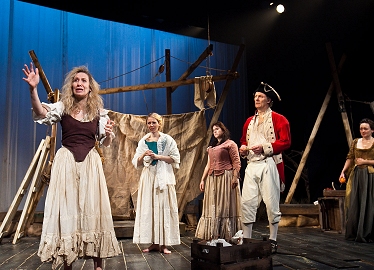
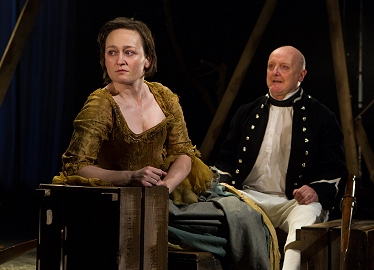
The set was evocative; there were two wooden frames which dominated the stage, and one of them had some pulley tackle attached which could have been on a ship or part of a construction site, both appropriate for the play. There were wooden boxes scattered around the place as well, and these performed a number of roles – mainly furniture, but they even stretched to a rowing boat at one point. A table was brought on from time to time as needed and there were blankets for the stage curtains; that was about it. The convicts were in tatty clothes of the period, while the officers wore splendid red coats and wigs. There was also a Reverend dressed in sombre black. As almost everyone doubled up at least once, the women all played officers as well – one played the parson – and they all did a very good job.

During rehearsal

Our Country’s Good

The opening scene is set on the ship taking the convicts out to Australia. As one chap was being flogged by a couple of the officers on the central frame, the other convicts huddled on the front of the stage, singing a song. The image of brutality was very clear. The next scene introduced us to the Captain and some of the officers. Their conversation covered the nature of the penal colony they were now running, their differing attitudes on punishment vs. rehabilitation, and the unusual flora and fauna to be found in this strange land. Despite professing some enlightened views about providing a civilising influence on the convicts, I noticed it was the Captain himself who was the first to shoot something.

We then met Second Lieutenant Ralph Clark, a young officer missing his wife back home terribly and keen to find some way of earning his superior’s approval and preferment. One of the men suggested to him that he stage a play using the convicts as his cast, and he decided to act on this. The rest of the play showed us the casting process, the convicts’ different attitudes and abilities, the response from the officers, especially those who objected to the play being put on, and the developing relationship between Ralph and Mary Brenham, his lead actress and one of the few convicts who could read. The final scene showed the start of their performance, with the stage audience on the other side of the curtains as we watched the back stage preparations. From the reactions we could hear, this was going to be a total success, and rightly so.

There was so much meat to this performance that it’s hard to know where to begin. The story was told very clearly, and at times it was difficult to watch. The abuse of these people, treating them as sub-human when they were mostly ill-educated and poor, was beyond moving. These were harsh times, and people were being transported for stealing a loaf of bread. The number of lashes needed to be effective was being discussed by the officers at one point, and two hundred seemed to be a reasonable amount to them – it’s clear they never expected to be on the receiving end. I soon found myself longing, as the prisoners did, for the relief of a rehearsal scene; even so, the author cleverly increased the tension by having the most unpleasant officers invade the final rehearsal we see and, overriding Ralph’s protests, abuse the convict actors horribly. It only stops because one of them, the most enthusiastic actor of the troupe, starts performing and the others join in, a brave choice in the circumstances but the only possible one if the play was to go on.

From time to time throughout the play, one of the natives came on stage and commented on what he saw. At first he thought these strange white people were part of a dream, but it didn’t take him long to realise they’re no dream; nightmare more like. Just before the final scene, as they were setting up the stage, the native appeared again but this time he was covered in sores from the diseases the white folk have brought with them. This oblique referencing of the natives’ experience was very powerful, as it emphasised both the impact which the new arrivals had and their disinterest in the native population – two hours of soapboxing wouldn’t have been so effective.

I want to remember so much about this play that I know I won’t be able to get it all down in time. There were so many layers that I’m still discovering things as I write. The discussion among the officers showed us their brutality, and with the doubling, it emphasised for me that the officers and men were just as brutal and uncivilised as the prisoners, but with the power they had they could express it more easily. There were educated prisoners as well such as Mary and John Wisehammer, who was also interested in Mary but had to watch as she and Ralph gradually became an item.

Our Country’s Good

Harry Brewer represented the guilty conscience, as his obsession with the ghost of a man he’d hanged on ship eventually drove him to madness and death. His relationship with Duckling Smith, in which he wanted some kindness and she withheld it until it was too late, showed the difficulty for women in those conditions. They were expected to provide ‘comfort’ for the men, but how could they then have any affection or tenderness in a relationship?

Ralph’s gradual change from dedicated husband to Mary’s lover was nicely done, and there were many lovely moments in the performance. I did find it hard to hear the lines occasionally – Liz Morden’s story was particularly quiet – but it didn’t stop me understanding what was going on. The music was good – we like traditional folk songs – and the cast did a fantastic job. It’s still early in the tour, so it may even improve, though we were very happy with our experience.

It’s a dark piece covering a difficult subject, and it’s a shame there weren’t more people in the audience to appreciate this excellent production. I can understand the difficulty, but this is definitely a modern classic – should be done in schools if it isn’t already – and I wish them every success with the tour.

The Original Theatre Company website – www.originaltheatre.com

© 2012 Sheila Evans at ilovetheatre.me

Written On The Heart – January 2012 (1)

8/10

By David Edgar

Directed by Greg Doran

Venue: Swan Theatre

Date: Thursday 5th January 2012

The opening scene of this new play by David Edgar was well complicated, with all sorts of historical characters, done up in drag most of ‘em, chattering on about different bits of the Christian Bible and which English word they should use for which Hebrew, Latin or Greek one. This was a hastily summoned meeting of several of the important members of the translation committee (who were 54 men in total) with the Bishop of Ely (at his London residence apparently) to finalise the last few controversial verses of the new King James Bible. It was hard to follow and a little dry at times, but as we learned in the post-show session, David Edgar had likened this bit to The West Wing, where no quarter is given to the uninitiated audience, and characters talk freely and fast in full blown jargon until we catch up.  Fortunately there was also some humour to keep us going, mainly through the political aspects of the different choices, and with the Bishop refusing to put in an appearance for a while (busy praying) the stage gradually cleared so that we could savour some discussions between just two or three characters at a time. Much easier to follow, and now I felt I was getting a handle on the debates. A lot was at stake, literally in the case of the Protestant Martyrs burned by Queen Mary, and it was enlightening to see such passions involved in what to us is now a very abstruse and academic subject.

This first scene was set in London in 1610. The next scene took us to Flanders in 1536, while the third scene, set in Yorkshire in 1586, bridged the gap between then and 1610, to which we returned for the final scenes. For Flanders, a small square platform rose up from the bowels of the stage, containing a table and chair, a stool, an unlit stove, and William Tyndale. This was Tyndale’s prison cell, and as he was due to be executed very soon, a Catholic priest had been sent to persuade him to recant his ‘heretical’ views, particularly those relating to his translation of the Bible into English. He refused, and in his heartfelt urging of the importance of a Bible that a ploughboy could read for himself, he converted the young priest to his way of thinking. As a result, Tyndale’s translations of several more books of the Old Testament  were rescued by the priest, just in the nick of time. The guard, helpfully setting a fire in the hitherto unused stove, was planning to use Tyndale’s work as kindling; the priest deftly substituted his own now worthless papers about Tyndale’s ‘crimes’, and secured the precious translations for posterity.

They had one minor problem with this scene when the candle, blown out to distract the guard, unhelpfully went out a second time before its cue, but never mind. I did find the long opening section of this scene a bit too gloomy, in terms of the lighting rather than the mood, but I appreciate it’s a tough call when Tyndale’s main complaint is that he hasn’t been allowed any artificial light in his cell, thereby hindering his work. They had to give us a lot of information at the start of this scene, to establish who was who, when, what had happened, etc., and on the whole this worked OK, although I was surprised that Tyndale had to explain what the Pentateuch was to a priest. However I know a lot of that was to explain it to the audience, and I’m sure many of them were grateful for that. Oliver Ford Davies explained at the post-show that with David Edgar, you had to keep pushing him to explain things so the audience can follow what’s going on. He’s worked with David on a number of plays now, so he spoke from experience, and with feeling.

The next scene, in Yorkshire, is set during Elizabeth’s reign, and shows the visit of a group of clergy to a small church which does not appear to have done everything it could to remove all traces of Popery. There are still stained glass windows, pictures of saints have been reapplied to the whitewashed panels within the building (intruders, apparently) and there’s no record of the disposal of the gold chalice or some ornate vestments. The visiting group have the authority to punish the churchwarden for these offences, and one chap, a clerk, is just about to smash the windows when a local lord and his wife turn up and try to put a stop to it. It doesn’t help that this Lord isn’t as familiar with the Ten Commandments and Articles of Faith of the Church of England as he ought to be to take Communion, but at least he distracts the clerk from his mission of destruction. With some stiff warnings to the errant churchwarden, and his promise to get rid of the remaining Catholic accoutrements, the group is relatively satisfied with their work.

At the start of this scene, the young priest from Tyndale’s cell met the Archdeacon who leads the visiting group, and after a little while I realised this was the same man at two stages in his career. The archdeacon used Tyndale’s very words when expounding on the necessary changes to religious practices, and it was very interesting to see that, despite being ignored and rejected during his lifetime, Tyndale’s approach had finally become the accepted norm in England. During the course of this scene, we also get to see a discussion between the clerk, a rampant Puritan, and the Chaplain, who turns out to be a younger version of the Bishop of Ely – this is how the scenes bridge between the time zones. I didn’t follow all of their conversation, but I did gather that the Puritans were keen to disassociate themselves from the ‘impure’ in society (judge not, least ye be judged?) and the chaplain was strongly against that idea, seeing the divisions it would cause. In the second half, which is all set in London, we get flashbacks to this earlier time, with the clerk now in chains being visited by the chaplain, who has been given the same task as the young priest in the second scene – get the man to confess to save his soul. It’s not entirely clear, but it seems that the Bishop of Ely is full of guilt over his treatment of this man, whom he may have betrayed to the authorities, and whose fate he almost seems to relish. To return to the end of this third scene, the chaplain buys the chalice off the churchwarden, claiming that he can get a better price for it in York than the churchwarden could get locally, and then as the Bishop comes on stage for the end of the first half (we have covered a lot of ground, haven’t we?) passes the chalice to him.

The second half begins with the Bishop at prayer, yet again, kneeling at the altar at the back of the stage. Samuel Ward, one of the translators with a serious concern about allowing any hint of Catholic terminology into the King James Version, brings on a pile of books, a pile which he’d taken from the Bishop’s servant to take to the Bishop at the end of the first scene, another nice link. They have another chat about the choices facing them; the Bishop just wants to wash his hands of the whole thing and leave the decisions to others, while Ward is vociferous in his convictions about how a number of the verses should be translated.

Then things get a little more complicated. After Ward leaves, the Bishop still wants help with the situation, and suddenly hears a voice speaking to him. A moment or two later, Tyndale (the ghost of) walks on stage, and there follows a most entertaining conversation between the two men, with the Bishop bringing Tyndale up to date on the rash of English Bibles since his time (and even an officially approved one during Tyndale’s last year on earth!) and Tyndale having a good old rant about how much of the Catholic tradition is still flourishing in the ostensibly Protestant Church of England. It really brought home both how much of Tyndale’s battle had been won and how much had been lost.

During their conversation, we see the flashback to the younger version of the Bishop, visiting the clerk in prison, and when that finishes Tyndale has gone and the translators have turned up. Tyndale’s dictation to the Bishop, resolving the contested verses, is seized upon by the rest of the committee members as giving them the finality they need. Unfortunately the paper gets blotted with ink (the Bishop being clumsy) and they can’t read it all.

Prince Henry turns up, the Prince of Wales, with his younger brother Charles, the future king. With Henry taking charge of the discussion, the decisions are made surprisingly quickly for once, and the resulting hodgepodge, which includes the classic ‘swords into ploughshares’, is quickly taken to the printers. With the departure of the Royal entourage and most of the committee members, the Bishop has a change of heart, and accepts his servant’s offer to write a letter at his dictation to the Archbishop of Canterbury to suggest the revisions may themselves need to be revised. His servant, a woman who was brought up on the English Bible and the stories of the martyrs – her grandmother was one of those burned as a heretic in Mary’s reign – does the writing OK, but she gets very upset at the idea of changing the word of God. Her fanatical zeal for leaving things as they are (in which case the Bible she adores would still be in Latin, if not Hebrew) is terrifying, and gives a clear link to some of the religious issues facing us today, where a little learning coupled with passionate beliefs can have horrific results. However, she does agree to take the letter, and after she leaves, the Bishop starts looking up the sources for some lines from Genesis. Tyndale makes a handy reappearance to help him, and the play finishes with these men facing each other over the texts on the table.

Although I found it hard going at the start, once we got into Tyndale’s story it all flowed much better. The humour was lovely, and there was lots of it. I felt for the poor folk in Yorkshire; the Lord’s wife expressed the difficulty so many people had when they were told to worship one way, then it was changed, then changed back again, and yet again. They just wanted to be left in peace to do things the way they’d always done them. The linking of the scenes with the younger and older versions of characters was nicely done, and again the author hasn’t taken sides in this debate, just shown us the sort of things that went on to increase our understanding; we can all make up our own minds about the issues, of course.

English: William Tyndale, Protestant reformer ...

Image via Wikipedia

The crucial aspect of the whole piece is the way that Tyndale (right) emphasises the heart rather than the head; this stops it being just an intellectual debate which could have become very boring. I found I could relate to the characters and their situations, and it left me feeling I understood more of that period and the huge importance placed on theological ideas. Earthly kingdoms were at risk, never mind heavenly ones. I hadn’t realised how much I expected to hear the King James Version, and how odd some of the others sounded, although I found I preferred some of the alternatives on offer and I have a sense of liberation now that I don’t have to take any translation as gospel!

The set was pretty impressive, making the Swan feel very much like a church for most of the performance. There were carved arches with central double doors screening off the rear of the stage; these were dressed differently for the different locations. Four large circular candelabras were lit at one point, and apart from the platform for scene two there were tables and chairs brought on and off as needed. The costumes were period – this led to one approving comment from a member of the audience later – and there was music between scenes. The singers were good, but there was a little too much dissonance in the music for me.

The performances were all excellent, especially those of the two central characters, Tyndale (Stephen Boxer) and the Bishop of Ely (Oliver Ford Davies). Almost the entire cast came out for the post-show, and there were some very good questions again tonight. The cast had eleven weeks for rehearsals, but this was split between two plays, so they had to move pretty sharpish from one rehearsal room to the other at times. They covered the difficulty of the massive amounts of exposition in the play, not to mention the relatively undramatic nature of the story, and they did a lot of research themselves into various related subjects. Jodie McNee, who played the Bishop’s servant Mary, researched the Protestant Martyrs, and discovered the story of a plough girl who was burned as a heretic. With Tyndale’s emphasis on ploughboys being able to read the word of God, this girl’s story was added to the script during Mary’s passionate speech at the end of the first scene.

There was a lot more that I don’t remember now, but it was a thoughtful discussion with plenty of humour, as was the play. Having slept on it, I reckon this is such a detailed piece of work that it really needs to be seen at least twice to fully appreciate it; good job we’ve already booked.

© 2012 Sheila Evans at ilovetheatre.me

The Comedy Of Errors – December 2011

8/10

By William Shakespeare

Directed by Dominic Cooke

Venue: Olivier Theatre

Date: Tuesday 20th December 2011

I liked the liveliness of this production, and the contemporary London setting was effective too, especially in the chase sequence. I felt the cumbersome nature of the set slowed things down a bit at times, but overall it was a really enjoyable production with some good performances.

The opening scene was set in a disused warehouse, with lots of balconies, windows and stairs, very effective when they were miming the shipwreck in Egeon’s story, although this was one of the times when the set did slow things down. At first it looked like Egeon was being mugged, with the Duke’s men taking his money, and I suspect they kept a fair bit for themselves before they handed the rest over to the Duke – that’s how he can estimate Egeon’s resources so accurately. When the Duke turned up he wasn’t friendly, but once he’d heard Egeon’s story he was kinder to the man.

The scene changes were covered by a street band singing familiar songs in a foreign language – couldn’t tell you which ones, though a couple of the tunes were familiar. For the next scene, the buildings rotated to reveal street cafes with metal tables and chairs in amongst office buildings – London, in effect. There were several other people at the café, and when Antipholus of Syracuse beat up Dromio of Ephesus he also caused mayhem with the food and drink on the tables.

The next scene was at the Phoenix, an ultra modern housing development nestled between two older buildings. Adriana and Luciana were on the first floor balcony, and Dromio of Ephesus spoke to them from the ground level, hiding under the overhang to swig from a bottle. This setting restricted the women’s movements, and I felt it held the scene back a little, certainly from our perspective, being close in. It may have worked better for people further back.

The following scene was set in a snooker hall, where Dromio of Syracuse found his Antipholus playing at one of the tables. Dromio got into trouble, yet again, for not knowing about his twin’s visit to this Antipholus, and Antipholus made good use of the snooker cue to give him a beating. This done, and some sense of jesting restored, we saw the two women walking past the snooker hall window. When they saw Antipholus, they came in, drawing the attention of the other men in the place, with several lewd looks and a whistle or two. Adriana was very seductive in her complaint to Antipholus, and there was the usual laugh at Antipholus’s amazed comment “To me she speaks”.

Antipholus and Dromio went along with the women’s mistake, and soon arrived at the Phoenix. They all went up in the lift (only just squeezed in) and shortly afterwards Antipholus of Ephesus entered with his two companions and his Dromio. As I recall, while they were going through their discussion of welcome versus food, we got to see Luce herself tidying up on the balcony. The banter between the Dromios was largely conducted over the speaker phone; once Antipholus of Ephesus joined in, the argument became even rowdier, and when Adriana joined in, she stepped out of the upper room, clad only in a bedsheet! Lunch was a short meal that day.

Once the Ephesian pair have left, Luciana and Antipholus of Syracuse have their scene downstairs, coming out of the building. Dromio joined his Antipholus there, running away from the kitchen maid. His descriptions of her were pretty funny, though not the best I’ve seen, and then Antipholus sent him to the harbour to find a ship leaving that very night. The goldsmith then turned up and gave him the gold chain, after which they took the interval.

The second half started with the Porcupine on the right and a jeweller’s on the left. Antipholus of Ephesus was soon arrested – the goldsmith handed even more cash to the officer than the merchant, so the officer kindly gave the merchant his money back – and the wrong Dromio was sent to get the money from Adriana. This time, however, we were inside the building, and Luciana and Adriana were wheeled onto the stage front and centre. Adriana was lying face down on a massage table (in theory) and Luciana was sitting in a chair having her nails done. Luciana’s expressions were very good here, showing her sympathy for her sister at her (presumed) husband’s abuse, then concern about telling her of said (presumed) husband’s proposal, then self-satisfaction as she recounted the ways in which she had been praised.

Adriana was lying on the table for the first half of this; she kept lifting her head up so she could question or complain, and her masseur kept putting her head back down in the slot, which got some laughs. When Luciana got to the proposal, it was too much for Adriana, and she got up. The masseur held her robe for her, so she was fairly decent by the time Dromio of Syracuse ran in, out of breath. With Dromio despatched carrying the money, Luciana wheeled off her chair, and after another few lines Adriana left with her table.

I think this was the point where there was a knife shop on the left and an empty one on the right, and this was the setup for the chase sequence. The empty building on the right soon had a woman posing in the window, and was revealed as a knocking shop; the courtesan came out of here to accost Antipholus of Syracuse about the chain he’d promised her, and a group of these women ganged up on the hapless visitors. After their departure, and the courtesan’s decision to visit Antipholus’s wife (troublemaker!), Antipholus of Ephesus and the officer came on for the encounter with Dromio of Ephesus. This was followed by the arrival of Adriana and a small entourage, including Pinch. This was a better version of Pinch than some, a modern dress charlatan, and when he was trying to take Antipholus away, a small ambulance van came on stage, and a remarkable number of medical staff came out of it! This led to the chase sequence, and here we had lots of medical folk running around, not quite Keystone cops, but almost that level. One of the team tried to put a straightjacket on someone in the audience, presumably because he/she was wearing a red top, vaguely like the Dromios’ Arsenal strip.

With the two men caught at last, and taken away for their recovery, the other Antipholus and Dromio crept out of the knife shop, carrying some very large kitchen knives. There was another confrontation or two, and finally they were chased into the Abbey, in this case the Abbey Clinic, an imposing looking building with a nameplate and letters above the door. The Abbess, who ran the clinic, was very definite that no one would be entering her clinic to take the men away.

When Luciana suggested an appeal to the Duke, Adriana got her iPhone out, and was scrolling through her contacts for the Duke’s number. She didn’t need to call him, though, as he turned up himself for Egeon’s execution a few moments later. The rest of the story was staged very nicely, and I sniffled a bit, as I usually do – I like happy endings. I also love the way this family, separated for years, take so long to realise what’s going on.

We enjoyed this production very much. The two pairs of twins were well cast to match each other, although the Dromios’ frizz wigs and some padding under the clothes helped a lot too. Mind you, they needed the padding to take the sting out the many beatings they got. The Ephesus pair talked with London accents, while the Syracusans had strong African accents – this really helped to differentiate them, and was a good reminder that the Syracusans were strangers in a dangerous city. I did find Adriana a bit muted compared to the usual interpretation, which was a surprise, but other than that the cast did a great job. I felt they could have done more with Egeon – they did have people walking through the set during scene changes, as well as the band – but it’s a very minor quibble when the performance as a whole was such great fun.

© 2011 Sheila Evans at ilovetheatre.me

Steeleye Span – December 2011

Martletss Hall, Burgess Hill   8/10

Sunday 18th December 2011

Lineup: Liam Genocky, Rick Kemp, Peter Knight, Julian Littman, Maddy Prior, Pete Zorn,

Two concerts in two nights! Life is good. Night one, in Burgess Hill, was excellent. It was a bit cold on stage apparently, and it took them a couple of numbers to fully warm up. Maddy wore a patterned print jacket, white blouse, black skirt for the first half, and a swirly blue skirt with shot silk jacket, blue and crimson, for the second half.

First half songs:

Seven Hundred Elves – not a bad start

Drink Down The Moon – fine

Now We Are Six (3 Riddles) – got them all

Thomas the Rhymer – the original is my favourite Steeleye, but this was good fun too. I thought the fiddle and flute weren’t differentiated enough, so those sections were a bit of a muddle, but it’s such a good song that it was great to hear it again.

Mooncoin Jig – excellent. Peter did the intro, and while mentioning the retail opportunity, he told us of a new type of guarantee – if you buy the new Gigspanner CD and don’t like it, send it back to him, and he’ll send you a CD he doesn’t like. Very fair.

Edwin – Rick was in fine singing voice, even if the introduction was up to his usual level of strangeness.

Long A-growing – very good version

Two Magicians – good fun

Twinkle, Twinkle, Little Star – excellent. Peter’s fiddle playing was clear and bright, and his solo absolutely magical, as always. A lovely updating.

To Know Him Is To Love Him – I never liked the original much; I know it’s just a bit of fun, but Maddy’s voice was just too little-girly for me. This was much better, and I actually enjoyed it. A lot. David Bowie’s stand-in on saxophone was the multi-talented Pete Zorn, of course.

Second half songs:

Today in Bethlehem – from Winter. This was their Christmas selection, all from the same album. I love this one.

Sing We The Virgin Mary – not a favourite, but the fiddle solo was lovely

Bright Morning Star – took a couple of verses to warm up, then a great sound

The Two Constant Lovers – fine

Edward – rocking!

Who Told The Butcher – good

Creeping Jane – also good

Cold, Haily, Windy Night – or ‘Eric’, as Rick likes to call it. (So that his three songs all begin with an ‘E’.) The intro was another lovely ramble through the magic land that is Rick’s mind. As well as trying to flog one of his guitars, he told us about the group getting way off key during the start of this song last night. He claimed that he was only telling us because he felt comfortable sharing with Burgess Hill; he wouldn’t mention it tomorrow night at the Barbican….. We shall see.

Bonny Black Hare – seriously rocking!

Encores: (no surprises here)

All Around My Hat – were we better than Margate? I think we should be told!

Gaudete – lovely

That’s it till tomorrow. Picked up the new CD plus some extra clothes, as usual.

Barbican Hall     10/10

Monday 19th December 2011

Night two – the Barbican. With special guests The Acoustic Strawbs, Martin Carthy and John Spiers. What would change from last night? Well, the sound was much better, and Steeleye were property warmed up from the start. They cut the intros to the bare minimum for the first half. Songs as for the previous night, Maddy’s outfit the same too, for both halves.

700 elves

Drink down the moon

3 Riddles

Thomas the Rhymer – better than last night

Mooncoin Jig – had to visit the loo, but could still hear most of it on the speakers.

Edwin

Long A-growing

Two Magicians

Twinkle Twinkle, Little Star – Maddy dedicated this to Dr Brian Cox, same as last night, and the fiddle solo was just as good, too

To Know Him Is To Love Him – even better, or maybe I’m getting used to it.

After this set, the compère, Kevin Donnelly, rambled on for a bit in a mildly entertaining way while the crew set up the stage for the Acoustic Strawbs. I don’t know the names of some of their songs, so I’ve identified them by any lines I could make out. Their set consisted of:

‘Bless the day’

‘I was blind but now I see’

Ghosts

‘May you rot/ may you rest’

Autumn

Lay Down – we were invited to join in

The King – with Maddy – a world premiere live performance!

The sound setup for them wasn’t great, which may account for my not enjoying their set very much. Dave Cousins did the ‘retail opportunity’ speech after the third or fourth song, and did it very entertainingly. Given the lack of Steeleye intros, he was able to use the ‘special guarantee’ joke – if you don’t like our CD, send it back….etc.

2nd half – Steeleye

Edward – still good

Two Constant Lovers – probably enjoyed it more than last night. Good fiddle solo; he’d been picking the strings during the verses, so when he unleashed the full sound with his bow, it was lovely. Peter repeated his story from last night about the East Sussex version of this song – it’s too short, cause the bloke pushes her over the cliff!

Bright morning star – apart from Gaudete, their only Christmas number

Then they were joined by Martin Carthy and John Spiers (accordion) for:

Padstow – we gave the final ‘wesus’ some welly

Bedlam Boys – good fun

The Lark In The Morning – lovely

Bryan O’Lynn/The Hag With The Money (jigs) – nice and lively

This section was a bit rougher round the edges, but then they wouldn’t have had a lot of rehearsal time. Martin and John then left, and the current lineup completed their set with the final two from last night:

Eric – that’s Cold, Haily, Windy Night to us. Rick did explain the alternative title, but true to his word, he didn’t mention the problems from the night before last!

Bonny Black Hare – still great. They’ve extended the live intro to give Rick a bass solo.

Encores:

All around my hat – with Martin, John and Dave Cousins from the Acoustic Strawbs joining in. We were good, but were we as good as last night? Or Margate?

Gaudete – even stronger with the extra support. Lovely finish.

A great evening, and Steve’s only question was, why didn’t we book for more? Good question.

© 2011 Sheila Evans at ilovetheatre.me

Collaborators – December 2011

8/10

By John Hodge

Directed by Nicholas Hytner

Venue: Cottesloe Theatre

Date: Werdnesday 14th December 2011

I don’t know how easy it will be to record my impressions of a piece that was both flamboyant and surreal. It was inspired by a play which Bulgakov actually wrote about Stalin’s early life, but which was never performed. It seems to have been part of the Soviet state’s process of playing mind games with dissidents and opponents, and this play reflects that aspect in its imaginary journey through the writing process.

In this play, Bulgakov is commissioned to write a play about Stalin in his younger days, for the great man’s 60th birthday celebrations. It’s meant to be a surprise for Stalin, but of course he knows all about it, and even joins in the creative process. In fact, he does more than join in, he writes the whole thing from beginning to end, scene by scene. Bulgakov only writes a final scene at the behest of a disillusioned NKVD officer in order to expose the truth about comrade Stalin. This scene was soon burned, and the play itself was never seen, because it was all a ploy to subvert Bulgakov into becoming a state stooge.

While he’s working hard at the typewriter, Stalin asks Bulgakov to do some of his government work – a fair division of labour. With a pretence of world-weary frankness, Stalin feeds Bulgakov little titbits to begin with, such as writing notes on steel production reports from the various parts of the vast Soviet Union and signing his mate Joe’s initials. When Bulgakov sees the results – reports of production up by 5% week on week – the nature of creative fiction under an oppressive regime takes on a new twist; Bulgakov wrote his plays and then (occasionally) saw them come to life, Stalin wrote his notes and then subsequent reports create the ‘reality’ he wanted. It’s an intriguing idea, and we get enough time to register it before moving on to the next phase.

During their next meeting Bulgakov is faced with an ethical dilemma. A city needs grain to feed its workers; the local farmers have grain but won’t give up enough of it because they need to feed themselves and their families, and have enough seed for next year’s harvest. What to do? Bulgakov makes his choice, and when he hears of the consequences, he’s shocked. Later, though, his feelings of guilt lead him to defend the government’s actions.

His next decision seems easier. He sees three confessions signed by men Stalin trusted absolutely, confessing that they were plotting against him. Stalin appears unaware of these confessions, and when Bulgakov tells him, he throws an almighty wobbly. To calm him down, Bulgakov suggests carrying out further investigations, and even writes that on the confessions – ‘carry out further investigations’. This calms Stalin down nicely, but at what cost? As the ‘further investigations’ are carried out, more and more people are arrested, and the apparent conspiracy which Bulgakov has helped uncover comes closer and closer to home.

When Bulgakov shows some stirrings of conscience, Stalin stops writing the play to concentrate on studying the conspiracy files. To help him out, Bulgakov rashly suggests a quota system; instead of investigating every case, just do some, and winnow out the traitors that way. Stalin was so taken with this idea that for their next meeting he asked Bulgakov to sign the death orders for the quotas of traitors to be killed and those to be sent to camps or into exile. Now, suddenly, Bulgakov draws the line; these are no longer numbers, they’re individual human beings, and he can’t go along with this job swap any more.

Stalin seems OK with this; he’s got what he wanted, so the final step doesn’t really matter. By now, Bulgakov’s friends have either deserted him or have disappeared. His wife is taken, and as Bulgakov finally collapses on his bed, dying, we see her put through a mock execution, one of the NKVD’s favourite pastimes. The play ends as Yelena, Bulgakov’s wife, finds her husband dead on the bed. The phone rings, and it’s Stalin’s voice asking if it’s true that Bulgakov is dead. She doesn’t answer, the line goes dead, and the lights go out.

This is a very simplified version of the story. In performance, many elements were interwoven, but without losing track of where we were and who was who – a remarkable feat. For example, as the scenes of the play are written and handed over to Vladimir, an NKVD officer and director of the new play, we see them performed by two actors, one young and handsome, the other older. The younger one plays the young Stalin in a noble and heroic style, with gestures and poses reminiscent of Soviet propaganda films of the time. The other actor takes on most of the other parts – prison guard, priest at the seminary, young woman who’s passionately in love with Stalin, etc. His performance as the young woman was particularly funny.

The set was on long sweep of acting space that pushed right across the Cottesloe with the seats wrapped around it. To our left was the kitchen area, with the large cupboard which was Sergei’s bedroom – space was short in those days. A walkway sloped down to the central area which held the typewriter on its table in the middle and the gramophone on the far side. To the right, the stage sloped up again to the bedroom. There were lots of angles to the floor – must have been a nightmare walking on it – and around the whole platform there was space to walk, with a lamppost in the far right corner. This lower walkway also came back up onto the stage on the other side of the central section, so there were lots of potential entrances, including the cupboard doors.

In fact, the opening scene made good use of these doors. Bulgakov was having a nightmare in which Stalin emerged from the cupboard and chased him round the flat, finally grabbing the typewriter and using it to smash Bulgakov over the head. Only we didn’t see that bit; the lights went out and when they came back again Bulgakov was sitting on the bed and Stalin had disappeared. It was a very funny sequence, with appropriate chase music to accompany it, and both actors going completely over the top. At one point, they were facing each other across the table and screaming – hilarious.

It’s a long time after that before we see Stalin again, and in the meantime we meet Bulgakov’s flatmates, and learn about medical treatment in the Soviet Union. Bulgakov is hoping for a diagnosis for his tiredness and other symptoms, but it’s unlikely he’ll get very far with the doctor assigned to him. This chap remembers watching one of Bulgakov’s plays many years before, and being scandalised by the nakedness of a very attractive young actress on the stage. He was even more shocked the next night, when he went back and sat even closer, and even more the night after that, and so on. He kept asking Bulgakov if he knew where the actress was now, as he’d love to get in touch with her. Bulgakov hadn’t a clue, of course, so he had to keep fobbing him off. Later, when Bulgakov is temporarily back in favour, he’s taken to the top hospital, the one where all the top men at the politburo are treated, and although it’s the same doctor, the experience is completely different. The doctor’s smartened up, he has a pretty young nurse – she used to be an actress, but he’s taken her away from all that – and miraculously, Bulgakov’s kidney disease has disappeared. No trace of it at all! Since Bulgakov trained as a doctor, he knows that can’t be true, but the doctor simply gives him a prescription for good food, and that’s it.

The action moves smoothly from there to the setting of the tables for a grand feast, and that’s where the interval was taken. The restart was at the end of the feast, and this is where Bulgakov hears about the fate of the grain farmers. We’d seen The Grain Store back in 2009 which told the story of the famine from the Ukrainian point of view, so we could fill out the story with a greater awareness of the suffering.

Following this feast, we see the session where the confessions are discovered, and from here people start to disappear. Bulgakov is even taken with Vladimir to the arrest of a married couple. The husband’s only ‘crime’ is having ‘objective characteristics’ which could mean he’s part of the conspiracy, while her only ‘crime’ is to be the wife of such a man. When he returns home, Bulgakov finds that their flatmates have gone, and before long Vladimir has also disappeared, with his second-in-command taking over as director of the play. The play has a noticeably darker tone in this second half, as there are fewer people to present the different perspectives. Even Sergei, the committed socialist, is taken away, so that only Bulgakov and Yelena remain, and with his death, she’s on her own.

Early in this play, we saw part of a performance of Bulgakov’s play Molière, showing the death of that playwright during a performance of The Hypochondriac. This was reprised at the end of this play as Bulgakov lay dying on his bed, and the lines about marking the day with a black cross applied to Bulgakov just as well as Molière. Of course, that was the point of Bulgakov’s play, to satirise the Soviet state and Stalin, but sadly it wasn’t as well hidden a satire as it needed to be – the play was banned and had very few performances in Bulgakov’s lifetime. In this play, it’s the carrot that Stalin holds out to keep Bulgakov going, the prospect that Molière will finally be staged. The stick, much in evidence in the later scenes, is the threat against his wife Yelena. Between these two, Bulgakov is easily led where Stalin wants him to go.

The pace was pretty fast throughout this play, even though Simon Russell Beale and Alex Jennings held some longish pauses during their scenes together. The scenes flowed one into the other, with characters simply turning from one scene to appear in the next. They kept the sense of place going very clear, though, even when there was more than one location being shown on stage at a time; good use of lighting helped here. The humour was another fine aspect of this play, with lots of it in the first half, and while there was less in the second half that was entirely appropriate in the circumstances. This is a cracking good production, and we hope to get another chance to see it in the Olivier to appreciate it even more.

© 2011 Sheila Evans at ilovetheatre.me

Hearing The Song – December 2011

8/10

By Will Gore

Venue: Orange Tree Theatre

Date: Saturday 10th December 2011

We stayed to see the response piece for Next Time I’ll Sing To You. Called Hearing the Song, it lasted fifteen minutes, and was a much more interesting little play than the work that inspired it, in my view. It was written by Will Gore, with a cast of two – Alex Mugnaioni and Huw Parmenter – and it was a very good short piece, with a number of echoes of the main play.

The two actors introduced the play as ‘themselves’; the writer character wanted to get a move on as they only had ten minutes, while his brother kept going off track – telling us about his limited amateur acting career, questioning the authenticity of the script, wanting to know where his long speech had got to – and had to be brought back to the point by the writer. This sort of thing went on in NTISTY, one of the echoes.

The subject matter of the play was an interaction between the brothers some years before, which was dramatised in a scene where the brother visited the writer early one morning at the writer’s request. The story that gradually emerged – not too gradually, obviously – picked up on a major theme of NTISTY, that of grief. The writer brother had been seeing his mother, long dead, and hearing a tune that she used to sing. The brother wasn’t entirely sympathetic, although as he’d apparently laughed out loud when the writer originally told him, he was being much kinder in the reconstruction.

The play ended with the brother going off to work, and telling the writer to take care of himself. For such a short play, and with very little rehearsal time, the two actors got a lot of detail into their performances, and with the humour in the writing as well, we enjoyed this very much. It probably also benefitted from us finding the main piece a bit dull, but even so we were well impressed.

© 2011 Sheila Evans at ilovetheatre.me

Measure For Measure – November 2011

8/10

By William Shakespeare

Directed by Roxana Silbert

Venue: Swan Theatre

Date: Friday 25th November 2011

This is a classic example of the difference between rating the production and rating my experience of a performance. The production is worth 10/10, absolutely no doubt, but with my view frequently restricted by actors’ backs, I was continually frustrated as I attempted to see one or another character’s reaction to events as they unfolded. Of course, the cause of my frustration was the excellent performances – I wouldn’t have been so bothered if it had been an average production.

The Duke began proceedings with a display of control and showmanship, altering the lighting, doing some little magic tricks, and it was perfectly topped off when he set himself up to welcome Escalus from one direction, only to have him walk on from another. That’s probably the earliest laugh I’ve ever experienced at this play. Raymond Coulthard had been at the pre-show talk earlier, along with assistant director Adam Lenson – apologies from Roxana – and this section had changed a great deal from the previews apparently, where they had attempted to show the Duke in a great haste to leave. Now he’s more leisurely in his actions, but still focused on executing his plans, and his fur coat and hat complete his outfit beautifully. There’s a hint of campness to the performance, but just enough to bring out the humour, and for once the Duke is fully central to the production, either as himself or as the friar. He produced the commissions for Angelo and Escalus by means of a magic trick as well.

The brothel scene was done as an S&M dungeon, with Lucio?, Froth and the others being beaten or whipped according to their preference. I think there was a judge involved at some point as a customer? The costumes were a mixture, being mainly modern-ish with Elizabethan references, such as the embossed codpiece (which had a cross on it as well – weird!). The dialogue was very clear, so I was aware that there’s actually an international conflict going on, which gave the Duke a plausible reason for being out of the country. The sense of a change in policy also came across well, with the locals being so used to getting away with their sexual peccadilloes that the law might as well not have existed.

Claudio and Juliet were being paraded through the streets to display their shame, and Claudio ended up chained to one of the mini-posts along the sides of the stage. These were about 5 inches high, gold coloured, with embossed square studs all round them and a gold chain dangling off each one. Juliet was 8 months 29 days pregnant, and I wasn’t sure if the glittery silver horns on her head were part of a fancy headband she was wearing, or whether they were meant to indicate the nature of her venal sin – they looked nice, though.

At the monastery, the chanting monks brought on a bier with a body, covered over by a cloth. Once the other monks had left, the friar who was the Duke’s accomplice removed the cloth to reveal the Duke, still in his posh clothes. The friar wasn’t happy at all about the Duke’s plan, and didn’t seem convinced about the propriety of him impersonating a monk, but he went along with the Duke’s orders. When they left, the nuns came on, also singing, and moved the bier to behind the whiplash curtain (more details on the set later). This left Isabella and one nun behind, and it’s clear that Isabella is several stages beyond devout. If anything, she may be too ferociously puritanical for these nuns, so I suspect they may have had a narrow escape.

Lucio tried to converse with the nun when he arrived, but she couldn’t talk with him as her face was visible. This led to some laughs, as Lucio is determined to speak with the nun, and all she can do is shake or nod her head while making grimaces at Isabella to help out. Fortunately Isabella soon realised that she was the one Lucio wanted to see, and the message about her brother’s imminent execution was soon delivered. Isabella’s quick decision to get this matter sorted before she took orders showed her leadership capabilities to the full, so much so that the nun was looking a bit askance at her blithe assumption that she can leave the nunnery as she pleases. If she did join a nunnery, she’d be abbess within two years, or she’d know the reason why!

Angelo and Escalus heard the case against Pompey and Froth with either impatience or humour, according to their temperament. Froth was a nice-looking chap, and didn’t he know it, posturing and posing himself, as well as overacting the bereft son when Pompey mentioned the death of his father. Lots of humour in this performance. Elbow was marvellous, with every Malapropism coming across clearly (doesn’t always happen) along with his total indignation that anyone should claim his wife was a respected woman! Pompey was also superb, the best I’ve seen, although he gets more to do in later scenes. Geoffrey Beevers was also good as Escalus, ready to see the funny side of things, but also with enough gravitas to explain his position within Duke Vincentio’s court.

Isabella’s pleading to Angelo was one of the scenes I found I couldn’t see enough of, but what I did see was pretty splendid. There’s always a point where Isabella’s own passion kicks in, thanks to Lucio’s insistence that she keep going and the fact that Angelo’s arguments are so close to the ones she wants to use herself, at least initially. At least, that’s how I see it. Without seeing all the reactions, I can’t fully record this scene, but I understood the way the two protagonists affected each other, with Isabella finally finding not just her voice but also her heart, and putting the argument for mercy as forcefully as she might have put the opposite ones just minutes earlier. She’s not cold, this Isabella, just strongly devout. Angelo on the other hand is cold, and it’s the passion of her arguments and the clarity of her wits that kindles the flame of lust in him. I felt there was almost a chance for this Angelo to back off from the rash choice that gets him into trouble, but of course we wouldn’t have a play if he didn’t plunge into the dark side. It was mentioned in the pre-show, that for such absolutists the choice is either good or bad, and if you can’t be one, you have to be the other. As Adam Lenson pointed out, grey is such a useful shade. I was also aware that Isabella is more distressed by the possibility of Claudio’s execution being too soon for his soul to be prepared for heaven than by the bare fact of his execution. It was such an immediate response compared to the way she’d had to be pushed into pleading for her brother’s life. Again I was reminded of how this scene echoes the trial scene in The Merchant of Venice, with Isabella putting an equally strong case for mercy.

In the jail, the ‘Friar’ is soon meddling away to his heart’s content. He’s quite the manipulator, this Duke, and after the pre-show chat it was interesting to watch how Raymond Coulthard develops his character. He set up his plans, and then something happened which wasn’t what he expected, and so he had to adapt and change things. It was a good interpretation of the role, and allowed for plenty of humour as well as the tough decisions. When he was catechising Juliet at the start of this next scene, I reckoned the Provost had been deliberately keeping the news of Claudio’s execution from Juliet, and isn’t best pleased that the friar blurts it out so unfeelingly.

The second scene between Isabella and Angelo was absolutely brilliant. The dialogue was remarkably clear – I often have trouble with some of the lines in this play, so it’s a relief that they managed this – and the reactions were spot on for their characters. Isabella really didn’t understand what Angelo was getting at to begin with. She thought he was concerned that granting a pardon would be a sin, and was happy to take that burden on herself. It seemed to me that Angelo became even more the villain as the scene wore on and he had to spell his offer out to Isabella ever more clearly. I was very aware of the risk to her of revealing what he’s said, but I got the feeling that she’s a strong and resourceful person, if a bit idealistic and optimistic about her brother’s reactions to the news she’s about to bring him.

In the jail, the Duke coached Claudio in how to handle his situation, not that he has to suffer it for long. Claudio looked a bit bashed round the edges – had he been fighting?  When Isabella arrived, the Duke eavesdropped from behind the whiplash curtain, and was clearly disturbed to hear of Angelo’s corrupt offer. Claudio’s fall from grace caused Isabella to get really cross, and then the Duke interrupted to start meddling again. Isabella waited by the front of the stage while the Duke had a few words with Claudio; I was struck that this was one gabby Duke, as near as dammit revealing the secrets of the confessional. Isabella was very keen to help the Duke with his plot, no hesitation or concern once she grasped what he was proposing, and she’s very quick on the uptake, this one.

I’m not sure of the order of scenes at this point, as I think the first half ended after the Duke has sent Isabella off to arrange the secret tryst with Angelo, and involved some more magic tricks, with a coin this time. I also think the Duke spoke the lines at the end of Act III scene II. The second half then opened with Mariana singing a song, accompanied by a guitar-playing monk. She sat on a swing, and although she was a little sad in manner, she seemed relatively self-possessed compared to some Marianas we’ve seen (booze, fags, etc.). I don’t remember if some of the in-between scenes were cut or simply inserted elsewhere – I’ll try to pick up on this when we see it again in January. One thing we both noticed was Mariana’s comment about the Duke/friar – ‘a man of comfort, whose advice hath often still’d my brawling discontent’. Given that he only became a friar a day or so ago, how ‘often’ has been with Mariana? This led me to wonder if she actually knew he was the Duke, and that perhaps the Duke himself had been comforting her, looking for a way to bring her and Angelo together. However, there was no sign of that, so I just had to assume this is one of Will’s wonky time bits – he has plenty of those.

One thing to mention now, though, about the Duke’s first disguised confrontation with Lucio, was that the Duke became very angry and threatening towards Lucio. Between ‘..too unhurtful an opponent’ and ‘But indeed I can do you little harm’ he remembered his disguise, and changed his tune completely, with the second sentence being said meekly and with hands held in prayer. It was funny, and emphasised the way this Duke really didn’t get the ‘friar’ bit, acting much too cocky for the part, ordering people around as if he were….. well, the Duke. His arrogance later in the final scene was deliberate, but there’s still a lot to spare during these scenes as well.

Back at the jail, Pompey was entertaining during his job interview, and even more entertaining later on when telling us about all the familiar faces he’d met while in prison. Many of them were sitting in the audience tonight, in fact, which kept us laughing for a while. Before that, when the orders came from Angelo to carry out the executions regardless, the Duke had to think quickly of a new plan to delay things. The Provost was very reluctant to begin with, but once he did decide to join in, he was all gung-ho with the planning.

Barnadine stuck his head up through a small window in the floor at first, then came up from the basement to tell the Duke straight out that he wasn’t going to be hanged today. Some productions try a bit too hard with this character; this version was very well done by Daniel Stewart and was funny without being ludicrous – he just wasn’t going to cooperate with other people’s plans. The Provost’s suggestion that they take advantage of the fortuitous death of Ragadine was played for humour, as was the Duke’s response, and we all joined in the fun with our laughter.

Raymond Coulthard had explained earlier that he saw the Duke’s decision not to tell Isabella that her brother is alive when she arrives at the prison as a spur of the moment thing. He doesn’t want to tell her partly because he doesn’t think she could carry off the next part of his plan – accusing Angelo – if she knew the truth, but also because he’s still testing her. Of course his lines give another reason as well, but in any case I could see the need for a quick choice in his performance tonight – his plan hasn’t worked the way he expected, he’s moved to plan B (or is it C?) and it’s all happened a bit too quickly for him to sit back and consider all the angles.

Isabella’s reaction here was good, and set things up for her final choice of the evening. She’s sad that her brother is dead, but accepts, with a little nod, the Duke’s instruction to go along with next part of his plan. For once, this Isabelle has grasped that devotion to God involved forgiveness, and this greater level of flexibility explains why she can pull through such adverse circumstances. The Duke had been moved by her actions earlier, when she was so willing to trust him and cooperate with his plan. During one of these scenes, she held his hands, and after she left it was clear that her touch as well as her personality had affected him.

Angelo is off stage for quite a while during all this plotting, so when he came on again with the letter from the Duke, it was our first chance to see what state of mind he was in. A bit unsure at first, perhaps, but he talked himself into greater confidence, and if he didn’t get his comeuppance a short while later he might have become a hardened villain eventually – suppressed guilt can do that to people.

The final scene had the Duke arriving back with lots of his friends. The friar who showed Mariana and Isabella where to stand had also attached a line to scoop up much of the curtain strands, so there was a bit more room at the back – very necessary for this scene. The Duke was full of praise for everyone, but especially Angelo – setting him up for a bigger fall. Isabella’s accusation was soon rebuffed, but the Duke had to make several attempts to get her to mention the ‘friar’s’ involvement in the ‘plot’. Raymond Coulthard had mentioned this aspect of the scene earlier – that the Duke needs the others to say the right lines so his plan can unfold properly. Once she brought the friar into it, Isabella could be sent off to prison while Mariana had her turn. Of course the Duke also had to stop Lucio prattling on and on, telling the Duke how this friar had been spreading all sorts of lies about him.

When Mariana entered, she had a simple black blindfold on her eyes, and again the Duke had to work hard to get her to reveal that Angelo himself is her husband. Once her identity was revealed, the Duke absented himself, having sent the Provost to fetch this troublesome friar. He returned pretty soon in his monk’s disguise, but not before Angelo had given Lucio free rein to slander the man even more. With his plot coming to a head, the Duke/friar was arrogant with Angelo and Escalus, and they soon determined to bring him down a peg or two. It was Lucio who wrestled with him to get his hood off, managing to give him a spanking on the way. When the robe was off and the Duke revealed, Lucio sank to his knees saying ‘it’s the Duke’ in a way that suggests he was fully aware of how much trouble he was in.

Naturally the Duke pardoned Escalus, but started to turn the screw on Angelo, sending him off to be married to Mariana. I didn’t see Isabella’s reaction to the uncovering of the Duke’s disguise, but she didn’t seem upset or hugely disturbed. She seemed to adapt quite quickly to the new situation, and when Mariana asked for her help to plead for Angelo’s life, she didn’t have to think for long before making her own plea for clemency. And it wasn’t forced or reluctant; her argument that Angelo’s death won’t bring back Claudio seemed to be exactly what she thought and felt.

Next he had the Provost (who was very relieved now he knew he’d actually been helping the Duke) bring out Barnadine, and dealt with him, showing his magnanimity. Barnadine was brought on with a hood over his head; when it was removed, he simply stood there and smoothed back the hair on one side, then the other, getting a good laugh. The other prisoner, also with a hood, was then revealed – Claudio! As he looked around him, a little dazed, Isabella was very happy to see him and gave him a long hug.

The Duke made one attempt to propose to Isabella, but realised it wasn’t the best time.  There’s just one other matter to deal with – Lucio – and then he can have another go. Lucio’s ‘punk’ turned up at just the right time (for her, not for Lucio) and he was off to a fate that he considers worse than death. The ‘lady’ in question was slovenly, with torn tights and scruffy clothes, and she carried her young child on her hip (but is it also Lucio’s?).

Finally the Duke turned his attention to Isabella, and this time he did a full proposal, on one knee, emphasising her willingness in the choice. She was pretty quick to accept him; her experiences had taught her a lot about life in a short time, and from her expression I guessed she’d fallen for this strange Duke/friar hybrid. A cloistered life was no longer viable for her, and in terms of their mettle, they’re well matched. However she’s spent her time with the friar – will she find the Duke as much to her liking?

It was a high-energy performance which they rounded off with a dance. We applauded mightily, and left very happy with our evening’s entertainment. This play is so often treated as ‘dark’ piece, and it made a pleasant change to see it given a lighter touch, bringing out more of the comedy. The choices all worked well together, and we’re looking forward to seeing this again in January.

The performances were all excellent. Raymond Coulthard’s Duke was very much in charge, but not infallible. When the Duke is set up to be too good, there’s always the question of how he let the problems arise in the first place. The setting for this production made it clear that the decadence the Duke is trying to stamp out by way of Angelo’s appointment is at all levels of society; he just hadn’t noticed it creep up on him. One Duke’s erotica is a working man’s porn, that sort of thing. He got so much humour out of the part that it may be difficult to watch another version for a while – we’ll miss the laughter.

Jodie McNee gave a very intelligent performance as Isabella. Not an intellectual one – this was an Isabella who wasn’t a prude as such – but well thought out and as quick in understanding as any Rosalind. She’ll soon be president of several charities while bringing up numerous children, running the Duke’s household and probably writing uplifting books for the edification of the general population in her spare time. Not someone I’d care to spend much time with, but much more likeable than most Isabellas.

Jamie Ballard did a good job with Angelo. It’s a difficult part, because although he’s a villain in one sense, he doesn’t set out to be one like Richard III, for example. While many have commented on Isabella’s lack of dialogue at the end of this play, Angelo also has to be present without speaking a lot as well, and Jamie managed this very well. I still want to see more of the exchange between Angelo and Isabella to get a clearer picture, though.

Paul Chahidi was very good fun as Lucio, and I always enjoy seeing Bruce Alexander on stage; his Provost was a nicely detailed performance. I’ve already praised Elbow (Ian Midlane) and Pompey (Joseph Kloska), and the rest of the cast did equally well in the smaller roles.

Finally I’ll describe the set. It was an interesting mixture which set the scene perfectly.  The floor had sections of black leather with a circular pattern punched in them – a spiral of dots. These encompassed the large trapdoor in the middle, and two smaller windows fore and aft of this. At the back of the thrust there were strands of black leather hanging down to form a curtain – it may not have been leather, of course, but that’s the impression it gave. There were at least three layers to this whiplash curtain, which allowed for concealed characters, as well as lots of possible entrances and exits. Assorted furniture was brought on and off, and there were two human lamps on either side under the balconies. These came on at the start, when the Duke was manipulating the lights, and switched on when he snapped his fingers, then stood there with their hands posed, looking very elegant. When Angelo saw Isabella for the second time, I noticed the lamps again, but this time their hands were held in prayer – he was clearly affecting the furniture as well. We were aware that some people apparently enjoy being used as furnishing items – there’s probably a word for it, but I’m not going to search the internet to find out – so again that suggested the sexual corruption in this Vienna was at all levels of society. The Duke himself wore a leather corselet which echoes the dominatrix gear Mistress Overdone and the other prostitutes had on, while the Duke’s servant who announced Isabella wore a French maid’s outfit which was too sexy to be real. Other characters wore mainly modern dress, but with Elizabethan-type references, giving a sense of this being a world of its own, neither one thing nor another, and so representing all times.

© 2011 Sheila Evans at ilovetheatre.me
Call Mr Robeson – November 2011

8/10

By Tayo Aluko

Directed by Olusola Oyeleye

Venue: Mill Studio

Date: Thursday 24th November 2011

I knew very little about Paul Robeson before tonight – black singer and actor, politically active, married a white woman (wrong, they were only ‘close’ friends) which angered both the white and black communities in America; that was about it. Turns out I knew more than many Americans do about this amazing man, who stood up for the rights of black people, but even more strongly for the rights of all working people, regardless of skin colour, and whose powerful influence was so cruelly wiped out by a hostile American government that his name is largely forgotten amongst many of the groups who ultimately benefitted from his contribution.

His life story was compellingly told by Tayo Aluko, who also wrote the piece. He had been ignorant of Paul Robeson’s existence until a chance remark by someone at a concert he performed at.  He had unknowingly sung a song performed by Robeson, and the person commented on this. Once he’d heard the name, the Paul Robeson biography pretty much threw itself at him in a library, and he was hooked. He wrote this play not just as a tribute to the great man, but to make people more aware that he existed, and to promote a passion to fight for a better world for all, a passion which Paul Robeson exemplified.

The set was interesting. At first it looked a bit of a jumble, with boxes, flags, books and photos everywhere. The piano was far left, draped with what turned out to be the flag of one of the International Brigades, and we were entertained as we entered the auditorium by Michael Conliffe, a talented pianist who accompanied Tayo for the evening. As I sat and looked at the objects, I realised there was a pattern. The centre of the stage had an irregular piece of an old record, a single of Going Home, much enlarged. Then I registered that there were other sections of broken record placed around this, with some hanging up at the back, and the pattern fell into place. The flags which were draped over some of the boxes – USSR, Wales, USA, titchy little Union Jack – represented places that were important to Robeson, and the photos were part of his story too. I didn’t know it at the time, but he was a great lover of books, reading a great deal and with a ‘yearning for learning’ – the books represented that aspect of his personality.

When the lights went down, the singing started off stage – I forget which song. Gradually the voice came nearer, and then we saw him, standing but bent under the weight of a heavy load (he had a plain chair upturned on his shoulders), coming from the back of the small acting space to place the chair down on the centre of the record. The lights had come up gently, and when this entrance was complete, we could see a tall, dapper man in a smart, slightly flashy suit. He started into Ole Man River, and was well into it when he was interrupted by his wife, who didn’t want him singing ‘that darn song’ anymore. From here on he told us his story in a blend of narration, acting and singing that was very effective. There were recorded sound effects used as well, and one of these related to the title of the play: ‘Call Mr Robeson’ was the effect used when he was being summoned to appear before the House Committee on Un-American Activities.

He covered some aspects of Robeson’s youth, especially his American football career and the attack on him by not just the opposition but his own team as well. This story brought out his father’s encouragement that he should stand up for what he believed, and to set an example which would help every black boy who came after him. Other events, such as his mother’s death (in a fire?) were glanced at, but he avoided the detail while showing us Robeson’s emotional reaction – a very compact form of storytelling, and I very much liked this layered effect. I feel I could watch the play several times and come away with some new aspect of his life that I hadn’t realised before.

The story continued for about 75 minutes, covering Robeson’s hugely successful early career, the unfortunate remarks which were misinterpreted quite viciously in the American press, the government’s suppression of his work by keeping him a prisoner in his own country, the suicide attempt, his appearance before the McCarthy hearings, his all too brief reprieve and travel abroad, and the final ignominy of being unrecognised by a journalist who asked him for his views on the Civil Rights movement as he walked through Harlem. The final song was Going Home, and he reversed the entrance by taking the chair up on his shoulders again and walking off. It was a fitting end to the evening’s performance, but we weren’t done yet.

After we’d applauded for a while, Tayo interrupted us to say that he was happy to answer any questions we might have, unless we needed to leave, which would be fine. Nobody left. The questions were mainly specific ones about Paul Robeson’s life, but we also found out about Tayo’s discovery of the man (see above) and learned that he is hoping to perform the show at Carnegie Hall on his 50th Birthday next year – good luck with that. He’s also planning some new plays, including one on the exploitation of the Congo – sounds interesting.

It was a powerful evening all round, and the chance to ask questions afterwards was the icing on the cake. I felt moved by the story many times, and the section describing Robeson’s treatment by the US government was hard to listen to. This stifling of his talent was a ‘cruel and unusual punishment’ for such a man, not to mention robbing the world of its enjoyment of his talent. No doubt his popularity would have waned in due course as new styles of music came along; good as the songs were, and the singing, they were simpler than the modern taste prefers. Still, in his time he was the biggest star, and for him to speak up as he did was perceived as a threat by the people in power at that time – we can only hope we don’t see such events again, but don’t hold your breath.

I enjoyed the story of the Welsh miners singing in London during the 1930s, and I liked the shift in Robeson’s awareness to a recognition that working people all over the world were being oppressed, not just black folk. After the show, Tayo told us a story from a time he’d been in Wrexham and someone had pointed out the hotel (no longer there) where Robeson had sung from a balcony to raise money for a local mining disaster. His feeling for the ordinary working folk came over very strongly, and was probably the most attractive aspect of his character.

Not that he wasn’t attractive in other ways. He had a succession of ‘close’ female friends throughout his life, but always returned to his wife Essie, who acted as his agent and manager. His fulsome praise for the Soviet Union was unfortunate; they may have treated him as an equal, but we now recognise that their workers weren’t as free as they claimed under Kremlin rule, so his views now seem politically naïve. Even so, his compassion and caring for his fellow human beings shone through.

His deteriorating mental state was signalled by Robeson interrupting himself and looking around, as if there was someone there. This had happened with his wife in the early stages, so I wasn’t concerned at first, but eventually it became clear that Robeson had become paranoid about being spied on (presumably he was being spied on?) and his breakdown was very difficult to watch. Apparently Robeson had some ECT treatments in England which may have been at too high a dose, and this may have led to his inability to resume his career afterwards. It was a sad end to a remarkable life, and sadder still that his name has been largely forgotten by so many. Steve and I are old enough to know of him, and I suspect most of tonight’s audience did, but in America his reputation appears to have been virtually obliterated. Hopefully this play can change all that.

For more information and to check out tour dates: http://cmr.tayoalukoandfriends.com/

© 2011 Sheila Evans at ilovetheatre.me
The Madness of George III – November 2011

8/10

By Alan Bennett

Directed by Philip Franks

Company: Theatre Royal, Bath

Venue: Chichester Festival Theatre

Date: Tuesday 15th November 2011

This was a fabulous production with an excellent central performance and strong support throughout. I hadn’t seen the original production at the National so I have nothing to compare it with, but I suspect this production would have stood up against it very well.

The set was very sparse, although that was due to the nature of Chichester’s main stage. A black wall with gaps all along the back, and a square of beige flooring in the middle of the stage – that was it! We gathered from the post-show discussion that in the proscenium arch settings, there are lots of backdrops which are used to separate the rooms; with this open set, they had to work a bit harder to get the locations across, and our response was that they’d done that very well. There were lots of chairs and a desk or two which were brought on and taken off, and the costumes were lovely as well, but otherwise it was just acting, and lots of it.

The story is pretty well known now, and although the stage play is necessarily different from the film, they cover the same ground. We weren’t shown the contents of the King’s chamber pots (mercifully!), but we did have to sit through some of the tortures inflicted on him in the name of ‘healing’ – blistering, purging, and that horrible chair.  Thank God for modern medicine.

David Haig’s performance as King George was superb. He was likeable as the relatively sane monarch, with his little idiosyncrasies and his concern for his people, but as the ‘madman’ it was very difficult to watch him at times, especially with such little understanding on the part of those around the king. With the king’s suffering so clear, he brought a huge amount of compassion out in me, which is no bad thing. He told us in the post-show that he’d started learning his lines months before rehearsals began, as it was the only way he could get all that dialogue into his memory in time. His delivery was fantastic – even the gobbledygook was understandable, if you see what I mean.

The queen was magnificently regal, while the Prince of Wales (are we allowed to hiss and boo?) was wonderfully self-centred and petulant, with a face you just wanted to slap (no offence to the actor). Mr Pitt was sober and careful, the Lord Chancellor sly and politically adroit, and Fox, Sheridan and the Prince’s other cronies creepily reminiscent of recent political events. The doctors were marvellously unconcerned about the efficacy of their treatments with the exception of Willis, who although he showed the most concern for the King as a human being, was equally ineffective with his treatments and received a deserved cold shoulder by the end. At least he wasn’t torturing his Lincolnshire patients to make them better. The servants also did a good job, although their parts were less well defined, and the whole cast did a fine job of adapting to the wide open spaces of Chichester. There was plenty of agony along the way, but plenty of humour to lighten the load as well – a good mix.

From the post show we learned that this was the final week of their tour, before the production goes into London in January. The audience who stayed behind were very appreciative of their hard work, and David Haig in particular was very complimentary about the Festival Theatre as a performance space, with the audience wrapped around the stage. Apparently Alan Bennett doesn’t go to revivals of his plays as he always sees things he wants to rewrite, so he prefers to concentrate on whatever play he’s currently developing. He sends his brother Gordon to see the revivals instead!

© 2011 Sheila Evans at ilovetheatre.me

South Downs – October 2011

8/10

By: David Hare

Directed by: Jeremy Herrin

Venue: Minerva Theatre

Date: Friday 7th October 2011

Yet again, another great performance of this new play. While the performances had sharpened up a bit over the run, I didn’t feel this had come on as much as The Browning Version – Steve disagrees – but that was mainly because they had nailed the play so well from the start, so there was less scope for improvement. If anything, the audience was much better tonight – we laughed much more and much sooner, it seemed to me. No significant changes at all that I could see – I hope this play gets another outing soon.

© 2011 Sheila Evans at ilovetheatre.me